Find the expectation value for the linear momentum operator applied to a free particle in 1D.
Find the expectation value for the linear momentum operator applied to a free particle in 1D.
Homework Answers

Add Answer to:
Find the expectation value for the linear momentum operator
applied to a free particle in 1D.
Problem 1 Consider the expectation value of the momentum of a particle to follow from the...
 Problem 1 Consider the expectation value of the momentum of a particle to follow from the clas- sical relation da Using the expectation value of position of the particle dt Jo derive the expression for the momentum operator in the position representation, i.e -ih
I. Consider a particle in an infinite square well potential with sides at x = ±a. Find the expectation value of the operator given below in any eigenstate of the particle: I. Consider a parti...
 I. Consider a particle in an infinite square well potential with sides at x = ±a. Find the expectation value of the operator given below in any eigenstate of the particle:
I. Consider a particle in an infinite square well potential with sides at x = ±a. Find the expectation value of the operator given below in any eigenstate of the particle:
I. Consider a particle in an infinite square well potential with sides at x = ±a. Find the expectation value of the operator given below in any eigenstate of the particle:
Find the expectation value and uncertainty of the z component of the angular momentum Lz for...
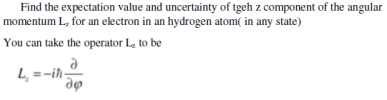 Find the expectation value and uncertainty of the z component of the angular momentum Lz for an electron in an hydrogen atom( in any state) You can take the operator Lz to be Lz = -i / psi
A free electron is described by the wave function: Using the linear momentum operator, derive an expression for the mo...
 A free electron is described by the wave function:
Using the linear momentum operator, derive an expression for
the momentum of the electron. Is your answer consistent with de
Broglie's equation?
Write answers clearly on the sheet. Show all working and underline your final answer 1. A free electron is described by the wave function, *(x) = Ae ** Using the linear momentum operator, P = -ih d/dx, derive an expression for the momentum of the electron. Is your answer...
A free electron is described by the wave function:
Using the linear momentum operator, derive an expression for
the momentum of the electron. Is your answer consistent with de
Broglie's equation?
Write answers clearly on the sheet. Show all working and underline your final answer 1. A free electron is described by the wave function, *(x) = Ae ** Using the linear momentum operator, P = -ih d/dx, derive an expression for the momentum of the electron. Is your answer...
2. Find the expectation value for <p2 > for the ground-state wave function of the infinite...
2. Find the expectation value for <p2 > for the ground-state wave function of the infinite 1-d square well. Here p = -i(hbar) d/dx is the (linear) momentum operator
Problem Three (1) Write the expression that defines the expectation value of the operator <x> for...
 Problem Three (1) Write the expression that defines the expectation value of the operator <x> for any function Y. (II) Find the expectation value of <x> for the particle in a box defined by the wave function: Y=N(L x - X°) within limits ( < x < L. which you previously normalized in Problem Two on the previous page.
3. If (:) is a wave function in which the expectation value of the momentum is...
 3. If (:) is a wave function in which the expectation value of the momentum is P, then find the expectation value of the momentum i.e. <p> in the state el (po)/ \(r) (5 points).
Expeotation value Calculate the expeotation value of the linear momentum Px of a particle described by...
Expeotation value Calculate the expeotation value of the linear momentum Px of a particle described by the following normalized wavefucntions. a. Ncos(kx) b. Ne^(-ax^2) Please leave a detailed step by step guide so i can use it for studying! Thank you for your help
With what amplitude and frequency does the expectation value of the momentum of a proton (m=1.67x10⁻²⁷...
 With what amplitude and frequency does the expectation value of the momentum of a proton (m=1.67x10⁻²⁷ kg) in a ID box of length 0.02 nm oscillate with time? The particle has the initial wave function Voya- Vioys.
A particle with an initial linear momentum of 4.12 kg · m/s directed along the positive...
A particle with an initial linear momentum of 4.12 kg · m/s directed along the positive x-axis collides with a second particle, which has an initial linear momentum of 8.24 kg · m/s, directed along the positive y-axis. The final momentum of the first particle is 6.18 kg · m/s, directed 45.0° above the positive x-axis. Find the final momentum of the second particle. magnitude direction above the negative x-axis
 Problem 1 Consider the expectation value of the momentum of a particle to follow from the clas- sical relation da Using the expectation value of position of the particle dt Jo derive the expression for the momentum operator in the position representation, i.e -ih
 I. Consider a particle in an infinite square well potential with sides at x = ±a. Find the expectation value of the operator given below in any eigenstate of the particle:
I. Consider a particle in an infinite square well potential with sides at x = ±a. Find the expectation value of the operator given below in any eigenstate of the particle:
I. Consider a particle in an infinite square well potential with sides at x = ±a. Find the expectation value of the operator given below in any eigenstate of the particle:
 Find the expectation value and uncertainty of the z component of the angular momentum Lz for an electron in an hydrogen atom( in any state) You can take the operator Lz to be Lz = -i / psi
 A free electron is described by the wave function:
Using the linear momentum operator, derive an expression for
the momentum of the electron. Is your answer consistent with de
Broglie's equation?
Write answers clearly on the sheet. Show all working and underline your final answer 1. A free electron is described by the wave function, *(x) = Ae ** Using the linear momentum operator, P = -ih d/dx, derive an expression for the momentum of the electron. Is your answer...
A free electron is described by the wave function:
Using the linear momentum operator, derive an expression for
the momentum of the electron. Is your answer consistent with de
Broglie's equation?
Write answers clearly on the sheet. Show all working and underline your final answer 1. A free electron is described by the wave function, *(x) = Ae ** Using the linear momentum operator, P = -ih d/dx, derive an expression for the momentum of the electron. Is your answer...
 Problem Three (1) Write the expression that defines the expectation value of the operator <x> for any function Y. (II) Find the expectation value of <x> for the particle in a box defined by the wave function: Y=N(L x - X°) within limits ( < x < L. which you previously normalized in Problem Two on the previous page.
 3. If (:) is a wave function in which the expectation value of the momentum is P, then find the expectation value of the momentum i.e. <p> in the state el (po)/ \(r) (5 points).
 With what amplitude and frequency does the expectation value of the momentum of a proton (m=1.67x10⁻²⁷ kg) in a ID box of length 0.02 nm oscillate with time? The particle has the initial wave function Voya- Vioys.
Most questions answered within 3 hours.
-
Where is the error in this code sequence?
String s1 = "Hello";
String s2 = "ello";...
asked 10 months ago -
Financial data for Joel de Paris, Inc., for last year
follow:
Joel de Paris, Inc.
Balance...
asked 10 months ago -
Consider this reaction:
Al2(SO4)3 (aq)+ BaCl3
(aq) Al2Cl6 (aq)- +
3BaSO4(s) . What is the...
asked 10 months ago -
Suppose that Savneet is considering increasing her
recent random sample from 20 car rentals to 40...
asked 10 months ago -
Trucks arrive at an unloading terminal at an average rate of 120
per hour.
Trucks arrive...
asked 10 months ago -
Why are methanol and ethanol completely soluble in water while
octanol is not very little soluble....
asked 10 months ago -
A facilities manager at a university reads in a research report
that the mean amount of...
asked 10 months ago -
When the CuSO4 is rehydrated by adding water to the anhydrous
compound, is this an endothermic...
asked 10 months ago -
A ray of sunlight is passing from diamond into crown glass; the
angle of incidence is...
asked 10 months ago -
A block of mass 0.249 kg is placed on top of a light, vertical
spring of...
asked 10 months ago -
how do the kidneys compensate in the presences of acidosis
a) trigger hyperventilate
b) reserve acid...
asked 10 months ago -
Question 501 pts
The rental rate of capital to the firm increases. Which of the
following...
asked 10 months ago