Consider the reaction: Sn(s) + 2Cu2+(aq) → Sn2+(aq) + 2Cu+(aq). How many electrons are transferred in...
Consider the reaction: Sn(s) + 2Cu2+(aq) → Sn2+(aq) + 2Cu+(aq). How many electrons are transferred in this reaction?
Homework Answers
Request Answer!
We need at least 10 more requests to produce the answer.
0 / 10 have requested this problem solution
The more requests, the faster the answer.
Add Answer to:
Consider the reaction: Sn(s) + 2Cu2+(aq) → Sn2+(aq) + 2Cu+(aq).
How many electrons are transferred in...
Consider the concentration cell Sn(s) | Sn2+(aq, a(Sn2+)A) || Sn2+(aq, a(Sn2+)C) | Sn(s) The subscripts A...
Consider the concentration cell Sn(s) | Sn2+(aq, a(Sn2+)A) || Sn2+(aq, a(Sn2+)C) | Sn(s) The subscripts A and C in the activities a(Sn2+)A and a(Sn2+)C of the Sn2+(aq) ionic species refer, respectively, to the anodic and cathodic solutions. The standard reduction potential for the half reaction Sn2+(s) + 2e- ===> Sn(s) is E0(Sn2+/Sn) = -0.14 V. What is the anode/cathode ratio of the activities of the Sn2+(aq) ion a(Sn2+)C / a(Sn2+)A if the electromotive force of the cell is E =...
Use standard reduction potentials to calculate the equilibrium constant for the reaction: 2Cu2 (aq)+ Fe(s)-2Cu (aq)+...
 Use standard reduction potentials to calculate the equilibrium constant for the reaction: 2Cu2 (aq)+ Fe(s)-2Cu (aq)+ Fe2 (aq) Hint: Carry at least 5 significant figures during intermediate calculations to avoid round off error when taking the antilogarithm. Equilibrium constant: AG° for this reaction would be than zero.
Consider the following reaction at 29SK Cu1+ (aq) +Sn (s)Cu (s) +Sn2+ (ag) Which of the...
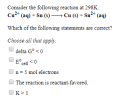 Consider the following reaction at 29SK Cu1+ (aq) +Sn (s)Cu (s) +Sn2+ (ag) Which of the following statements are comect? Choose all that apply. 4 cell0 n = 5 mol electrons The reaction is reactant-favored
How many electrons are transferred in the following reaction? (The reaction is unbalanced.) Fe2+(aq) + Cr(s)...
How many electrons are transferred in the following reaction? (The reaction is unbalanced.) Fe2+(aq) + Cr(s) → Fe(s) + Cr3+(aq)
How many overall electrons are transferred in the following chemical reaction: Al (s) + Fe2+ (aq)...
How many overall electrons are transferred in the following chemical reaction: Al (s) + Fe2+ (aq) → Al3+ (aq) + Fe (s)
3&4 please Question 3 1 pts How many electrons are transferred in the following two reactions?...
 3&4 please
Question 3 1 pts How many electrons are transferred in the following two reactions? Enter your answers as integers. Br2(0)+2 1" (aq) - Br" (aq) + 12(s), n = 2 Fe3+ (aq) + 3 Sn(s) - 2Fe(s) + 3 Sn2(aq),n=1 Question 4 1 pts How many electrons are transferred in the following reaction? Enter your answer as an integer. 4 NO3 + 4H+ + 4 Sb - 4 NO + 2 H2O + Sb406
3&4 please
Question 3 1 pts How many electrons are transferred in the following two reactions? Enter your answers as integers. Br2(0)+2 1" (aq) - Br" (aq) + 12(s), n = 2 Fe3+ (aq) + 3 Sn(s) - 2Fe(s) + 3 Sn2(aq),n=1 Question 4 1 pts How many electrons are transferred in the following reaction? Enter your answer as an integer. 4 NO3 + 4H+ + 4 Sb - 4 NO + 2 H2O + Sb406
Balance the redox reaction below using the half-reaction method. Sn(s) + Re3+ (aq) Sn2+(aq) + Re(s)...
 Balance the redox reaction below using the half-reaction method. Sn(s) + Re3+ (aq) Sn2+(aq) + Re(s) (a) To show your method, write the balanced half reactions below. Use the smallest integer coefficients possible and show electrons as e. If a box is not needed, leave it blank. (Coefficients of 1 are not needed). Oxidation half-reaction: + Reduction half-reaction: + (b) To show your balanced equation, enter an integer in each of the boxes but if the integer is "1", you...
How many electrons are transferred in the following reaction? (The reaction is unbalanced.) Ca2+ (aq) +...
 How many electrons are transferred in the following reaction? (The reaction is unbalanced.) Ca2+ (aq) + Li(s) + Ca(s) + Lit(aq) 0 1 O 3 O4 O 2 O 6 Submit Request Answer
Consider the following reaction at 298K. Sn2+ (aq) + H2(g) -Sn (8) + 2 H+ (aq)...
 Consider the following reaction at 298K. Sn2+ (aq) + H2(g) -Sn (8) + 2 H+ (aq) Which of the following statements are correct? Choose all that apply. OK>1 n= 4 mol electrons delta Gº> The reaction is reactant-favored. E cell > 0 Sited
Use standard reduction potentials to calculate the equilibrium constant for the reaction: 2Cu2+(aq) + Hg(l)2Cu+(aq) +...
 Use standard reduction potentials to calculate the equilibrium
constant for the reaction:
2Cu2+(aq)
+ Hg(l)2Cu+(aq)
+ Hg2+(aq)
Hint: Carry at least 5 significant figures during intermediate
calculations to avoid round off error when taking the
antilogarithm.
Equilibrium constant... ?
G° for this
reaction would be greater or less than zero????
question 2
Use standard reduction potentials to calculate the equilibrium
constant for the reaction:
2Fe3+(aq)
+ Cu(s)2Fe2+(aq)
+ Cu2+(aq)
Hint: Carry at least 5 significant figures during intermediate
calculations to...
Use standard reduction potentials to calculate the equilibrium
constant for the reaction:
2Cu2+(aq)
+ Hg(l)2Cu+(aq)
+ Hg2+(aq)
Hint: Carry at least 5 significant figures during intermediate
calculations to avoid round off error when taking the
antilogarithm.
Equilibrium constant... ?
G° for this
reaction would be greater or less than zero????
question 2
Use standard reduction potentials to calculate the equilibrium
constant for the reaction:
2Fe3+(aq)
+ Cu(s)2Fe2+(aq)
+ Cu2+(aq)
Hint: Carry at least 5 significant figures during intermediate
calculations to...
 Use standard reduction potentials to calculate the equilibrium constant for the reaction: 2Cu2 (aq)+ Fe(s)-2Cu (aq)+ Fe2 (aq) Hint: Carry at least 5 significant figures during intermediate calculations to avoid round off error when taking the antilogarithm. Equilibrium constant: AG° for this reaction would be than zero.
 Consider the following reaction at 29SK Cu1+ (aq) +Sn (s)Cu (s) +Sn2+ (ag) Which of the following statements are comect? Choose all that apply. 4 cell0 n = 5 mol electrons The reaction is reactant-favored
 3&4 please
Question 3 1 pts How many electrons are transferred in the following two reactions? Enter your answers as integers. Br2(0)+2 1" (aq) - Br" (aq) + 12(s), n = 2 Fe3+ (aq) + 3 Sn(s) - 2Fe(s) + 3 Sn2(aq),n=1 Question 4 1 pts How many electrons are transferred in the following reaction? Enter your answer as an integer. 4 NO3 + 4H+ + 4 Sb - 4 NO + 2 H2O + Sb406
3&4 please
Question 3 1 pts How many electrons are transferred in the following two reactions? Enter your answers as integers. Br2(0)+2 1" (aq) - Br" (aq) + 12(s), n = 2 Fe3+ (aq) + 3 Sn(s) - 2Fe(s) + 3 Sn2(aq),n=1 Question 4 1 pts How many electrons are transferred in the following reaction? Enter your answer as an integer. 4 NO3 + 4H+ + 4 Sb - 4 NO + 2 H2O + Sb406
 Balance the redox reaction below using the half-reaction method. Sn(s) + Re3+ (aq) Sn2+(aq) + Re(s) (a) To show your method, write the balanced half reactions below. Use the smallest integer coefficients possible and show electrons as e. If a box is not needed, leave it blank. (Coefficients of 1 are not needed). Oxidation half-reaction: + Reduction half-reaction: + (b) To show your balanced equation, enter an integer in each of the boxes but if the integer is "1", you...
 How many electrons are transferred in the following reaction? (The reaction is unbalanced.) Ca2+ (aq) + Li(s) + Ca(s) + Lit(aq) 0 1 O 3 O4 O 2 O 6 Submit Request Answer
 Consider the following reaction at 298K. Sn2+ (aq) + H2(g) -Sn (8) + 2 H+ (aq) Which of the following statements are correct? Choose all that apply. OK>1 n= 4 mol electrons delta Gº> The reaction is reactant-favored. E cell > 0 Sited
Most questions answered within 3 hours.
-
Where is the error in this code sequence?
String s1 = "Hello";
String s2 = "ello";...
asked 11 months ago -
Financial data for Joel de Paris, Inc., for last year
follow:
Joel de Paris, Inc.
Balance...
asked 11 months ago -
Consider this reaction:
Al2(SO4)3 (aq)+ BaCl3
(aq) Al2Cl6 (aq)- +
3BaSO4(s) . What is the...
asked 11 months ago -
Suppose that Savneet is considering increasing her
recent random sample from 20 car rentals to 40...
asked 11 months ago -
Trucks arrive at an unloading terminal at an average rate of 120
per hour.
Trucks arrive...
asked 11 months ago -
Why are methanol and ethanol completely soluble in water while
octanol is not very little soluble....
asked 11 months ago -
A facilities manager at a university reads in a research report
that the mean amount of...
asked 11 months ago -
When the CuSO4 is rehydrated by adding water to the anhydrous
compound, is this an endothermic...
asked 11 months ago -
A ray of sunlight is passing from diamond into crown glass; the
angle of incidence is...
asked 11 months ago -
A block of mass 0.249 kg is placed on top of a light, vertical
spring of...
asked 11 months ago -
how do the kidneys compensate in the presences of acidosis
a) trigger hyperventilate
b) reserve acid...
asked 11 months ago -
Question 501 pts
The rental rate of capital to the firm increases. Which of the
following...
asked 11 months ago