A 100-m3 open tank contains water 3 m deep. A. What is the pressure on the...
A 100-m3 open tank contains water 3 m deep. A. What is the pressure on the water at the bottom of the tank, relative to atmospheric pressure?
Homework Answers
You can calculate the hydrostatic pressure of the liquid in a tank as the force per area for the area of the bottom of the tank as given by pressure = force/area units. In this case, the force would be the weight the liquid exerts on the bottom of the tank due to gravity.
Let base area of the tank is A square meter.
Because depth of water is =3meter
Therefore volume of water (V) = 3×A cubic meter
Density of water (d) in SI unit = 1000
So, mass of water = V×d
= 3×A×1000
= 3000×A kg
So total force on the base F= mg
= 3000×A×10 N
= 30000A Newtons
Therefore pressure at the base
P = F/A = 30000 A/ A = 30000 N/ square meter
= 3.0×10⁴ N/m²
Add Answer to:
A 100-m3 open tank contains water 3 m deep. A. What
is the pressure on the...
A tank contains a pool of mercury 0.30 m deep, covered with a layer of water...
A tank contains a pool of mercury 0.30 m deep, covered with a layer of water that is 1.2 m deep. Determine the pressure exerted by the double layer of liquids on the bottom of the tank.
1. (5 points) (hydrostatie pressure An open water manometer is used to measure the pressure in a tank. The tank is half illd with 75000 kg of a liquid chemical that is not miscible in water. The...
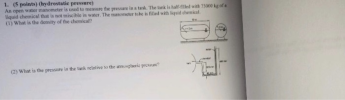 1. (5 points) (hydrostatie pressure An open water manometer is used to measure the pressure in a tank. The tank is half illd with 75000 kg of a liquid chemical that is not miscible in water. The manometer tehe is filied with liquid chemical. (1) What is the density of the chemical? (2) What is the pressure in the tank relative to the atmospheric prssure?
1. (5 points) (hydrostatie pressure An open water manometer is used to measure the pressure...
1. (5 points) (hydrostatie pressure An open water manometer is used to measure the pressure in a tank. The tank is half illd with 75000 kg of a liquid chemical that is not miscible in water. The manometer tehe is filied with liquid chemical. (1) What is the density of the chemical? (2) What is the pressure in the tank relative to the atmospheric prssure?
1. (5 points) (hydrostatie pressure An open water manometer is used to measure the pressure...
The absolute pressure at the bottom of a water tank is 160 kPa. With an atmospheric...
The absolute pressure at the bottom of a water tank is 160 kPa. With an atmospheric pressure of 94 kPa, how deep is the tank?
A tall storage tank contains liquid water at 17.5oC and is vented to atmosphere at the...
A tall storage tank contains liquid water at 17.5oC and is vented to atmosphere at the top (where atmospheric pressure = 760mm Hg). The distance from the bottom of the tank to the liquid surface level is 8.0 m. What will be the absolute pressure at the bottom of the tank?
Oil with a specific gravity of 0.80 forms a layer 0.90m deep in an open tank...
Oil with a specific gravity of 0.80 forms a layer 0.90m deep in an open tank that is otherwise filled with water. The total depth of water and oil is 3m. What is the gage pressure at the bottom of the tank?
3.4 An open tank with horizontal base contains water and oil in two sections separated by...
 3.4 An open tank with horizontal base contains water and oil in two sections separated by a vertical plate. The plate is 2.85m long, and the water on one side is 1.92 m deep and the crude oil on the other side is 1.48 m deep. Calculate the force on each side of the plate, and the resultant moment about the bottom edge of the plate. [51.5 kN: 26.3 kN; 19.9 kN-m
A tank contains 5 m3 of hydrogen at 400K is evacuated from atmospheric pressure to a...
A tank contains 5 m3 of hydrogen at 400K is evacuated from atmospheric pressure to a final pressure of 2.5 kPa. Determine (a) The mass of hydrogen remains in the tank. (b) The mass of hydrogen pumped out. (c) Pressure of the remaining hydrogen if the temperature is reduced to 10oC
A storage tank contains ethanol (density 8.1×10²kg/m3). The tank is 4.0 m in radius, the short...
A storage tank contains ethanol (density 8.1×10²kg/m3). The tank is 4.0 m in radius, the short pipe at the bottom of the tank is 1.0 cm in radius, and the height of ethanol in the tank is 3.2 m. The volume flow rate of ethanol from the short pipe is 4.4×10⁻³m3/s. What is the gauge pressure of the air inside the tank in the space above the ethanol?
A tank with a volume of 1.3m^3 contains air with a gage pressure of 350kPa. A...
A tank with a volume of 1.3m^3 contains air with a gage pressure of 350kPa. A mercury manometer is attached to the tank and is open to the atmosphere on the other end. The atmospheric pressure is 100kPa and the tank temperature is 27C. What is the height of the mercury in the manometer?
2. A rigid tank contains air at a gage pressure of 100 kPa at the surface...
 2. A rigid tank contains air at a gage pressure of 100 kPa at the surface of a lake. How deep would the tank have to be submerged for the gage pressure to be 0 kPa? a. The gage pressure would not change b. The gage pressure would rise as the tank is submerged c. 8.7 m d. 10.2 m
 1. (5 points) (hydrostatie pressure An open water manometer is used to measure the pressure in a tank. The tank is half illd with 75000 kg of a liquid chemical that is not miscible in water. The manometer tehe is filied with liquid chemical. (1) What is the density of the chemical? (2) What is the pressure in the tank relative to the atmospheric prssure?
1. (5 points) (hydrostatie pressure An open water manometer is used to measure the pressure...
1. (5 points) (hydrostatie pressure An open water manometer is used to measure the pressure in a tank. The tank is half illd with 75000 kg of a liquid chemical that is not miscible in water. The manometer tehe is filied with liquid chemical. (1) What is the density of the chemical? (2) What is the pressure in the tank relative to the atmospheric prssure?
1. (5 points) (hydrostatie pressure An open water manometer is used to measure the pressure...
 3.4 An open tank with horizontal base contains water and oil in two sections separated by a vertical plate. The plate is 2.85m long, and the water on one side is 1.92 m deep and the crude oil on the other side is 1.48 m deep. Calculate the force on each side of the plate, and the resultant moment about the bottom edge of the plate. [51.5 kN: 26.3 kN; 19.9 kN-m
 2. A rigid tank contains air at a gage pressure of 100 kPa at the surface of a lake. How deep would the tank have to be submerged for the gage pressure to be 0 kPa? a. The gage pressure would not change b. The gage pressure would rise as the tank is submerged c. 8.7 m d. 10.2 m
Most questions answered within 3 hours.
-
Where is the error in this code sequence?
String s1 = "Hello";
String s2 = "ello";...
asked 11 months ago -
Financial data for Joel de Paris, Inc., for last year
follow:
Joel de Paris, Inc.
Balance...
asked 11 months ago -
Consider this reaction:
Al2(SO4)3 (aq)+ BaCl3
(aq) Al2Cl6 (aq)- +
3BaSO4(s) . What is the...
asked 11 months ago -
Suppose that Savneet is considering increasing her
recent random sample from 20 car rentals to 40...
asked 11 months ago -
Trucks arrive at an unloading terminal at an average rate of 120
per hour.
Trucks arrive...
asked 11 months ago -
Why are methanol and ethanol completely soluble in water while
octanol is not very little soluble....
asked 11 months ago -
A facilities manager at a university reads in a research report
that the mean amount of...
asked 11 months ago -
When the CuSO4 is rehydrated by adding water to the anhydrous
compound, is this an endothermic...
asked 11 months ago -
A ray of sunlight is passing from diamond into crown glass; the
angle of incidence is...
asked 11 months ago -
A block of mass 0.249 kg is placed on top of a light, vertical
spring of...
asked 11 months ago -
how do the kidneys compensate in the presences of acidosis
a) trigger hyperventilate
b) reserve acid...
asked 11 months ago -
Question 501 pts
The rental rate of capital to the firm increases. Which of the
following...
asked 11 months ago