Compare and contrast how first-order reaction kinetics and zero-order reaction kinetics differ in terms of the...
Compare and contrast how first-order reaction kinetics and zero-order reaction kinetics differ in terms of the depletion of a reactant A in a chemical reaction. Assume an initial concentration of 420 mg of A. Assume a half-life of 30 minutes if first-order kinetics are obeyed, and a depletion rate of 60 mg/hour if zero-order kinetics are obeyed. Use a clearly drawn graph(s) to determine which rate will result in complete depletion of A over the shortest time. Assume 99% to be complete depletion of A
Homework Answers
Note: First we will describe each type of the reaction kinetics one by one and then proceed to compare them graphically to determine which is faster.
Zero Order reaction
For a generic reaction

Rate of the reaction means either the rate of appearance of product or the rate of disappearance of reactants and written as

Note that there is a -ve sign in front for the rate of disappearance of A as rate of the reaction is a positive quantity which measure how fast the reaction is happening.
Now for a zero-order reaction the rate is independent of the concentration of reactant.
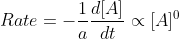
or simply
 where k is the depletion rate of A.
Integrating the above relation we get

Hence, given that the initial amount of A present 
and k = 60 mg/hr i.e 1 mg/min.
We can plot 
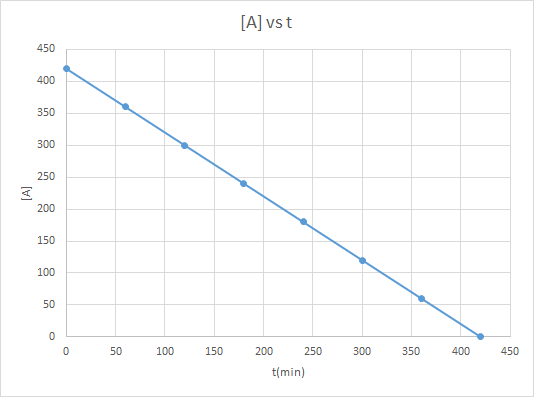
We can see the the amount of A drop to 0 mg after 420 min. Note we can take 100% completion for this zero order reaction instead of 99% completion.
Or simply we can solve for time t for completion of the reaction
by putting  in the integrated rate law for zero order scheme

Now coming to the first order reaction.
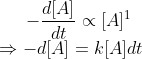
Where k is the first order rate constant
Here the rate of the reaction depends on the first power of concentration of A.
Integrating the rate law we get

Taking exponential on both side

Now given that the half life of the first order reaction is 30 min, it means the amount decreases to half its initial value value after 30 min.
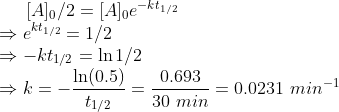
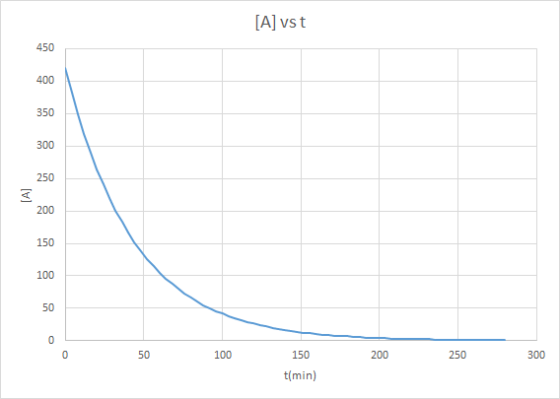
Hence, the plot of [A] vs t will be
Note that here for 99% completion we can take

Hence, putting it in the equation for first order reaction
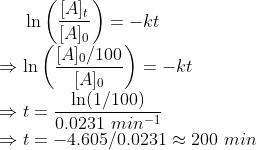
We can also see in the graph that around 200 min the amount of A has decreased to almost 0 mg whereas zero order reaction took 420 min for completion.
Hence, clearly first order rate will result in faster depletion of A.
Add Answer to:
Compare and contrast how first-order reaction kinetics and
zero-order reaction kinetics differ in terms of the...
1. The following chemical reaction: A → products shows first order kinetics with respect to A;...
1. The following chemical reaction: A → products shows first order kinetics with respect to A; rate = k[A]. Assume k = 10.09 x 10⁻⁴ s-1 . If the initial concentration of A was 0.82 mol L-1 and then decreased to 0.11 mol L-1 , how much time elapsed in minutes? 2. Consider the following balanced chemical equation: H2O2 (aq) + 3 I-(aq) + 2 H+(aq) → I3- (aq) + 2 H2O (l) In the first 62.9 seconds of the...
The following chemical reaction: A → products shows first order kinetics with respect to A; rate...
The following chemical reaction: A → products shows first order kinetics with respect to A; rate = k[A]. If k = 1.15 x 10⁻⁴ s-1 and the initial concentration of A is 1.11 mol L-1, what is the half life of this reaction in minutes?
The following chemical reaction: A → products shows first order kinetics with respect to A; rate...
The following chemical reaction: A → products shows first order kinetics with respect to A; rate = k[A]. Assume k = 2.46 x 10⁻⁴ s-1 . If the initial concentration of A was 0.89 mol L-1 and then decreased to 0.04 mol L-1 , how much time elapsed in minutes?
The following chemical reaction: A → products shows first order kinetics with respect to A; rate...
The following chemical reaction: A → products shows first order kinetics with respect to A; rate = k[A]. If k = 6.78 x 10⁻⁵ s-1 and the initial concentration of A is 0.57 mol L-1, what is the half life of this reaction in hours?
The isomerization of cyclopropane follows first order kinetics. The rate constant at 700 K is 6.20...
The isomerization of cyclopropane follows first order kinetics. The rate constant at 700 K is 6.20 × 10⁻⁴ min–1. A.) What is the half-life for this reaction in minutes? B.) If a sealed flask originally contains 0.150 M cyclopropane, what is the concentration remaining after one hour?
Question text The following chemical reaction: A → products shows first order kinetics with respect to...
Question text The following chemical reaction: A → products shows first order kinetics with respect to A; rate = k[A]. If k = 6.80 x 10⁻⁵ s-1 and the initial concentration of A is 0.63 mol L-1, what is the half life of this reaction in hours?
A zero-order reaction (A rightarrow B) is known to be 40% complete after 30 minutes in...
 A zero-order reaction (A rightarrow B) is known to be 40% complete after 30 minutes in a batch reactor. How long is required to achieve 95% completion? Assume the initial concentration of the reactant is 100 mg/L.
please help me with both. TIA The following chemical reaction: A → products shows zero order...
 please help me with both. TIA
The following chemical reaction: A → products shows zero order kinetics with respect to A; rate = k[A]º. if k = 9.65 x 10⁻³ moll's and the initial concentration of A is 0.622 mol L-1, what is the half life of this reaction in minutes? You have 5 attempts at this question. Remember: if you want to express an answer in scientific notation, use the letter "E". For example "4.32 x 10⁴ should be...
please help me with both. TIA
The following chemical reaction: A → products shows zero order kinetics with respect to A; rate = k[A]º. if k = 9.65 x 10⁻³ moll's and the initial concentration of A is 0.622 mol L-1, what is the half life of this reaction in minutes? You have 5 attempts at this question. Remember: if you want to express an answer in scientific notation, use the letter "E". For example "4.32 x 10⁴ should be...
A first-order reaction (A → B) is known to be 40% complete after 30 minutes in...
A first-order reaction (A → B) is known to be 40% complete after 30 minutes in a batch reactor. How long is required to achieve 95% completion? Assume the initial concentration of the reactant is 100 mg/L.
At a certain temperature this reaction follows first-order kinetics with a rate constant of Suppose a...
 At a certain temperature this reaction follows first-order
kinetics with a rate constant of Suppose a vessel contains at a
concentration of . Calculate how long it takes for the
concentration of to decrease to . You may assume no other reaction
is important. Round your answer to significant digits.
At a certain temperature this reaction follows first-order kinetics with a rate constant of 0.0366 s ": 250z (g) 2502(g) +0,(g) Suppose a vessel contains SO, at a concentration of...
At a certain temperature this reaction follows first-order
kinetics with a rate constant of Suppose a vessel contains at a
concentration of . Calculate how long it takes for the
concentration of to decrease to . You may assume no other reaction
is important. Round your answer to significant digits.
At a certain temperature this reaction follows first-order kinetics with a rate constant of 0.0366 s ": 250z (g) 2502(g) +0,(g) Suppose a vessel contains SO, at a concentration of...
 A zero-order reaction (A rightarrow B) is known to be 40% complete after 30 minutes in a batch reactor. How long is required to achieve 95% completion? Assume the initial concentration of the reactant is 100 mg/L.
 please help me with both. TIA
The following chemical reaction: A → products shows zero order kinetics with respect to A; rate = k[A]º. if k = 9.65 x 10⁻³ moll's and the initial concentration of A is 0.622 mol L-1, what is the half life of this reaction in minutes? You have 5 attempts at this question. Remember: if you want to express an answer in scientific notation, use the letter "E". For example "4.32 x 10⁴ should be...
please help me with both. TIA
The following chemical reaction: A → products shows zero order kinetics with respect to A; rate = k[A]º. if k = 9.65 x 10⁻³ moll's and the initial concentration of A is 0.622 mol L-1, what is the half life of this reaction in minutes? You have 5 attempts at this question. Remember: if you want to express an answer in scientific notation, use the letter "E". For example "4.32 x 10⁴ should be...
 At a certain temperature this reaction follows first-order
kinetics with a rate constant of Suppose a vessel contains at a
concentration of . Calculate how long it takes for the
concentration of to decrease to . You may assume no other reaction
is important. Round your answer to significant digits.
At a certain temperature this reaction follows first-order kinetics with a rate constant of 0.0366 s ": 250z (g) 2502(g) +0,(g) Suppose a vessel contains SO, at a concentration of...
At a certain temperature this reaction follows first-order
kinetics with a rate constant of Suppose a vessel contains at a
concentration of . Calculate how long it takes for the
concentration of to decrease to . You may assume no other reaction
is important. Round your answer to significant digits.
At a certain temperature this reaction follows first-order kinetics with a rate constant of 0.0366 s ": 250z (g) 2502(g) +0,(g) Suppose a vessel contains SO, at a concentration of...
Most questions answered within 3 hours.
-
Where is the error in this code sequence?
String s1 = "Hello";
String s2 = "ello";...
asked 10 months ago -
Financial data for Joel de Paris, Inc., for last year
follow:
Joel de Paris, Inc.
Balance...
asked 10 months ago -
Consider this reaction:
Al2(SO4)3 (aq)+ BaCl3
(aq) Al2Cl6 (aq)- +
3BaSO4(s) . What is the...
asked 10 months ago -
Suppose that Savneet is considering increasing her
recent random sample from 20 car rentals to 40...
asked 10 months ago -
Trucks arrive at an unloading terminal at an average rate of 120
per hour.
Trucks arrive...
asked 10 months ago -
Why are methanol and ethanol completely soluble in water while
octanol is not very little soluble....
asked 10 months ago -
A facilities manager at a university reads in a research report
that the mean amount of...
asked 10 months ago -
When the CuSO4 is rehydrated by adding water to the anhydrous
compound, is this an endothermic...
asked 10 months ago -
A ray of sunlight is passing from diamond into crown glass; the
angle of incidence is...
asked 10 months ago -
A block of mass 0.249 kg is placed on top of a light, vertical
spring of...
asked 10 months ago -
how do the kidneys compensate in the presences of acidosis
a) trigger hyperventilate
b) reserve acid...
asked 10 months ago -
Question 501 pts
The rental rate of capital to the firm increases. Which of the
following...
asked 10 months ago