Statistical Inference. I Need help with the questions below: 4-You are testing for significant differences between...
Statistical Inference.
I Need help with the questions below:
4-You are testing for significant differences between the mean scores of 2 groups. You set the level of significance at 0.05 if the mean differences is so large that it would occur by chance 1% of the time, would you accept or reject the null hypothesis?
-Accept H0
-Rejected H0
5-When you make a prediction about the direction of mean differences between an experimental and a control group, would you use a 1-tailed or 2-tailed test of significance?
- 1-tailed
- 2-tailed
Homework Answers
Solution :
4) Since, occurrence of the mean difference by chance is 1% = 0.01, which is less than the significance level of 0.05, therefore we would reject the null hypothesis.
5) When we make a prediction about the direction of mean differences between an experimental and a control group, we would use 1- tailed test of significance, because for directional hypothesis always one-tailed test of significance is used.
Add Answer to:
Statistical Inference.
I Need help with the questions below:
4-You are testing for significant differences between...
need help with the last questions. Prothrombin time is a measure of the clotting ability of...
 need help with the last questions.
Prothrombin time is a measure of the clotting ability of blood. For 10 rats treated with an antibiotic and 10 control rats, the prothrombin times (in seconds) were reported as follows: Control Antibiotic 10 25 10 23 sample mean sample standard deviation 10 (a) (3 points) What is the explanatory variable? Is it categorical or quantitative? Explanatory variable is type of treatment and is categorical. (b) (3 points) What is the response variable? Is...
need help with the last questions.
Prothrombin time is a measure of the clotting ability of blood. For 10 rats treated with an antibiotic and 10 control rats, the prothrombin times (in seconds) were reported as follows: Control Antibiotic 10 25 10 23 sample mean sample standard deviation 10 (a) (3 points) What is the explanatory variable? Is it categorical or quantitative? Explanatory variable is type of treatment and is categorical. (b) (3 points) What is the response variable? Is...
Hypothesis Testing Method A = ADKAR Framework (column A) Method B = Prosci Change Management Methodology...
Hypothesis Testing Method A = ADKAR Framework (column A) Method B = Prosci Change Management Methodology (column B) Null hypothesis is H0: Method A = Method B Research (Alternative) hypothesis is H1:Method A < Method B Sample size: 30 One-tailed test: Direction stated in the hypothesis is determine more effective (greater or less than). Level of Significance (a): .05 t-test is used because standard deviation of population is unknown, sample size is less than 30 Cutoff Sample Score (critical value)...
1. What are null hypothesis and alternative hypothesis? 2. Inastatisticaltest,wehavethechoiceofatwo-tailedtest,aleft- tailed test, or a right-tailed test. Which hypothesis is the determining factor fo...
1. What are null hypothesis and alternative hypothesis? 2. Inastatisticaltest,wehavethechoiceofatwo-tailedtest,aleft- tailed test, or a right-tailed test. Which hypothesis is the determining factor for choosing the direction of the test? (In other words, how would you decide it) 3. Forthesamesampledataandnullhypothesis,howdoesthe P-value for a two-tailed test compare to that for a one-tailed test? 4. Using P-value method, how would you reject or fail to reject the null hypothesis? (what is the decision criteria?) How does level of significance matter to the hypothesis...
In testing Null hypothesis H0:β2=10 H 0 : β 2 = 10 and alternative hypothesis H0:β2≠10...
In testing Null hypothesis H0:β2=10 H 0 : β 2 = 10 and alternative hypothesis H0:β2≠10 H 0 : β 2 ≠ 10 using a 1% significance level, you find a p-value of 0.05. What should you conclude? Select one: a. There is not sufficient evidence to reject null hypothesis (H0) so we maintain the null hypothesis by default. b. H0 is not true, and thus β2=c. β 2 = c . c. H0 should be rejected and is unlikely...
HW8 1) A cereal company is marketing a product that contains only 100 calories. You want...
HW8 1) A cereal company is marketing a product that contains only 100 calories. You want to test the hypothesis that in fact their product on average does has 100 calories. (a) state your Null and Alternative hypotheses? 2) You go out a sample 10 packages of the product and find that the mean of your sample X---bar is 102 and the standard deviation of you sample ‘s’ is 1. (a) Perform the appropriate significance test… what is the probability...
sorry i posted everytbjng bc it goes together. if you can help me with as much...
 sorry i posted everytbjng bc it goes together. if you can help
me with as much as you can thankyou
Question 1 5 pts We're interested in whether Biology students have higher Visual relative to Kinesthetic learning styles. We've decided to use a paired t-test to investigate the question, based on our classroom as our sample. What assumptions do we have to make to use this method? our sample is an unbiased representative sample of the population both the Visual...
sorry i posted everytbjng bc it goes together. if you can help
me with as much as you can thankyou
Question 1 5 pts We're interested in whether Biology students have higher Visual relative to Kinesthetic learning styles. We've decided to use a paired t-test to investigate the question, based on our classroom as our sample. What assumptions do we have to make to use this method? our sample is an unbiased representative sample of the population both the Visual...
Suppose you are testing whether there is a statistically significant difference in depression level between a...
Suppose you are testing whether there is a statistically significant difference in depression level between a treatment and placebo group. You find a p-value of p=0.90. Do you reject or fail to reject the null hypothesis of no difference between groups? Why? Explain.
12. Consider a statistical inference that test the null hypothesis be Ho: c against H : esuch that c is a positive...
 12. Consider a statistical inference that test the null hypothesis be Ho: c against H : esuch that c is a positive value. The test statistic associated with this mull hypothesis is given by t(b-c)/se(b) At significance level a, the test statistic is smaller than the critical value te(a/2, N - 2), that is iste(a/2, N- 2). Mark the correct alternative: (a) The test p-value increases if we increase c. (b) c does not belong to the estimated confidence interval...
1A. With a significance level of 0.05, you observe a p-value of 0.09. What conclusion should...
1A. With a significance level of 0.05, you observe a p-value of 0.09. What conclusion should you draw? a. Reject the null hypothesis b. Accept the null hypothesis c. Fail to reject the null hypothesis d. Fail to accept the null hypothesis 1B. With a significance level of 0.05, and a p-value of 0.02, what conclusion should you draw? a. Reject the null hypothesis b. Accept the null hypothesis c. Fail to reject the null hypothesis d. Accept the alternative...
QUESTION 2 Suppose that you are testing the following hypotheses: H:u= 10 vs H : 4#10...
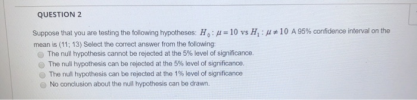 QUESTION 2 Suppose that you are testing the following hypotheses: H:u= 10 vs H : 4#10 A 95% confidence interval on the mean is (11; 13) Select the correct answer from the following: The null hypothesis cannot be rejected at the 5% level of significance. The null hypothesis can be rejected at the 5% level of significance. The null hypothesis can be rejected at the 1% level of significance No conclusion about the null hypothesis can be drawn
 need help with the last questions.
Prothrombin time is a measure of the clotting ability of blood. For 10 rats treated with an antibiotic and 10 control rats, the prothrombin times (in seconds) were reported as follows: Control Antibiotic 10 25 10 23 sample mean sample standard deviation 10 (a) (3 points) What is the explanatory variable? Is it categorical or quantitative? Explanatory variable is type of treatment and is categorical. (b) (3 points) What is the response variable? Is...
need help with the last questions.
Prothrombin time is a measure of the clotting ability of blood. For 10 rats treated with an antibiotic and 10 control rats, the prothrombin times (in seconds) were reported as follows: Control Antibiotic 10 25 10 23 sample mean sample standard deviation 10 (a) (3 points) What is the explanatory variable? Is it categorical or quantitative? Explanatory variable is type of treatment and is categorical. (b) (3 points) What is the response variable? Is...
 sorry i posted everytbjng bc it goes together. if you can help
me with as much as you can thankyou
Question 1 5 pts We're interested in whether Biology students have higher Visual relative to Kinesthetic learning styles. We've decided to use a paired t-test to investigate the question, based on our classroom as our sample. What assumptions do we have to make to use this method? our sample is an unbiased representative sample of the population both the Visual...
sorry i posted everytbjng bc it goes together. if you can help
me with as much as you can thankyou
Question 1 5 pts We're interested in whether Biology students have higher Visual relative to Kinesthetic learning styles. We've decided to use a paired t-test to investigate the question, based on our classroom as our sample. What assumptions do we have to make to use this method? our sample is an unbiased representative sample of the population both the Visual...
 12. Consider a statistical inference that test the null hypothesis be Ho: c against H : esuch that c is a positive value. The test statistic associated with this mull hypothesis is given by t(b-c)/se(b) At significance level a, the test statistic is smaller than the critical value te(a/2, N - 2), that is iste(a/2, N- 2). Mark the correct alternative: (a) The test p-value increases if we increase c. (b) c does not belong to the estimated confidence interval...
 QUESTION 2 Suppose that you are testing the following hypotheses: H:u= 10 vs H : 4#10 A 95% confidence interval on the mean is (11; 13) Select the correct answer from the following: The null hypothesis cannot be rejected at the 5% level of significance. The null hypothesis can be rejected at the 5% level of significance. The null hypothesis can be rejected at the 1% level of significance No conclusion about the null hypothesis can be drawn
Most questions answered within 3 hours.
-
Where is the error in this code sequence?
String s1 = "Hello";
String s2 = "ello";...
asked 11 months ago -
Financial data for Joel de Paris, Inc., for last year
follow:
Joel de Paris, Inc.
Balance...
asked 11 months ago -
Consider this reaction:
Al2(SO4)3 (aq)+ BaCl3
(aq) Al2Cl6 (aq)- +
3BaSO4(s) . What is the...
asked 11 months ago -
Suppose that Savneet is considering increasing her
recent random sample from 20 car rentals to 40...
asked 11 months ago -
Trucks arrive at an unloading terminal at an average rate of 120
per hour.
Trucks arrive...
asked 11 months ago -
Why are methanol and ethanol completely soluble in water while
octanol is not very little soluble....
asked 11 months ago -
A facilities manager at a university reads in a research report
that the mean amount of...
asked 11 months ago -
When the CuSO4 is rehydrated by adding water to the anhydrous
compound, is this an endothermic...
asked 11 months ago -
A ray of sunlight is passing from diamond into crown glass; the
angle of incidence is...
asked 11 months ago -
A block of mass 0.249 kg is placed on top of a light, vertical
spring of...
asked 11 months ago -
how do the kidneys compensate in the presences of acidosis
a) trigger hyperventilate
b) reserve acid...
asked 11 months ago -
Question 501 pts
The rental rate of capital to the firm increases. Which of the
following...
asked 11 months ago