Why would an increase in brown adipose tissue be helpful in reducing a patient's body weight?
Why would an increase in brown adipose tissue be helpful in reducing a patient's body weight?
Homework Answers
Request Answer!
We need at least 10 more requests to produce the answer.
0 / 10 have requested this problem solution
The more requests, the faster the answer.
Add Answer to:
Why would an increase in brown adipose tissue be helpful in
reducing a patient's body weight?
1. Which of the following statements are true about adipose tissue? a. Brown adipose tissue is...
 1. Which of the following statements are true about adipose tissue? a. Brown adipose tissue is responsible for storage of energy b. Brown adipose tissue is responsible for producing heat (thermogenesis) c. White adipose tissue is responsible for producing heat (thermogenesis) d. White adipocytes have more mitochondria than brown adipocytes. e. Brown adipocytes have a large lipid droplet 2. Which protein is known as the "master regulator of adipocyte differentiation"? a. PPAR b. SNP c. STZ d. P53 e. Ras...
Many scientists believe that there is a regulatory system the body uses to maintain adipose tissue,...
Many scientists believe that there is a regulatory system the body uses to maintain adipose tissue, this system is known as an ______ Adipose tissue has several important functions including influencing hunger and metabolism as part of the ____________ feedback system described earlier. The major site of energy storage in the body is ____________ adipose tissue. In this fat, ____________ (fat cells) store ____________ in a single large droplet in the cell. It is believed that these fat cells are not merely storage sites but also secrete ____________ that are...
Why would increasing the amount of uncoupling proteins in adipose tissue constitute a reasonable approach to...
Why would increasing the amount of uncoupling proteins in adipose tissue constitute a reasonable approach to facilitate weight loss?
1. Most newborn babies have significant amounts of brown adipose tissue (fat). This tissue is gradually...
1. Most newborn babies have significant amounts of brown adipose tissue (fat). This tissue is gradually reduced during development. What is a plausible role for the brown adipose cells in babies and why their function becomes less important as child grows? 2. Imagine you are growing some photosynthetic algae in a flask and can measure amount of oxygen they release. When you illuminate them with 700mm wavelength light, almost no oxygen is produced. But, when you change the bulb and...
QUESTION 9 A type of adipose tissue in many organisms is called brown fat. Identify the...
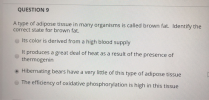 QUESTION 9 A type of adipose tissue in many organisms is called brown fat. Identify the correct state for brown fat. Its color is derived from a high blood supply It produces a great deal of heat as a result of the presence of thermogenin • Hibernating bears have a very little of this type of adipose tissue The efficiency of oxidative phosphorylation is high in this tissue
What is the purpose of uncoupling proteins in mammalian brown adipose tissue? A. They give the...
What is the purpose of uncoupling proteins in mammalian brown adipose tissue? A. They give the tissue its color. B. They help the tissue expand and contract when needed. C. They function as a source of heat production during exposure to cold temperatures. D. They allow the production of a larger number of ATPs per glucose.
Brown adipose tissue O a. contains very few brite adipocytes O b. can become white adipose tissue O c. provides...
 Brown adipose tissue O a. contains very few brite adipocytes O b. can become white adipose tissue O c. provides energy to other cells O d. releases stored energy as heat O e. stores fat for other cells Glomerulonephritis is usually caused by: antigen-antibody complexes. vesicoureteral reflux. catheter-induced infection. glomerular membrane viruses. Glomerulonephritis is usually caused by: antigen-antibody complexes. vesicoureteral reflux. catheter-induced infection. glomerular membrane viruses.
why would researchers seek to induce thermogenin expression only in adipose tissue and not in tissues...
why would researchers seek to induce thermogenin expression only in adipose tissue and not in tissues that rely primarily on carbohydrates for energy?
please answer all 1. A type of adipose tissue in many organisms is called brown fat....
please answer all 1. A type of adipose tissue in many organisms is called brown fat. Which of the following statements is correct for brown fat? Hibernating bears have very little of this type of adipose tissue. It produces a great deal of heat as a result of the presence of thermogenin. The efficiency of oxidative phosphorylation is high in this tissue. Its color is derived from high blood supply. 2. What statement illustrates the role of Ca2+ in regulation...
Question 10 0 / 1 point Adipose tissue actively secretes several hormones known as several body...
 Question 10 0 / 1 point Adipose tissue actively secretes several hormones known as several body functions. proteins that help regulate energy balance and influence
 1. Which of the following statements are true about adipose tissue? a. Brown adipose tissue is responsible for storage of energy b. Brown adipose tissue is responsible for producing heat (thermogenesis) c. White adipose tissue is responsible for producing heat (thermogenesis) d. White adipocytes have more mitochondria than brown adipocytes. e. Brown adipocytes have a large lipid droplet 2. Which protein is known as the "master regulator of adipocyte differentiation"? a. PPAR b. SNP c. STZ d. P53 e. Ras...
 QUESTION 9 A type of adipose tissue in many organisms is called brown fat. Identify the correct state for brown fat. Its color is derived from a high blood supply It produces a great deal of heat as a result of the presence of thermogenin • Hibernating bears have a very little of this type of adipose tissue The efficiency of oxidative phosphorylation is high in this tissue
 Brown adipose tissue O a. contains very few brite adipocytes O b. can become white adipose tissue O c. provides energy to other cells O d. releases stored energy as heat O e. stores fat for other cells Glomerulonephritis is usually caused by: antigen-antibody complexes. vesicoureteral reflux. catheter-induced infection. glomerular membrane viruses. Glomerulonephritis is usually caused by: antigen-antibody complexes. vesicoureteral reflux. catheter-induced infection. glomerular membrane viruses.
 Question 10 0 / 1 point Adipose tissue actively secretes several hormones known as several body functions. proteins that help regulate energy balance and influence
Most questions answered within 3 hours.
-
Where is the error in this code sequence?
String s1 = "Hello";
String s2 = "ello";...
asked 10 months ago -
Financial data for Joel de Paris, Inc., for last year
follow:
Joel de Paris, Inc.
Balance...
asked 10 months ago -
Consider this reaction:
Al2(SO4)3 (aq)+ BaCl3
(aq) Al2Cl6 (aq)- +
3BaSO4(s) . What is the...
asked 10 months ago -
Suppose that Savneet is considering increasing her
recent random sample from 20 car rentals to 40...
asked 10 months ago -
Trucks arrive at an unloading terminal at an average rate of 120
per hour.
Trucks arrive...
asked 10 months ago -
Why are methanol and ethanol completely soluble in water while
octanol is not very little soluble....
asked 10 months ago -
A facilities manager at a university reads in a research report
that the mean amount of...
asked 10 months ago -
When the CuSO4 is rehydrated by adding water to the anhydrous
compound, is this an endothermic...
asked 10 months ago -
A ray of sunlight is passing from diamond into crown glass; the
angle of incidence is...
asked 10 months ago -
A block of mass 0.249 kg is placed on top of a light, vertical
spring of...
asked 10 months ago -
how do the kidneys compensate in the presences of acidosis
a) trigger hyperventilate
b) reserve acid...
asked 10 months ago -
Question 501 pts
The rental rate of capital to the firm increases. Which of the
following...
asked 10 months ago