Mr. and Mrs. Tinker own a sizeable investment portfolio of stock in publicly held corporations. The...
Mr. and Mrs. Tinker own a sizeable investment portfolio of stock in publicly held corporations. The couple has four children—ages 20, 22, 25, and 27—with whom they want to share their wealth. Unfortunately, none of the children has demonstrated an ability to manage money. As a result, Mr. and Mrs. Tinker plan to transfer their portfolio to a new corporation in exchange for 20 shares of voting stock and 400 shares of nonvoting stock. They will give 100 nonvoting shares to each child. The couple will serve as the directors of the corporation, manage the investment portfolio, and distribute cash dividends when their children need money. They estimate that the portfolio will generate $72,000 annual dividend income.
- If the Tinker Family Corporation is operated as an S corporation, compute the annual income tax burden on the dividend income generated by the investment portfolio. Assume that Mr. and Mrs. Tinker are in the 37 percent tax bracket and each child is in the 12 percent tax bracket. To simplify the case, ignore any value of the couple’s management service to the corporation.
- Compute the tax burden for the first year if Tinker Family Corporation does not have an S election in effect and distributes a $100 annual dividend per share.
Homework Answers
The annual earning is 72000
The dividend earned by voting stock will be 3429 and the dividend earned by non voting stock would be 68571
(Computed on proportionate basis)
The tax burden on moving stock shall be 3429 dollars *37%=1269
The tax buden on non moving stock would be 68571 dollars*12%=8229.
The tax buden on each child would be 2057.25
If annual dividend distributed is $100
Therefore the earning on moving stock would be 2000 dollars and the earning on non moving stock would be 40000 dolars. The tax burden on moving stock would be 2000 dollars *37% =740 dollars.
On non moving stock the tax burden would be 40000*12%=4800.The tax burden on non moving stock for each child would be 1200 dollars.
Add Answer to:
Mr. and Mrs. Tinker own a sizeable investment portfolio of stock
in publicly held corporations. The...
Mr. and Mrs. Tinker own a sizeable investment portfolio of stock in publicly held corporations. The...
Mr. and Mrs. Tinker own a sizeable investment portfolio of stock in publicly held corporations. The couple has four children—ages 20, 22, 25, and 27—with whom they want to share their wealth. Unfortunately, none of the children has demonstrated an ability to manage money. As a result, Mr. and Mrs. Tinker plan to transfer their portfolio to a new corporation in exchange for 20 shares of voting stock and 400 shares of nonvoting stock. They will give 100 nonvoting shares...
Mrs. Franklin, who is in the 37 percent tax bracket, owns a residential apartment building that...
 Mrs. Franklin, who is in the 37 percent tax bracket, owns a residential apartment building that generates $100,000 annual taxable income. She plans to create a family partnership by giving each of her two children a 15 percent equity interest in the building. (She will retain a 70 percent interest.) Mrs. Franklin will manage the building, and value of her services is $25,000 per year. If Mrs. Franklin's children are in the 12 percent tax bracket, compute the tax savings...
Mrs. Franklin, who is in the 37 percent tax bracket, owns a residential apartment building that...
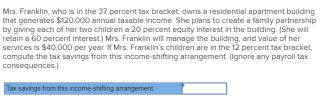 Mrs. Franklin, who is in the 37 percent tax bracket, owns a residential apartment building that generates $120,000 annual taxable income. She plans to create a family partnership by giving each of her two children a 20 percent equity interest in the building. (She will retain a 60 percent interest.) Mrs. Franklin will manage the building, and value of her services is $40,000 per year. If Mrs. Franklin's children are in the 12 percent tax bracket compute the tax savings...
Mr. Allen, whose marginal tax rate is 37%, owns an office building that generates $100,000 annual...
Mr. Allen, whose marginal tax rate is 37%, owns an office building that generates $100,000 annual taxable income. He plans to create a family partnership by giving each of his three children a 15% interest in the building. Mr. Allen will retain a 55% interest. Mr. Allen will manage the building, and receive a guaranteed payment of $20,000. If Mr. Allen's children are in the 12% tax bracket, compute the annual tax savings from this income-shifting arrangement. A. $11250 B....
Mr. and Mrs. Anderson own three shares of Magic Tricks Corporation's common stock. The market value...
 Mr. and Mrs. Anderson own three shares of Magic Tricks Corporation's common stock. The market value of the stock is $60. The Andersons also have $48 in cash. They have just received word of a rights offering. One new share of stock can be purchased at $48 for each three shares currently owned (based on three rights). (Do not round intermediate calculations and round your answers to the nearest whole dollar.) a. What is the value of a right? Value...
Mr and Mrs. Anderson own five shares of Magic Tricks Corporation's common stock. The market value...
 Mr and Mrs. Anderson own five shares of Magic Tricks Corporation's common stock. The market value of the stock is $60. The Andersons also have $42 in cash. They have just received word of a rights offering. One new share of stock can be purchased at $42 for each five shares currently owned (based on five rights). (Do not round intermediate calculations and round your answers to the nearest whole dollar.) a. What is the value of a right? Value...
Mr. and Mrs. Anderson own three shares of Magic Tricks Corporation's common stock. The market value...
 Mr. and Mrs. Anderson own three shares of Magic Tricks Corporation's common stock. The market value of the stock is $60. The Andersons also have $48 in cash. They have just received word of a rights offering. One new share of stock can be purchased at $48 for each three shares currently owned (based on three rights). (Do not round intermediate calculations and round your answers to the nearest whole dollar.) a. What is the value of a right? Value...
Mr. and Mrs. Anderson own five shares of Magic Tricks Corporation's common stock. The market value...
Mr. and Mrs. Anderson own five shares of Magic Tricks Corporation's common stock. The market value of the stock is $76. The Andersons also have $58 in cash. They have just received word of a rights offering. One new share of stock can be purchased at $58 for each five shares currently owned (based on five rights). (Do not round intermediate calculations and round your answers to the nearest whole dollar.) a. What is the value of a right? b....
Mr. and Mrs. Anderson own six shares of Magic Tricks Corporation's common stock. The market value...
Mr. and Mrs. Anderson own six shares of Magic Tricks Corporation's common stock. The market value of the stock is $70. The Andersons also have $56 in cash. They have just received word of a rights offering. One new share of stock can be purchased at $56 for each six shares currently owned (based on six rights). (Do not round intermediate calculations and round your answers to the nearest whole dollar.) a. What is the value of a right? b....
Mr. Lion, who is in the 37 percent tax bracket, is the sole shareholder of Toto...
 Mr. Lion, who is in the 37 percent tax bracket, is the sole
shareholder of Toto Inc., which manufactures greeting cards. Toto’s
average annual net profit (before deduction of Mr. Lion’s salary)
is $200,000. For each of the following cases, compute the income
tax burden on this profit. (Ignore any payroll tax
consequences.)
a. Mr. Lion’s salary is $100,000, and Toto pays no
dividends.
b. Mr. Lion’s salary is $100,000, and Toto distributes its
after-tax income as a dividend.
c....
Mr. Lion, who is in the 37 percent tax bracket, is the sole
shareholder of Toto Inc., which manufactures greeting cards. Toto’s
average annual net profit (before deduction of Mr. Lion’s salary)
is $200,000. For each of the following cases, compute the income
tax burden on this profit. (Ignore any payroll tax
consequences.)
a. Mr. Lion’s salary is $100,000, and Toto pays no
dividends.
b. Mr. Lion’s salary is $100,000, and Toto distributes its
after-tax income as a dividend.
c....
 Mrs. Franklin, who is in the 37 percent tax bracket, owns a residential apartment building that generates $100,000 annual taxable income. She plans to create a family partnership by giving each of her two children a 15 percent equity interest in the building. (She will retain a 70 percent interest.) Mrs. Franklin will manage the building, and value of her services is $25,000 per year. If Mrs. Franklin's children are in the 12 percent tax bracket, compute the tax savings...
 Mrs. Franklin, who is in the 37 percent tax bracket, owns a residential apartment building that generates $120,000 annual taxable income. She plans to create a family partnership by giving each of her two children a 20 percent equity interest in the building. (She will retain a 60 percent interest.) Mrs. Franklin will manage the building, and value of her services is $40,000 per year. If Mrs. Franklin's children are in the 12 percent tax bracket compute the tax savings...
 Mr. and Mrs. Anderson own three shares of Magic Tricks Corporation's common stock. The market value of the stock is $60. The Andersons also have $48 in cash. They have just received word of a rights offering. One new share of stock can be purchased at $48 for each three shares currently owned (based on three rights). (Do not round intermediate calculations and round your answers to the nearest whole dollar.) a. What is the value of a right? Value...
 Mr and Mrs. Anderson own five shares of Magic Tricks Corporation's common stock. The market value of the stock is $60. The Andersons also have $42 in cash. They have just received word of a rights offering. One new share of stock can be purchased at $42 for each five shares currently owned (based on five rights). (Do not round intermediate calculations and round your answers to the nearest whole dollar.) a. What is the value of a right? Value...
 Mr. and Mrs. Anderson own three shares of Magic Tricks Corporation's common stock. The market value of the stock is $60. The Andersons also have $48 in cash. They have just received word of a rights offering. One new share of stock can be purchased at $48 for each three shares currently owned (based on three rights). (Do not round intermediate calculations and round your answers to the nearest whole dollar.) a. What is the value of a right? Value...
 Mr. Lion, who is in the 37 percent tax bracket, is the sole
shareholder of Toto Inc., which manufactures greeting cards. Toto’s
average annual net profit (before deduction of Mr. Lion’s salary)
is $200,000. For each of the following cases, compute the income
tax burden on this profit. (Ignore any payroll tax
consequences.)
a. Mr. Lion’s salary is $100,000, and Toto pays no
dividends.
b. Mr. Lion’s salary is $100,000, and Toto distributes its
after-tax income as a dividend.
c....
Mr. Lion, who is in the 37 percent tax bracket, is the sole
shareholder of Toto Inc., which manufactures greeting cards. Toto’s
average annual net profit (before deduction of Mr. Lion’s salary)
is $200,000. For each of the following cases, compute the income
tax burden on this profit. (Ignore any payroll tax
consequences.)
a. Mr. Lion’s salary is $100,000, and Toto pays no
dividends.
b. Mr. Lion’s salary is $100,000, and Toto distributes its
after-tax income as a dividend.
c....
Most questions answered within 3 hours.
-
Where is the error in this code sequence?
String s1 = "Hello";
String s2 = "ello";...
asked 10 months ago -
Financial data for Joel de Paris, Inc., for last year
follow:
Joel de Paris, Inc.
Balance...
asked 10 months ago -
Consider this reaction:
Al2(SO4)3 (aq)+ BaCl3
(aq) Al2Cl6 (aq)- +
3BaSO4(s) . What is the...
asked 10 months ago -
Suppose that Savneet is considering increasing her
recent random sample from 20 car rentals to 40...
asked 10 months ago -
Trucks arrive at an unloading terminal at an average rate of 120
per hour.
Trucks arrive...
asked 10 months ago -
Why are methanol and ethanol completely soluble in water while
octanol is not very little soluble....
asked 10 months ago -
A facilities manager at a university reads in a research report
that the mean amount of...
asked 10 months ago -
When the CuSO4 is rehydrated by adding water to the anhydrous
compound, is this an endothermic...
asked 10 months ago -
A ray of sunlight is passing from diamond into crown glass; the
angle of incidence is...
asked 10 months ago -
A block of mass 0.249 kg is placed on top of a light, vertical
spring of...
asked 10 months ago -
how do the kidneys compensate in the presences of acidosis
a) trigger hyperventilate
b) reserve acid...
asked 10 months ago -
Question 501 pts
The rental rate of capital to the firm increases. Which of the
following...
asked 10 months ago