int is_prime(int n) { if (n <= 1) return 0; if (n % 2 == 0...
int is_prime(int n)
{
if (n <= 1) return 0;
if (n % 2 == 0 && n > 2) return 0;
for (int i = 3; i < n / 2; i += 2)
if (n % i == 0)
return 0;
return 1;
}
What do the three lines in this function mean?
Homework Answers
Program:
import java.io.*;
import java.util.Scanner;
public class TestPrime { // Here taking class name as
TestPrime
public int is_prime(int n) { // Definition of the method
is_prime()
/*if (n <= 1)
return 0; //The above condition is true then returning 0 to the
main()
if (n % 2 == 0 && n > 2)
return 0; //The above condition is true then returning 0 to the
main() */
for (int i = 3; i < n / 2; i += 2)
if (n % i == 0) //Here checking the condition if remainder is
zero
return 0; //The above condition is true then returning 0 to the
main()
return 1;
}
public static void main(String args[]) // Start of main()
{
int m=0; // Here initializing the value of integer varaible called
yr
TestPrime ob = new TestPrime(); // Here creating the object for
class TestPrime
Scanner in = new Scanner(System.in);
System.out.println("Enter Value of n: "); // Here taking Input from
the User
m = in.nextInt(); // Here scanning the input
System.out.println(ob.is_prime(m)); // Here calling the leapyear()
method
}// End of main()
} // End of class TestPrime
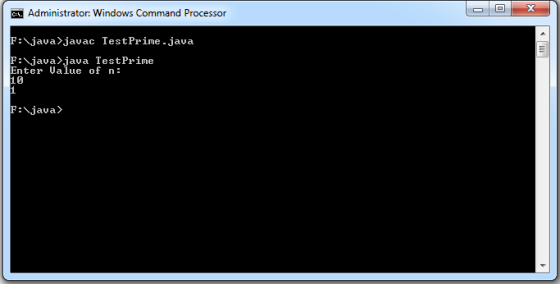
Output:
C language int is_prime(int n) { if (n <= 1) return 0; if (n % 2...
C language int is_prime(int n) { if (n <= 1) return 0; if (n % 2 == 0 && n > 2) return 0; for (int i = 3; i < n / 2; i += 2) if (n % i == 0) return 0; return 1; } What do the three lines in this function mean?
1. public int function(int x, int n) { if (n == 0) return 1; return x...
1. public int function(int x, int n) { if (n == 0) return 1; return x * function(x, n -1); } function(3,3) - What is the expected output? 3 12 9 27 2. int fun(int x) { if(x == 0) return 1; else return fun(x - 1); } fun(4) 18 1 24 4 3. Which one of the following calls results 6? int mystery(int n){ if (n == 1) return 1; else return n * mystery(n - 1); } mystery(3)...
(a) Consider the following C++ function: 1 int g(int n) { 2 if (n == 0)...
 (a) Consider the following C++ function: 1 int g(int n) { 2 if (n == 0) return 0; 3 return (n-1 + g(n-1)); 4} (b) Consider the following C++ function: 1 bool Function (const vector <int >& a) { 2 for (int i = 0; i < a. size ()-1; i ++) { 3 for (int j = i +1; j < a. size (); j ++) { 4 if (a[i] == a[j]) return false; 5 6 } 7 return...
What is the base case? -------------------------------------------------- int fibo(int n) { if(n <= 2){ return...
What is the base case? -------------------------------------------------- int fibo(int n) { if(n <= 2){ return n-1; } else{ return fibo(n-1) + fibo(n-2); } } --------------------------------------------------------------------------- int getFibo(int n){ if(n<=2){ return n-1; } else{ int term[n+1], i; term[0] = 0, term[1] = 1; for(i = 2;i= term[i] = term[i-1]+term[i-2]; } return term[n]; } }
How to prove G(n)=n+1 in this algorithm? 1. if (n 0) 2. return 1 3. else if (n1) f 4. return 2 5. else if (n 2) 6. return 3 7. else if (n3) t 8. return 4 else f 9. int OGnew int[n 11 10. G[O]1 1...
 How to prove G(n)=n+1 in this algorithm?
1. if (n 0) 2. return 1 3. else if (n1) f 4. return 2 5. else if (n 2) 6. return 3 7. else if (n3) t 8. return 4 else f 9. int OGnew int[n 11 10. G[O]1 12. G[2]3 13. G[3]4 14. int i:-4 15. while (i<n) t 16. if (i mod 20) else ( 20. return G[n]
1. if (n 0) 2. return 1 3. else if (n1) f...
How to prove G(n)=n+1 in this algorithm?
1. if (n 0) 2. return 1 3. else if (n1) f 4. return 2 5. else if (n 2) 6. return 3 7. else if (n3) t 8. return 4 else f 9. int OGnew int[n 11 10. G[O]1 12. G[2]3 13. G[3]4 14. int i:-4 15. while (i<n) t 16. if (i mod 20) else ( 20. return G[n]
1. if (n 0) 2. return 1 3. else if (n1) f...
Int h(int n) { if (n == 0) return 0; else return h(n/10) + n%10;} What...
Int h(int n) { if (n == 0) return 0; else return h(n/10) + n%10;} What is the output for each function call (a) Function call h(736). Output: (b) Function call h(12345). Output: Answer options: 16,15 26,25 36,35 46,45
#include <stdio.h> int josephus(int n, int k) { if (n == 1) return 1; else...
#include <stdio.h> int josephus(int n, int k) { if (n == 1) return 1; else /* The position returned by josephus(n - 1, k) is adjusted because the recursive call josephus(n - 1, k) considers the original position k%n + 1 as position 1 */ return (josephus(n - 1, k) + k-1) % n + 1; } // Driver Program to test above function int main() { int n = 14; int k = 2; printf("The chosen place...
The following function is_prime() is not a very efficient prime number test: #include <stdio.h> int is_prime(int...
The following function is_prime() is not a very efficient prime number test: #include <stdio.h> int is_prime(int n) { int d; for (d = 2; d < n; d++) { if (!(n % d)) return 0; } return 1; } int main() { if (is_prime(7)) printf("Seven is Prime!\n"); return 0; } It is unnecessary to divide n by all numbers between 2 and n - 1 to determine if n is prime. Only divisors up to and including need to be...
b) Consider the following code. public static int f(int n) if (n == 1) return 0;...
 b) Consider the following code. public static int f(int n) if (n == 1) return 0; else if (n % 2 == 0). return g(n/2); else return g(n+1); public static int g(int n) int r = n % 3; if (r == 0) return f(n/3); else if (r == 1) return f(n+2); else return f(2 * n); // (HERE) public static void main(String[] args) { int x = 3; System.out.println(f(x)); (1) (5 points) Draw the call stack as it would...
Q5 (25pts) Consider the code: int foo(int N){ if (N <= 3) return 2; int res1 = 3*foo(N-4); int...
Q5 (25pts) Consider the code: int foo(int N){ if (N <= 3) return 2; int res1 = 3*foo(N-4); int res2 = foo(N-2); return res1-res2; } a) (6 points) Write the recurrence formula for the time complexity of this function (including the base cases) for N>=0. You do NOT need to solve it. b) (5 points) Draw the tree that shows the function calls performed in order to compute foo(8) (the root will be foo(8) and it will have a child...
 (a) Consider the following C++ function: 1 int g(int n) { 2 if (n == 0) return 0; 3 return (n-1 + g(n-1)); 4} (b) Consider the following C++ function: 1 bool Function (const vector <int >& a) { 2 for (int i = 0; i < a. size ()-1; i ++) { 3 for (int j = i +1; j < a. size (); j ++) { 4 if (a[i] == a[j]) return false; 5 6 } 7 return...
 How to prove G(n)=n+1 in this algorithm?
1. if (n 0) 2. return 1 3. else if (n1) f 4. return 2 5. else if (n 2) 6. return 3 7. else if (n3) t 8. return 4 else f 9. int OGnew int[n 11 10. G[O]1 12. G[2]3 13. G[3]4 14. int i:-4 15. while (i<n) t 16. if (i mod 20) else ( 20. return G[n]
1. if (n 0) 2. return 1 3. else if (n1) f...
How to prove G(n)=n+1 in this algorithm?
1. if (n 0) 2. return 1 3. else if (n1) f 4. return 2 5. else if (n 2) 6. return 3 7. else if (n3) t 8. return 4 else f 9. int OGnew int[n 11 10. G[O]1 12. G[2]3 13. G[3]4 14. int i:-4 15. while (i<n) t 16. if (i mod 20) else ( 20. return G[n]
1. if (n 0) 2. return 1 3. else if (n1) f...
 b) Consider the following code. public static int f(int n) if (n == 1) return 0; else if (n % 2 == 0). return g(n/2); else return g(n+1); public static int g(int n) int r = n % 3; if (r == 0) return f(n/3); else if (r == 1) return f(n+2); else return f(2 * n); // (HERE) public static void main(String[] args) { int x = 3; System.out.println(f(x)); (1) (5 points) Draw the call stack as it would...
Most questions answered within 3 hours.
-
Where is the error in this code sequence?
String s1 = "Hello";
String s2 = "ello";...
asked 10 months ago -
Financial data for Joel de Paris, Inc., for last year
follow:
Joel de Paris, Inc.
Balance...
asked 10 months ago -
Consider this reaction:
Al2(SO4)3 (aq)+ BaCl3
(aq) Al2Cl6 (aq)- +
3BaSO4(s) . What is the...
asked 10 months ago -
Suppose that Savneet is considering increasing her
recent random sample from 20 car rentals to 40...
asked 10 months ago -
Trucks arrive at an unloading terminal at an average rate of 120
per hour.
Trucks arrive...
asked 10 months ago -
Why are methanol and ethanol completely soluble in water while
octanol is not very little soluble....
asked 10 months ago -
A facilities manager at a university reads in a research report
that the mean amount of...
asked 10 months ago -
When the CuSO4 is rehydrated by adding water to the anhydrous
compound, is this an endothermic...
asked 10 months ago -
A ray of sunlight is passing from diamond into crown glass; the
angle of incidence is...
asked 10 months ago -
A block of mass 0.249 kg is placed on top of a light, vertical
spring of...
asked 10 months ago -
how do the kidneys compensate in the presences of acidosis
a) trigger hyperventilate
b) reserve acid...
asked 10 months ago -
Question 501 pts
The rental rate of capital to the firm increases. Which of the
following...
asked 10 months ago