Could you please answer all of the following questions? 1. A 3 kg object attached to...
Could you please answer all of the following questions?
1. A 3 kg object attached to a spring oscillates with an amplitude of 15 cm and a period of 2 s. At a time t = 0.5 s, the object's position is x = 9.1 cm. Determine
a) the spring constant of the spring
b) the total energy of the system (in joules)
c) the maximum speed of the object
d) the position of the object as a function of time. Use a cosine function
2. The velocity of a 300 g mass attached to the end of a spring is represented by v = (160 m/s)cos(2.83t + pi/4). Determine
a) the system's period of oscillation
b) the total energy of the system (in joules)
c) the acceleration of the mass as a function of time
3. A hollow sphere of radius 25 cm is attached to a piece of wire of length 10 cm to form a physical pendulum. Assuming small amplitude motion and ignoring the mass of the wire, determine its period of oscillation.
4. A periodic wave is described by y = (0.15m)cos(10t + (pi/2)x) with x in meters and t in seconds. Determine
a) its wavelength
b) its speed
c) its direction of propagation
d) Sketch the wave at t = 0
Homework Answers


Add Answer to:
Could you please answer all of the following questions?
1. A 3 kg object attached to...
PHY152 Problem Assignment #1 SHOW YOUR WORK 1. A3 kg object attached to a spring oscillates...
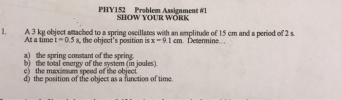 PHY152 Problem Assignment #1 SHOW YOUR WORK 1. A3 kg object attached to a spring oscillates with an amplitude of 15 cm and a period of 2s. At a time t0.5 s, the object's position is x - 9.1 cm. Determine... a) the spring constant of the spring b) the total energy of the system (in joules). maximum speed of the object d) the position of the object as a function of time.
please answer as many questions as possible. I will “thumb up” the answers. Thanks! 1. You are on a boat, which is bobbing up and down. The boat's vertical displacement y is given by y 1.2...
 please answer as many questions as possible. I will “thumb up” the
answers. Thanks!
1. You are on a boat, which is bobbing up and down. The boat's vertical displacement y is given by y 1.2 cos(t). Find the amplitude, angular frequency, phase constant, frequency, and period of the motion. (b) Where is the boat at t 1 s? (c) Find the velocity and acceleration as functions of time t. (d) Find the initial values of the position, velocity, and...
please answer as many questions as possible. I will “thumb up” the
answers. Thanks!
1. You are on a boat, which is bobbing up and down. The boat's vertical displacement y is given by y 1.2 cos(t). Find the amplitude, angular frequency, phase constant, frequency, and period of the motion. (b) Where is the boat at t 1 s? (c) Find the velocity and acceleration as functions of time t. (d) Find the initial values of the position, velocity, and...
14.5 The displacement as a function of time of a 0.05-kg object attached to a spring vibrating in...
 14.5 The displacement as a function of time of a 0.05-kg object attached to a spring vibrating in simple harmonic motion is shown below. x (cm) 2.00 1.00 0.0034 -9.00 For this motion, find the following: a) The amplitude b) The period c) The angular frequency d) The maximum speed e) The maximum acceleration f What is the amount of mechanical energy of the system during the motion? g) Write an equation for its position as a function of time....
Help with these 2 questions An object of mass 0.67 kg is attached to a spring...
 Help with these 2 questions
An object of mass 0.67 kg is attached to a spring with spring onstant 15 N/m. If the object is pulled 14 cm from the equilibrium position and released. What is the maximum speed of the object? The displacement of an object is given by y (4.7 cm) sin 20T. What are the object's (a) amplitude, (b) frequency, and (o) period of oscillation?
Help with these 2 questions
An object of mass 0.67 kg is attached to a spring with spring onstant 15 N/m. If the object is pulled 14 cm from the equilibrium position and released. What is the maximum speed of the object? The displacement of an object is given by y (4.7 cm) sin 20T. What are the object's (a) amplitude, (b) frequency, and (o) period of oscillation?
please give me answers to all the questions and i would really appreciate that thank you...
 please give me answers to all the questions and i would really
appreciate that
thank you
6. -0 points My Notes O Ask Your Teache A 10.1 kg object oscillates at the end of a vertical spring that has a spring constant of 2.20 x 10⁴ N/m. The effect of air resistance is represented by the damping coefficient b = 3.00 N-s/m (a) Calculate the frequency of the dampened oscillation. H2 (b) By what percentage does the amplitude of the...
please give me answers to all the questions and i would really
appreciate that
thank you
6. -0 points My Notes O Ask Your Teache A 10.1 kg object oscillates at the end of a vertical spring that has a spring constant of 2.20 x 10⁴ N/m. The effect of air resistance is represented by the damping coefficient b = 3.00 N-s/m (a) Calculate the frequency of the dampened oscillation. H2 (b) By what percentage does the amplitude of the...
Find the amplitude, frequency and period of motion for an object vibrating at the of a...
 Find the amplitude, frequency and period of motion for an object vibrating at the of a horizontal spring if the equation for its position as a function of time is: X = (0.250m) cos(pi/8.00 t) Amplitude Frequency Period Find the position, velocity and acceleration at t = 1.0 s for the wave in question 2: position
A mass of 0.280 kg is attached to a spring and set into oscillation on a...
A mass of 0.280 kg is attached to a spring and set into oscillation on a horizontal frictionless surface. The simple harmonic motion of the mass is described by x(t) = (0.780 m)cos[(14.0 rad/s)t]. Determine the following: (a) amplitude of oscillation for the oscillating mass (m) (b) force constant for the spring (N/m) (c) position of the mass after it has been oscillating for one half a period (m) (d) position of the mass two-thirds of a period after it...
Part A: 10 points each (Questions 1-4 1. A block mass of 3 kg attached with a spring kg attached with a spring of s...
 Part A: 10 points each (Questions 1-4 1. A block mass of 3 kg attached with a spring kg attached with a spring of spring constant 2500 N/m as shown in the Figure below. The amplitude or maximum displacement X max is 7m. Calculate O a) Maximum Potential energy stored in the spring b) Maximum kinetic energy of the block c) the total energy-spring block system 2. A small mass moves in simple harmonic motion according to the equation x...
A mass m = 3 kg is attached to a spring with spring constant k =...
A mass m = 3 kg is attached to a spring with spring constant k = 3 N/m and oscillates with simple harmonic motion along the x-axis with an amplitude A = 0.10 m. (a) What is the angular frequency of this oscillation? (b) What is the period T and the frequency f of the oscillation? (c) If the phase constant = 0, write down expressions for the displacement, velocity and acceleration of the mass as a function...
Problem #1: 10 points A spring having a spring constant k is placed on a smooth...
 Problem #1: 10 points A spring having a spring constant k is placed on a smooth horizontal table and the left end is fixed. A mass of 200 g is attached to the other end of the spring. The mass is pushed 10.0 cm (to the left) against the spring, then released. A student with a stopwatch finds that 10 oscillations take 12.0 s. Draw a neat diagram showing the spring, mass, amplitude, equilibrium position, and both ends of the...
 PHY152 Problem Assignment #1 SHOW YOUR WORK 1. A3 kg object attached to a spring oscillates with an amplitude of 15 cm and a period of 2s. At a time t0.5 s, the object's position is x - 9.1 cm. Determine... a) the spring constant of the spring b) the total energy of the system (in joules). maximum speed of the object d) the position of the object as a function of time.
 please answer as many questions as possible. I will “thumb up” the
answers. Thanks!
1. You are on a boat, which is bobbing up and down. The boat's vertical displacement y is given by y 1.2 cos(t). Find the amplitude, angular frequency, phase constant, frequency, and period of the motion. (b) Where is the boat at t 1 s? (c) Find the velocity and acceleration as functions of time t. (d) Find the initial values of the position, velocity, and...
please answer as many questions as possible. I will “thumb up” the
answers. Thanks!
1. You are on a boat, which is bobbing up and down. The boat's vertical displacement y is given by y 1.2 cos(t). Find the amplitude, angular frequency, phase constant, frequency, and period of the motion. (b) Where is the boat at t 1 s? (c) Find the velocity and acceleration as functions of time t. (d) Find the initial values of the position, velocity, and...
 14.5 The displacement as a function of time of a 0.05-kg object attached to a spring vibrating in simple harmonic motion is shown below. x (cm) 2.00 1.00 0.0034 -9.00 For this motion, find the following: a) The amplitude b) The period c) The angular frequency d) The maximum speed e) The maximum acceleration f What is the amount of mechanical energy of the system during the motion? g) Write an equation for its position as a function of time....
 Help with these 2 questions
An object of mass 0.67 kg is attached to a spring with spring onstant 15 N/m. If the object is pulled 14 cm from the equilibrium position and released. What is the maximum speed of the object? The displacement of an object is given by y (4.7 cm) sin 20T. What are the object's (a) amplitude, (b) frequency, and (o) period of oscillation?
Help with these 2 questions
An object of mass 0.67 kg is attached to a spring with spring onstant 15 N/m. If the object is pulled 14 cm from the equilibrium position and released. What is the maximum speed of the object? The displacement of an object is given by y (4.7 cm) sin 20T. What are the object's (a) amplitude, (b) frequency, and (o) period of oscillation?
 please give me answers to all the questions and i would really
appreciate that
thank you
6. -0 points My Notes O Ask Your Teache A 10.1 kg object oscillates at the end of a vertical spring that has a spring constant of 2.20 x 10⁴ N/m. The effect of air resistance is represented by the damping coefficient b = 3.00 N-s/m (a) Calculate the frequency of the dampened oscillation. H2 (b) By what percentage does the amplitude of the...
please give me answers to all the questions and i would really
appreciate that
thank you
6. -0 points My Notes O Ask Your Teache A 10.1 kg object oscillates at the end of a vertical spring that has a spring constant of 2.20 x 10⁴ N/m. The effect of air resistance is represented by the damping coefficient b = 3.00 N-s/m (a) Calculate the frequency of the dampened oscillation. H2 (b) By what percentage does the amplitude of the...
 Find the amplitude, frequency and period of motion for an object vibrating at the of a horizontal spring if the equation for its position as a function of time is: X = (0.250m) cos(pi/8.00 t) Amplitude Frequency Period Find the position, velocity and acceleration at t = 1.0 s for the wave in question 2: position
 Part A: 10 points each (Questions 1-4 1. A block mass of 3 kg attached with a spring kg attached with a spring of spring constant 2500 N/m as shown in the Figure below. The amplitude or maximum displacement X max is 7m. Calculate O a) Maximum Potential energy stored in the spring b) Maximum kinetic energy of the block c) the total energy-spring block system 2. A small mass moves in simple harmonic motion according to the equation x...
 Problem #1: 10 points A spring having a spring constant k is placed on a smooth horizontal table and the left end is fixed. A mass of 200 g is attached to the other end of the spring. The mass is pushed 10.0 cm (to the left) against the spring, then released. A student with a stopwatch finds that 10 oscillations take 12.0 s. Draw a neat diagram showing the spring, mass, amplitude, equilibrium position, and both ends of the...
Most questions answered within 3 hours.
-
Where is the error in this code sequence?
String s1 = "Hello";
String s2 = "ello";...
asked 11 months ago -
Financial data for Joel de Paris, Inc., for last year
follow:
Joel de Paris, Inc.
Balance...
asked 11 months ago -
Consider this reaction:
Al2(SO4)3 (aq)+ BaCl3
(aq) Al2Cl6 (aq)- +
3BaSO4(s) . What is the...
asked 11 months ago -
Suppose that Savneet is considering increasing her
recent random sample from 20 car rentals to 40...
asked 11 months ago -
Trucks arrive at an unloading terminal at an average rate of 120
per hour.
Trucks arrive...
asked 11 months ago -
Why are methanol and ethanol completely soluble in water while
octanol is not very little soluble....
asked 11 months ago -
A facilities manager at a university reads in a research report
that the mean amount of...
asked 11 months ago -
When the CuSO4 is rehydrated by adding water to the anhydrous
compound, is this an endothermic...
asked 11 months ago -
A ray of sunlight is passing from diamond into crown glass; the
angle of incidence is...
asked 11 months ago -
A block of mass 0.249 kg is placed on top of a light, vertical
spring of...
asked 11 months ago -
how do the kidneys compensate in the presences of acidosis
a) trigger hyperventilate
b) reserve acid...
asked 11 months ago -
Question 501 pts
The rental rate of capital to the firm increases. Which of the
following...
asked 11 months ago