Plot sinusoid equation of x(t)
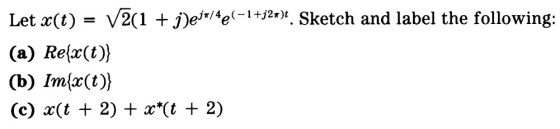
For this problem, I know that (1 + j) = sqrt(2)*e^(jpi/4)
But I am not sure where I should go from this to proceed with solving this problem
Homework Answers
*********** If x IS NOT AN INTEGER, prove that *Expression* Converges ********** I have to do...
 ***********
If x IS NOT AN INTEGER, prove that
*Expression*
Converges
**********
I have to do this without using operations with infinte sums, as
we dont know it is convergent. It also saids X IS NOT AN INTEGER,,
so I dont really know how to take taht into account or justify it
in the prove. I am not sure how to proceed so there is no doubt of
the proof.
1 Si x no es entero, probar que 1 1...
***********
If x IS NOT AN INTEGER, prove that
*Expression*
Converges
**********
I have to do this without using operations with infinte sums, as
we dont know it is convergent. It also saids X IS NOT AN INTEGER,,
so I dont really know how to take taht into account or justify it
in the prove. I am not sure how to proceed so there is no doubt of
the proof.
1 Si x no es entero, probar que 1 1...
Currently working a modern physics problem where the professor gave us the answer but I am...
Currently working a modern physics problem where the professor gave us the answer but I am having trouble with basic algebra. How do you solve for v given the equation where L = 4.2 light years, t' = 4 light years, c = speed of light, and sqrt{1- v^2/c^2} is the inverse gamma factor. v should = approx. 0.72c v = (L(sqrt{1- v^2/c^2})/t'
I know I need to apply the equation Q=mcdt but am not sure how to proceed?...
 I know I need to apply the equation Q=mcdt but am not sure how
to proceed? I can't tell what is happening in this situation.
A large power plant heats 1367 kg ot water per second to high-temperature steam to run its electrical generators. (a) How much heat transfer is needed each second to raise the water temperature from 65.0°C to 100°C, boi it, and then raise the resulting stefrom 100°C to 450°C Specific heat of water is 4184 J/(kg·°C),...
I know I need to apply the equation Q=mcdt but am not sure how
to proceed? I can't tell what is happening in this situation.
A large power plant heats 1367 kg ot water per second to high-temperature steam to run its electrical generators. (a) How much heat transfer is needed each second to raise the water temperature from 65.0°C to 100°C, boi it, and then raise the resulting stefrom 100°C to 450°C Specific heat of water is 4184 J/(kg·°C),...
I need some help solving for 't' time to discharge in part E. I don't know...
 I need some help solving for 't' time to discharge in part E. I
don't know if I am taking it down from the exponent correctly. I
think it's done by taking the log of both sides???
The energy U stored in the nerve cell capacitor as a result o this migration o uniposit ve ions into the cel is given by U= nerve cell. Calculate the energy U /2C0 where Q ls he charge due to he unipositive ons...
I need some help solving for 't' time to discharge in part E. I
don't know if I am taking it down from the exponent correctly. I
think it's done by taking the log of both sides???
The energy U stored in the nerve cell capacitor as a result o this migration o uniposit ve ions into the cel is given by U= nerve cell. Calculate the energy U /2C0 where Q ls he charge due to he unipositive ons...
Please Help. Where did I go wrong? Results for this submission Entered Answer Preview sqrt{{[4*sqrt{(x^2)+1}]/3)+75) 4.12...
 Please Help. Where did I go wrong?
Results for this submission Entered Answer Preview sqrt{{[4*sqrt{(x^2)+1}]/3)+75) 4.12 +1 +75 3 The answer above is NOT correct. (1 point) Solve the separable differential equation 4x – byvx2 +1 By/2 +1 = Subject to the initial condition: y(0) = 10. y= sqrt( (4* sqrt(x^2+1}}/3 + 75)
Please Help. Where did I go wrong?
Results for this submission Entered Answer Preview sqrt{{[4*sqrt{(x^2)+1}]/3)+75) 4.12 +1 +75 3 The answer above is NOT correct. (1 point) Solve the separable differential equation 4x – byvx2 +1 By/2 +1 = Subject to the initial condition: y(0) = 10. y= sqrt( (4* sqrt(x^2+1}}/3 + 75)
Determine the values of h and k for which the graph of y=he^kx passes through the points (1,4) and (4,32).
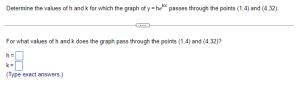 I am confused on how to go about solving this question. I tried plugging in the values of x and y into the equations but dont know what to do from there
Problem: Plot the egg holder function and find the global optimizer in Matlab Eggholder function: Y=...
 Problem:
Plot the egg holder function and find the global optimizer in
Matlab
Eggholder function:
Y= -(u2+47)*sin(sqrt(abs((u2)+(u1/2)+(47)))) -
(u1)*sin(sqrt(abs((u1)-(u2+47))))
where u equals x
Below is my code and the picture of the graph I got. I know for
a fact that it's wrong but don't know how to fix it.
<
x1=[-600:10:600];
x2=[-600:10:600];
[u1, u2] = meshgrid(x1, x2);
term1=-(u2+47)*sin(sqrt(abs((u2)+(u1/2)+(47))));
term2=-(u1)*sin(sqrt(abs((u1)-(u2+47))));
y=term1+term2;
figure
surf(u1,u2,y)
>
Please show all work and explain what you're doing so that I can
understand the process....
Problem:
Plot the egg holder function and find the global optimizer in
Matlab
Eggholder function:
Y= -(u2+47)*sin(sqrt(abs((u2)+(u1/2)+(47)))) -
(u1)*sin(sqrt(abs((u1)-(u2+47))))
where u equals x
Below is my code and the picture of the graph I got. I know for
a fact that it's wrong but don't know how to fix it.
<
x1=[-600:10:600];
x2=[-600:10:600];
[u1, u2] = meshgrid(x1, x2);
term1=-(u2+47)*sin(sqrt(abs((u2)+(u1/2)+(47))));
term2=-(u1)*sin(sqrt(abs((u1)-(u2+47))));
y=term1+term2;
figure
surf(u1,u2,y)
>
Please show all work and explain what you're doing so that I can
understand the process....
Find the equation of the line tangent to the r(t)=(t^2+t)*i+sqrt(t)*j when t=3
Find the equation of the line tangent to the r(t)=(t^2+t)*i+sqrt(t)*j when t=3
linear programming: where is i and m coming from in step5, from the second image?The algorithm...
 linear programming:
where is i and m coming from in step5, from the second
image?The algorithm is in the first image
i
am not looking for a solution, i am trying to figure out what the
variable i and m stand for
The Simplex Algorithm for Maximum Tableaus - (1) The current tableau is of the form (ind. var.'s) a 2,2 ... ain 2,1 2,2 azn --(dep. var.'s) c c ... d -f (2) If b.b2,...,b-20, go to (6). Otherwise,...
linear programming:
where is i and m coming from in step5, from the second
image?The algorithm is in the first image
i
am not looking for a solution, i am trying to figure out what the
variable i and m stand for
The Simplex Algorithm for Maximum Tableaus - (1) The current tableau is of the form (ind. var.'s) a 2,2 ... ain 2,1 2,2 azn --(dep. var.'s) c c ... d -f (2) If b.b2,...,b-20, go to (6). Otherwise,...
 ***********
If x IS NOT AN INTEGER, prove that
*Expression*
Converges
**********
I have to do this without using operations with infinte sums, as
we dont know it is convergent. It also saids X IS NOT AN INTEGER,,
so I dont really know how to take taht into account or justify it
in the prove. I am not sure how to proceed so there is no doubt of
the proof.
1 Si x no es entero, probar que 1 1...
***********
If x IS NOT AN INTEGER, prove that
*Expression*
Converges
**********
I have to do this without using operations with infinte sums, as
we dont know it is convergent. It also saids X IS NOT AN INTEGER,,
so I dont really know how to take taht into account or justify it
in the prove. I am not sure how to proceed so there is no doubt of
the proof.
1 Si x no es entero, probar que 1 1...
 I know I need to apply the equation Q=mcdt but am not sure how
to proceed? I can't tell what is happening in this situation.
A large power plant heats 1367 kg ot water per second to high-temperature steam to run its electrical generators. (a) How much heat transfer is needed each second to raise the water temperature from 65.0°C to 100°C, boi it, and then raise the resulting stefrom 100°C to 450°C Specific heat of water is 4184 J/(kg·°C),...
I know I need to apply the equation Q=mcdt but am not sure how
to proceed? I can't tell what is happening in this situation.
A large power plant heats 1367 kg ot water per second to high-temperature steam to run its electrical generators. (a) How much heat transfer is needed each second to raise the water temperature from 65.0°C to 100°C, boi it, and then raise the resulting stefrom 100°C to 450°C Specific heat of water is 4184 J/(kg·°C),...
 I need some help solving for 't' time to discharge in part E. I
don't know if I am taking it down from the exponent correctly. I
think it's done by taking the log of both sides???
The energy U stored in the nerve cell capacitor as a result o this migration o uniposit ve ions into the cel is given by U= nerve cell. Calculate the energy U /2C0 where Q ls he charge due to he unipositive ons...
I need some help solving for 't' time to discharge in part E. I
don't know if I am taking it down from the exponent correctly. I
think it's done by taking the log of both sides???
The energy U stored in the nerve cell capacitor as a result o this migration o uniposit ve ions into the cel is given by U= nerve cell. Calculate the energy U /2C0 where Q ls he charge due to he unipositive ons...
 Please Help. Where did I go wrong?
Results for this submission Entered Answer Preview sqrt{{[4*sqrt{(x^2)+1}]/3)+75) 4.12 +1 +75 3 The answer above is NOT correct. (1 point) Solve the separable differential equation 4x – byvx2 +1 By/2 +1 = Subject to the initial condition: y(0) = 10. y= sqrt( (4* sqrt(x^2+1}}/3 + 75)
Please Help. Where did I go wrong?
Results for this submission Entered Answer Preview sqrt{{[4*sqrt{(x^2)+1}]/3)+75) 4.12 +1 +75 3 The answer above is NOT correct. (1 point) Solve the separable differential equation 4x – byvx2 +1 By/2 +1 = Subject to the initial condition: y(0) = 10. y= sqrt( (4* sqrt(x^2+1}}/3 + 75)
 Problem:
Plot the egg holder function and find the global optimizer in
Matlab
Eggholder function:
Y= -(u2+47)*sin(sqrt(abs((u2)+(u1/2)+(47)))) -
(u1)*sin(sqrt(abs((u1)-(u2+47))))
where u equals x
Below is my code and the picture of the graph I got. I know for
a fact that it's wrong but don't know how to fix it.
<
x1=[-600:10:600];
x2=[-600:10:600];
[u1, u2] = meshgrid(x1, x2);
term1=-(u2+47)*sin(sqrt(abs((u2)+(u1/2)+(47))));
term2=-(u1)*sin(sqrt(abs((u1)-(u2+47))));
y=term1+term2;
figure
surf(u1,u2,y)
>
Please show all work and explain what you're doing so that I can
understand the process....
Problem:
Plot the egg holder function and find the global optimizer in
Matlab
Eggholder function:
Y= -(u2+47)*sin(sqrt(abs((u2)+(u1/2)+(47)))) -
(u1)*sin(sqrt(abs((u1)-(u2+47))))
where u equals x
Below is my code and the picture of the graph I got. I know for
a fact that it's wrong but don't know how to fix it.
<
x1=[-600:10:600];
x2=[-600:10:600];
[u1, u2] = meshgrid(x1, x2);
term1=-(u2+47)*sin(sqrt(abs((u2)+(u1/2)+(47))));
term2=-(u1)*sin(sqrt(abs((u1)-(u2+47))));
y=term1+term2;
figure
surf(u1,u2,y)
>
Please show all work and explain what you're doing so that I can
understand the process....
 linear programming:
where is i and m coming from in step5, from the second
image?The algorithm is in the first image
i
am not looking for a solution, i am trying to figure out what the
variable i and m stand for
The Simplex Algorithm for Maximum Tableaus - (1) The current tableau is of the form (ind. var.'s) a 2,2 ... ain 2,1 2,2 azn --(dep. var.'s) c c ... d -f (2) If b.b2,...,b-20, go to (6). Otherwise,...
linear programming:
where is i and m coming from in step5, from the second
image?The algorithm is in the first image
i
am not looking for a solution, i am trying to figure out what the
variable i and m stand for
The Simplex Algorithm for Maximum Tableaus - (1) The current tableau is of the form (ind. var.'s) a 2,2 ... ain 2,1 2,2 azn --(dep. var.'s) c c ... d -f (2) If b.b2,...,b-20, go to (6). Otherwise,...
Most questions answered within 3 hours.
-
Where is the error in this code sequence?
String s1 = "Hello";
String s2 = "ello";...
asked 10 months ago -
Financial data for Joel de Paris, Inc., for last year
follow:
Joel de Paris, Inc.
Balance...
asked 10 months ago -
Consider this reaction:
Al2(SO4)3 (aq)+ BaCl3
(aq) Al2Cl6 (aq)- +
3BaSO4(s) . What is the...
asked 10 months ago -
Suppose that Savneet is considering increasing her
recent random sample from 20 car rentals to 40...
asked 10 months ago -
Trucks arrive at an unloading terminal at an average rate of 120
per hour.
Trucks arrive...
asked 10 months ago -
Why are methanol and ethanol completely soluble in water while
octanol is not very little soluble....
asked 10 months ago -
A facilities manager at a university reads in a research report
that the mean amount of...
asked 10 months ago -
When the CuSO4 is rehydrated by adding water to the anhydrous
compound, is this an endothermic...
asked 10 months ago -
A ray of sunlight is passing from diamond into crown glass; the
angle of incidence is...
asked 10 months ago -
A block of mass 0.249 kg is placed on top of a light, vertical
spring of...
asked 10 months ago -
how do the kidneys compensate in the presences of acidosis
a) trigger hyperventilate
b) reserve acid...
asked 10 months ago -
Question 501 pts
The rental rate of capital to the firm increases. Which of the
following...
asked 10 months ago