Let a satellite orbits a planet of mass M at circular orbit of radius R. Find...
- Let a satellite orbits a planet of mass M at circular orbit of
radius R.
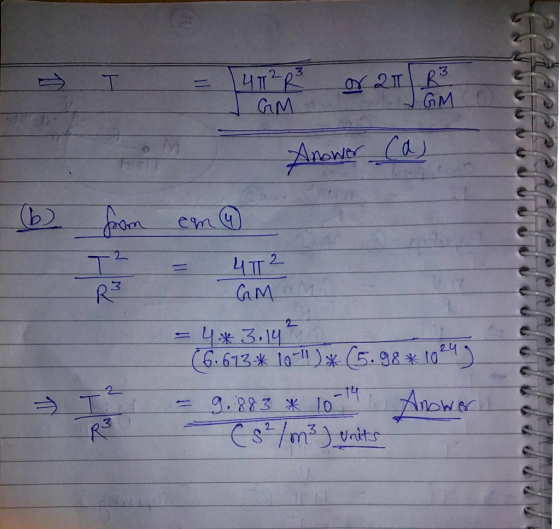
- Find the orbital period T. Express your answer in terms of G, M, R, and π
- If the mass of the planet is 5.98 x 1024 kg, calculate the ratio of T2 to R3.
Homework Answers
THIS QUESTION IS BASED ON CONCEPT OF
1. GRAVITATIONAL FORCE
2. CENTRIPETAL FORCE
3. ORBITAL VELOCITY
4. TIME PERIOD
5. MATHEMATICAL SIMPLIFICATION
THE DETAILED SOLUTION IS DESCRIBED BELOW

THANKS
Add Answer to:
Let a satellite orbits a planet of mass M at circular orbit of
radius R.
Find...
A satellite is orbiting around a planet in a circular orbit. The radius of the orbit,...
A satellite is orbiting around a planet in a circular orbit. The radius of the orbit, measured from the center of the planet is R = 1.7 × 10⁷ m. The mass of the planet is M = 10 × 1024 kg. A) Express the magnitude of the gravitational force F in terms of M, R, the gravitational constant G, and the mass m of the satellite. B) Express the magnitude of the centripetal acceleration ac of the satellite in terms...
A satellite of mass m is in a circular orbit of radius r about a planet...
 A satellite of mass m is in a circular orbit of radius r about a planet of mass M. The period of the satellite's orbit is T. A second satellite of mass 2m is in a circular orbit of radius 2r around the same planet. The period of orbit for the second satellite is 2T 8T O2T OT O 4T
A small satellite of mass m is in circular orbit of radius r around a planet of mass M and radius...
A small satellite of mass m is in circular orbit of radius r around a planet of mass M and radius R, where M>>m. a) For full marks, derive the potential, kinetic, and total energy of the satellite in terms of G, M, m, and r assuming that the potential energy is zero at r=infinity. b) What is the minimum amount of energy that the booster rockets must provide for the satellite to escape? c) Now we take into accouny...
The planet shown has a mass of M, and the satellite is in a circular orbit...
The planet shown has a mass of M, and the satellite is in a circular orbit of radius r. a) In terms of M, r, and the universal gravitational constant G, what is the period Tof the satellite? Derive the formula. b) By what factor would the period change if the mass of the planet doubled? c) By what factor would the period change if the radius of the orbit doubled?
5) A satellite in a circular orbit of radius R around planet X has an orbital...
5) A satellite in a circular orbit of radius R around planet X has an orbital period T. If Planet X had one-fourth as much mass, the orbital period of this satellite in an orbit of the same radius would be: A) 2T B) T square root(2) C) T/4 D) T/2 E) 4
A satellite of mass m is in a circular orbit of radius R2 around a spherical planet of radius R1 made of a material with density ρ. ( R2 is measured from the center of the planet, not its surface.) Use G for the universal gravitational constant.
 A satellite of mass m is in a circular orbit of radius R2 around a spherical planet of radius R1 made of a material with density ρ. ( R2 is measured from the center of the planet, not its surface.) Use G for the universal gravitational constant.A) Find the kinetic energy of this satellite, KExpress the satellite's kinetic energy in terms of G, m, π, R1, R2, and ρ.B) Find U, the gravitational potential energy of the satellite. Take the gravitational potential...
A satellite is in a circular orbit around the Earth at an altitude of 2.52 106...
A satellite is in a circular orbit around the Earth at an altitude of 2.52 106 m. (a) Find the period of the orbit. (Hint: Modify Kepler's third law: T2 =(4π^2/GMs)r^3 so it is suitable for objects orbiting the Earth rather than the Sun. The radius of the Earth is 6.38 106 m, and the mass of the Earth is 5.98 1024 kg.) _______________h (b) Find the speed of the satellite. _________km/s (c) Find the acceleration of the satellite....
10. Two satellites are in circular orbits around a planet that has radius 9.00 × 10⁶...
 10. Two satellites are in circular orbits around a planet that has radius 9.00 × 10⁶ m. One satellite has mass 68.0 kg, orbital radius 5.00 × 10⁷ m, and orbital speed 4800 m/s. The second satellite has mass 84.0 kg and orbital radius 3.00 × 10⁷ m. what is the orbital spced of this second satel!lite? 1 International Space Station. The International Space Station makes 15.65 revolutions per day in its orbit around the earth. Assuming a circular orbit,...
Problem 3 The planet shown has a mass of M, and the satellite is in a...
 Problem 3 The planet shown has a mass of M, and the satellite is in a circular orbit of radius r a) In terms of M, r, and the universal gravitational constant G, what is the period T of the satellite? Derive the formula b) By what factor would the period change if the mass of the planet doubled? c) By what factor would the period change if the radius of the orbit doubled?
A 4.6 × 10²¹ kg moon orbits a distant planet in a circular orbit of radius...
A 4.6 × 10²¹ kg moon orbits a distant planet in a circular orbit of radius 1.5 × 10⁸ m. It experiences a 1.1 × 10¹⁹ N gravitational pull from the planet. What is the moon's orbital period in earth days?
 A satellite of mass m is in a circular orbit of radius r about a planet of mass M. The period of the satellite's orbit is T. A second satellite of mass 2m is in a circular orbit of radius 2r around the same planet. The period of orbit for the second satellite is 2T 8T O2T OT O 4T
 10. Two satellites are in circular orbits around a planet that has radius 9.00 × 10⁶ m. One satellite has mass 68.0 kg, orbital radius 5.00 × 10⁷ m, and orbital speed 4800 m/s. The second satellite has mass 84.0 kg and orbital radius 3.00 × 10⁷ m. what is the orbital spced of this second satel!lite? 1 International Space Station. The International Space Station makes 15.65 revolutions per day in its orbit around the earth. Assuming a circular orbit,...
 Problem 3 The planet shown has a mass of M, and the satellite is in a circular orbit of radius r a) In terms of M, r, and the universal gravitational constant G, what is the period T of the satellite? Derive the formula b) By what factor would the period change if the mass of the planet doubled? c) By what factor would the period change if the radius of the orbit doubled?
Most questions answered within 3 hours.
-
Where is the error in this code sequence?
String s1 = "Hello";
String s2 = "ello";...
asked 11 months ago -
Financial data for Joel de Paris, Inc., for last year
follow:
Joel de Paris, Inc.
Balance...
asked 11 months ago -
Consider this reaction:
Al2(SO4)3 (aq)+ BaCl3
(aq) Al2Cl6 (aq)- +
3BaSO4(s) . What is the...
asked 11 months ago -
Suppose that Savneet is considering increasing her
recent random sample from 20 car rentals to 40...
asked 11 months ago -
Trucks arrive at an unloading terminal at an average rate of 120
per hour.
Trucks arrive...
asked 11 months ago -
Why are methanol and ethanol completely soluble in water while
octanol is not very little soluble....
asked 11 months ago -
A facilities manager at a university reads in a research report
that the mean amount of...
asked 11 months ago -
When the CuSO4 is rehydrated by adding water to the anhydrous
compound, is this an endothermic...
asked 11 months ago -
A ray of sunlight is passing from diamond into crown glass; the
angle of incidence is...
asked 11 months ago -
A block of mass 0.249 kg is placed on top of a light, vertical
spring of...
asked 11 months ago -
how do the kidneys compensate in the presences of acidosis
a) trigger hyperventilate
b) reserve acid...
asked 11 months ago -
Question 501 pts
The rental rate of capital to the firm increases. Which of the
following...
asked 11 months ago