1.Pentane (C5H12) has a surface tension of 1.61 x 10 ^ -2, while ethanol (C2H5OH) has...
1.Pentane (C5H12) has a surface tension of 1.61 x 10 ^ -2, while ethanol (C2H5OH) has a surface tension of 2.23 x 10 ^ -2, which would have the highest viscosity?
A) pentane
B) ethanol
C) both have the same viscosity
D) cannot be determined with the information provided
2.Which of the following is true for surface tension?
l is a measure of the surface area exposed by the liquid
ll increases with increasing intermolecular attraction forces
lll decreases with increasing intermolecular attractions
A) ll and lll
B) l and lll
C) l and ll
D) l, ll and lll
3.The pressure exerted by the vapor on the surface of its liquid increases when the temperature _________ and the intermolecular forces _______.
A) increase / increase
B) increase / decrease
C) decrease / increase
D) decrease / decrease
4.In which of the following the vapor pressure in equilibrium with its liquid is higher
A) C2H5OH at 25C
B) C2H5OH at 50C
C) C2H6 at 25C
D) C2H6 at 50C
Homework Answers
1.Pentane (C5H12) has a surface tension of 1.61 x 10 ^ -2, while ethanol (C2H5OH) has a surface tension of 2.23 x 10 ^ -2, which would have the highest viscosity?
B) ethanol
2.Which of the following is true for surface tension?
C) l and ll
3.The pressure exerted by the vapor on the surface of its liquid increases when the temperature _________ and the intermolecular forces _______.
B) increase / decrease
4.In which of the following the vapor pressure in equilibrium with its liquid is higher
D) C2H6 at 50C
Add Answer to:
1.Pentane (C5H12) has a
surface tension of 1.61 x 10 ^ -2, while ethanol (C2H5OH) has...
1.Which of the following indicates the boiling order for l CH3OH ll CH3Cl lll CH4 A)...
1.Which of the following indicates the boiling order for l CH3OH ll CH3Cl lll CH4 A) l< ll < lll B) l< lll < ll C) ll< l < lll D) lll < ll < l 2.A sample of ethanol in an open container boils when A) Vapor pressure is exactly an atmosphere B) vapor pressure equals atmospheric pressure C) the temperature is higher than the ambient temperature D) the vapor pressure is lower than the atmospheric pressure 3.A crystalline...
figure 1 Figure 2 Liquid ethanol mm P increasing P = equilibrium vapor pressure P=0 Add...
 figure 1
Figure 2
Liquid ethanol mm P increasing P = equilibrium vapor pressure P=0 Add System comes to equilibrium ethanol Evacuated flask, pressure zero Molecules begin to vaporize, pressure increases Molecules leave and enter liquid at equal rates, pressure reaches steady-state value 34.6 °C 78.3°C 100 °C Normal boiling point Diethyl ether Vapor pressure (torr) Ethyl alcohol (ethanol) Water Ethylene glycol 100 20 40 60 80 Temperature (°C) Copyright 2009 Pearson Prentice Hall,Inc. Click on: (Figure 2) and study...
figure 1
Figure 2
Liquid ethanol mm P increasing P = equilibrium vapor pressure P=0 Add System comes to equilibrium ethanol Evacuated flask, pressure zero Molecules begin to vaporize, pressure increases Molecules leave and enter liquid at equal rates, pressure reaches steady-state value 34.6 °C 78.3°C 100 °C Normal boiling point Diethyl ether Vapor pressure (torr) Ethyl alcohol (ethanol) Water Ethylene glycol 100 20 40 60 80 Temperature (°C) Copyright 2009 Pearson Prentice Hall,Inc. Click on: (Figure 2) and study...
What happens to these physical properties as the strength of intermolecular forces increases
What happens to these physical properties as the strength of intermolecular forces increases?My answers are there as well but its not correctIncrease or decrease?a) melting point - increasesb) vapor pressure-increasesc) boiling point- increasesd) viscosity - decreasese) surface tension - decreases
Which of the following changes would increase the vapor pressure of a liquid? i. An...
Which of the following changes would increase the vapor pressure of a liquid? i. An increase in temperature ii. An increase in the intermolecular forces in the liquid iii. An increase in the size of the open vessel containing the liquid a) i and ii only b) i and iii only c) i only d) ii only e) iii only If the rate of evaporation from the surface of a liquid exceeds...
27. Circle the one that has the indicated physical property. [5 x 1 pts] (a) lower...
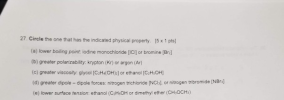 27. Circle the one that has the indicated physical property. [5 x 1 pts] (a) lower boiling point: iodine monochloride (ICIJ or bromine (Bra] (b) greater polarizability, krypton (Kr) or argon (Ar) (c) greater viscosity: glycol (C2H4OH)2] or ethanol [C2H5OH] (d) greater dipole - dipole forces: nitrogen trichloride (NCIS), or nitrogen tribromide (NBr3] (e) lower surface tension ethanol (C2H5OH or dimethyl ether (CH,OCH)
I need the best solution for these 2 questions on the section " Check your learning"...
 I need the best solution for these 2 questions on the
section " Check your learning" (10.4 and 10.5) to prepare my exam in class.
Thank you so much for helping me
Y althlon tai sok Translate Gm arch this book O Back Figure 10.20 Depending upon the relative strengths of adhesive and cohesive forces, a liquid may rise (such as water) or fall (such as mercury) in a glass capillary tube. The extent of the rise (or falt is...
I need the best solution for these 2 questions on the
section " Check your learning" (10.4 and 10.5) to prepare my exam in class.
Thank you so much for helping me
Y althlon tai sok Translate Gm arch this book O Back Figure 10.20 Depending upon the relative strengths of adhesive and cohesive forces, a liquid may rise (such as water) or fall (such as mercury) in a glass capillary tube. The extent of the rise (or falt is...
*Explanations should be brief. Draw a box around each final answer, if applicable.* 1. Consider intermolecular...
 *Explanations should be brief. Draw a box around each final answer, if applicable.* 1. Consider intermolecular forces and kinetic energies with respect to a solid and a liquid. Explain why molecules in a liquid are free to move past each other, while molecules in a solid are held in fixed positions. 2. Use your knowledge of intermolecular forces to provide an explanation for why the boiling point of 2-hexanol is higher than the boiling point of 2,3-dimethyl-2-butanol. Be sure to...
Fluid 7-The surface tension is phenomenon due to (a) Cohesion (b) Viscous force (c) Adhesion between...
 Fluid
7-The surface tension is phenomenon due to (a) Cohesion (b) Viscous force (c) Adhesion between liquid and solid molecules (d) Difference between the forces of adhesion and cohesion 8-The discharge 100 ft/min is equal to (a) 41.23 LUs (b) 45.23 L/s (c) 47.23 Ls (d) 49.23 L/s 9-Specific gravity is the relation between (a) the density of the fluid of specific material to the density of water at 4 °C (b) the density of the fluid of specific material...
Fluid
7-The surface tension is phenomenon due to (a) Cohesion (b) Viscous force (c) Adhesion between liquid and solid molecules (d) Difference between the forces of adhesion and cohesion 8-The discharge 100 ft/min is equal to (a) 41.23 LUs (b) 45.23 L/s (c) 47.23 Ls (d) 49.23 L/s 9-Specific gravity is the relation between (a) the density of the fluid of specific material to the density of water at 4 °C (b) the density of the fluid of specific material...
[Viscosity Questions] about chemistry: (multiple choice about viscosity) Please help. Thanks!! Explain each one thanks! 1....
[Viscosity Questions] about chemistry: (multiple choice about viscosity) Please help. Thanks!! Explain each one thanks! 1. A fluid is considered "Newtonian" if: a) it experience laminar flow b) η is independent of the velocity gradient c) η is a constant d) the shearing force is exerted in the direction of the flow e) all of the above 2. The viscosity η is a function of: a) temperature b) Pressure c) composition d) volume e) a, b, and c are correct...
18) What is the strongest intermolecular force is the strongest intermolecular force in a liquid containing...
 18) What is the strongest intermolecular force is the strongest intermolecular force in a liquid containing molecules with H-O bonds? A) covalent bonds B) dipole forces C) dispersion forces D) hydrogen bonds E) none of the above Section: 11.2 The Intermolecular Bond Concept 19) Consider the following liquids with similar molar masses. Predict which has the strongest intermolecular attraction based only on boiling point data. A) butyl alcohol (Bp @ 760 mm Hg = 117 °C) B) ethyl ether (Bp...
 figure 1
Figure 2
Liquid ethanol mm P increasing P = equilibrium vapor pressure P=0 Add System comes to equilibrium ethanol Evacuated flask, pressure zero Molecules begin to vaporize, pressure increases Molecules leave and enter liquid at equal rates, pressure reaches steady-state value 34.6 °C 78.3°C 100 °C Normal boiling point Diethyl ether Vapor pressure (torr) Ethyl alcohol (ethanol) Water Ethylene glycol 100 20 40 60 80 Temperature (°C) Copyright 2009 Pearson Prentice Hall,Inc. Click on: (Figure 2) and study...
figure 1
Figure 2
Liquid ethanol mm P increasing P = equilibrium vapor pressure P=0 Add System comes to equilibrium ethanol Evacuated flask, pressure zero Molecules begin to vaporize, pressure increases Molecules leave and enter liquid at equal rates, pressure reaches steady-state value 34.6 °C 78.3°C 100 °C Normal boiling point Diethyl ether Vapor pressure (torr) Ethyl alcohol (ethanol) Water Ethylene glycol 100 20 40 60 80 Temperature (°C) Copyright 2009 Pearson Prentice Hall,Inc. Click on: (Figure 2) and study...
 27. Circle the one that has the indicated physical property. [5 x 1 pts] (a) lower boiling point: iodine monochloride (ICIJ or bromine (Bra] (b) greater polarizability, krypton (Kr) or argon (Ar) (c) greater viscosity: glycol (C2H4OH)2] or ethanol [C2H5OH] (d) greater dipole - dipole forces: nitrogen trichloride (NCIS), or nitrogen tribromide (NBr3] (e) lower surface tension ethanol (C2H5OH or dimethyl ether (CH,OCH)
 I need the best solution for these 2 questions on the
section " Check your learning" (10.4 and 10.5) to prepare my exam in class.
Thank you so much for helping me
Y althlon tai sok Translate Gm arch this book O Back Figure 10.20 Depending upon the relative strengths of adhesive and cohesive forces, a liquid may rise (such as water) or fall (such as mercury) in a glass capillary tube. The extent of the rise (or falt is...
I need the best solution for these 2 questions on the
section " Check your learning" (10.4 and 10.5) to prepare my exam in class.
Thank you so much for helping me
Y althlon tai sok Translate Gm arch this book O Back Figure 10.20 Depending upon the relative strengths of adhesive and cohesive forces, a liquid may rise (such as water) or fall (such as mercury) in a glass capillary tube. The extent of the rise (or falt is...
 *Explanations should be brief. Draw a box around each final answer, if applicable.* 1. Consider intermolecular forces and kinetic energies with respect to a solid and a liquid. Explain why molecules in a liquid are free to move past each other, while molecules in a solid are held in fixed positions. 2. Use your knowledge of intermolecular forces to provide an explanation for why the boiling point of 2-hexanol is higher than the boiling point of 2,3-dimethyl-2-butanol. Be sure to...
 Fluid
7-The surface tension is phenomenon due to (a) Cohesion (b) Viscous force (c) Adhesion between liquid and solid molecules (d) Difference between the forces of adhesion and cohesion 8-The discharge 100 ft/min is equal to (a) 41.23 LUs (b) 45.23 L/s (c) 47.23 Ls (d) 49.23 L/s 9-Specific gravity is the relation between (a) the density of the fluid of specific material to the density of water at 4 °C (b) the density of the fluid of specific material...
Fluid
7-The surface tension is phenomenon due to (a) Cohesion (b) Viscous force (c) Adhesion between liquid and solid molecules (d) Difference between the forces of adhesion and cohesion 8-The discharge 100 ft/min is equal to (a) 41.23 LUs (b) 45.23 L/s (c) 47.23 Ls (d) 49.23 L/s 9-Specific gravity is the relation between (a) the density of the fluid of specific material to the density of water at 4 °C (b) the density of the fluid of specific material...
 18) What is the strongest intermolecular force is the strongest intermolecular force in a liquid containing molecules with H-O bonds? A) covalent bonds B) dipole forces C) dispersion forces D) hydrogen bonds E) none of the above Section: 11.2 The Intermolecular Bond Concept 19) Consider the following liquids with similar molar masses. Predict which has the strongest intermolecular attraction based only on boiling point data. A) butyl alcohol (Bp @ 760 mm Hg = 117 °C) B) ethyl ether (Bp...
Most questions answered within 3 hours.
-
Where is the error in this code sequence?
String s1 = "Hello";
String s2 = "ello";...
asked 11 months ago -
Financial data for Joel de Paris, Inc., for last year
follow:
Joel de Paris, Inc.
Balance...
asked 11 months ago -
Consider this reaction:
Al2(SO4)3 (aq)+ BaCl3
(aq) Al2Cl6 (aq)- +
3BaSO4(s) . What is the...
asked 11 months ago -
Suppose that Savneet is considering increasing her
recent random sample from 20 car rentals to 40...
asked 11 months ago -
Trucks arrive at an unloading terminal at an average rate of 120
per hour.
Trucks arrive...
asked 11 months ago -
Why are methanol and ethanol completely soluble in water while
octanol is not very little soluble....
asked 11 months ago -
A facilities manager at a university reads in a research report
that the mean amount of...
asked 11 months ago -
When the CuSO4 is rehydrated by adding water to the anhydrous
compound, is this an endothermic...
asked 11 months ago -
A ray of sunlight is passing from diamond into crown glass; the
angle of incidence is...
asked 11 months ago -
A block of mass 0.249 kg is placed on top of a light, vertical
spring of...
asked 11 months ago -
how do the kidneys compensate in the presences of acidosis
a) trigger hyperventilate
b) reserve acid...
asked 11 months ago -
Question 501 pts
The rental rate of capital to the firm increases. Which of the
following...
asked 11 months ago