Identify the first-row transition metal M that satisfies the requirements given (more than one answer may...
Homework Answers
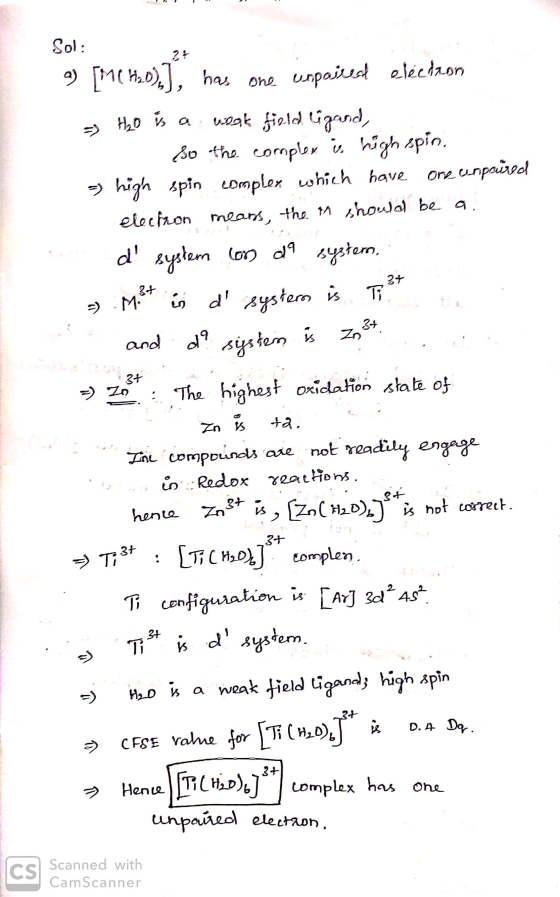
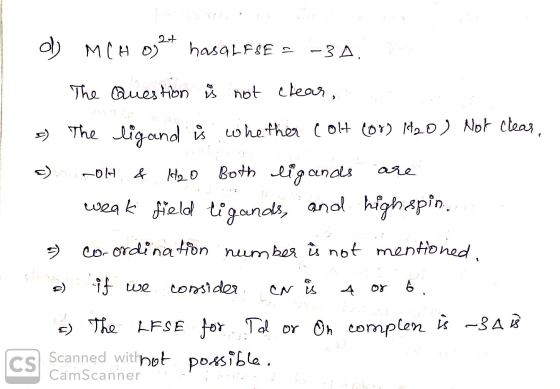
Identify the first-row transition metal M that satisfies the requirements given (more than one answer may be possible, for full credit you must identify all acceptable metals):
a) [M(H2O)6]3+, has one unpaired electron
b) MBr ]-, has a maximum number of unpaired electron 4

c) M(CN)6]3-, diamagnetic

d)M(H O) ]2+,hasaLFSE=-3Δ
Add Answer to:
Identify the first-row transition metal M that satisfies the
requirements given (more than one answer may...
Identify the first-row transition metal M that satisfies the requirements given (more than one answer may...
Identify the first-row transition metal M that satisfies the requirements given (more than one answer may be possible, for full credit you must identify all acceptable metals): )M(H O) ]2+,hasaLFSE=−3/5 delta oct
inorganic chemistry 3) Identify the first-row transition metal M that satisfies the requirements: a. [MCla] with...
 inorganic chemistry
3) Identify the first-row transition metal M that satisfies the requirements: a. [MCla] with four unpaired electrons b. [M(OH2)6]3 having one unpaired electron c. [MBra] having the most unpaired electrons d. Diamagnetic [M(CN)6]3- e. K3[M(CN)6] having 3 unpaired electrons
inorganic chemistry
3) Identify the first-row transition metal M that satisfies the requirements: a. [MCla] with four unpaired electrons b. [M(OH2)6]3 having one unpaired electron c. [MBra] having the most unpaired electrons d. Diamagnetic [M(CN)6]3- e. K3[M(CN)6] having 3 unpaired electrons
inorganic chemistry 3) Identify the first-row transition metal M that satisfies the requirements: a. [MC14] with...
 inorganic chemistry
3) Identify the first-row transition metal M that satisfies the requirements: a. [MC14] with four unpaired electrons b. [M(OH2)6]3+ having one unpaired electron C. (MBr4] having the most unpaired electrons d. Diamagnetic (M(CN)6]3- e. K3[M(CN)6] having 3 unpaired electrons . . C 12.
inorganic chemistry
3) Identify the first-row transition metal M that satisfies the requirements: a. [MC14] with four unpaired electrons b. [M(OH2)6]3+ having one unpaired electron C. (MBr4] having the most unpaired electrons d. Diamagnetic (M(CN)6]3- e. K3[M(CN)6] having 3 unpaired electrons . . C 12.
nan tne 3a orbitais 2) Identify the most likely transition metal M. There may seem to...
 nan tne 3a orbitais 2) Identify the most likely transition metal M. There may seem to be more than one possible answer to some questions. One is more correct than the other, use your best judgement. Ks[M(CN)ol, in which M is a first row transition metal with 3 unpaired electrons b. [M(H20)s]3, in which M is a second row transition metal with LFSE -2.4 A c. [MCle, in which M is a first row transition metal with 5 unpaired electrons...
1.) Identify the most likely transition metal, M and provide a suitable explanation: a.) A complex...
 1.) Identify the most likely transition metal, M and provide a
suitable explanation:
a.) A complex ion with the formula
[M(H2O)6]3+, where M is a second
row transition metal, that has a LFSE (CFSE) of -2.4
(ignoring pairing and exchange energies). Hint: only the low
spin configuration is observed in second row transition metals.
b.) A tetrahedral complex ion with the formula
[MCl4]-, where M is a first row transtion
metal, that has five unpaired electrons.
1.) Identify the most likely transition metal, M and provide a
suitable explanation:
a.) A complex ion with the formula
[M(H2O)6]3+, where M is a second
row transition metal, that has a LFSE (CFSE) of -2.4
(ignoring pairing and exchange energies). Hint: only the low
spin configuration is observed in second row transition metals.
b.) A tetrahedral complex ion with the formula
[MCl4]-, where M is a first row transtion
metal, that has five unpaired electrons.
ANSWER ALL QUESTIONS PLEASE 1. What are the characteristic electron configurations of transition metals? 2. What is...
ANSWER ALL QUESTIONS PLEASE 1. What are the characteristic electron configurations of transition metals? 2. What is the general trend in atomic size across a transition metal series? 3. Which electrons, 3d or 4s, have the lowest ionization energies in a transition metal? 4. What is the general trend of the reducing strength across a transition metal series? 5. Why do transition metals have similar chemical properties? 6. Name four transition metals that are essential to the biological system. 1. Write the...
The hexaaqua complex of a 3d transition metal, [M(H2O)6]SO4, has an effective magnetic moment corresponding to...
The hexaaqua complex of a 3d transition metal, [M(H2O)6]SO4, has an effective magnetic moment corresponding to 5 unpaired electrons. Reaction of this hexaaqua complex with excess KCN gave K4[M(CN)6] which has an effective magnetic moment of 1 unpaired electrons. Deduce the identity of the metal, M, and explain your reasoning.
inorganic chemistry 2) A first-row transition metal complex of the formula (M(OH2)6]2+ has a magnetic moment...
 inorganic chemistry
2) A first-row transition metal complex of the formula (M(OH2)6]2+ has a magnetic moment of 3.9 MR. Determine the most likely number of unpaired electrons and the identity of the metal(s).
inorganic chemistry
2) A first-row transition metal complex of the formula (M(OH2)6]2+ has a magnetic moment of 3.9 MR. Determine the most likely number of unpaired electrons and the identity of the metal(s).
Identify the first-row transition metal (M) that follows the 18-electron rule for each of the fol...
 Identify the first-row transition metal (M) that follows the 18-electron rule for each of the following compounds (show how you arrived at your answer): (a) [M(CO)2(PPh3)2] (c) [M(n5-CsHs)(CO)3]2 (assume single M-M bond) (b) [M(nt-C4H4)(CO)3]
Identify the first-row transition metal (M) that follows the 18-electron rule for each of the following compounds (show how you arrived at your answer): (a) [M(CO)2(PPh3)2] (c) [M(n5-CsHs)(CO)3]2 (assume single M-M bond) (b) [M(nt-C4H4)(CO)3]
Identify the first-row transition metal (M) that follows the 18-electron rule for each of the following compounds (show how you arrived at your answer): (a) [M(CO)2(PPh3)2] (c) [M(n5-CsHs)(CO)3]2 (assume single M-M bond) (b) [M(nt-C4H4)(CO)3]
inorganic chemistry 2) A first-row transition metal complex of the formula (M(OH2)612+ has a magnetic moment...
 inorganic chemistry
2) A first-row transition metal complex of the formula (M(OH2)612+ has a magnetic moment of 3.9 MB. Determine the most likely number of unpaired electrons and the identity of the metal(s).
inorganic chemistry
2) A first-row transition metal complex of the formula (M(OH2)612+ has a magnetic moment of 3.9 MB. Determine the most likely number of unpaired electrons and the identity of the metal(s).
 inorganic chemistry
3) Identify the first-row transition metal M that satisfies the requirements: a. [MCla] with four unpaired electrons b. [M(OH2)6]3 having one unpaired electron c. [MBra] having the most unpaired electrons d. Diamagnetic [M(CN)6]3- e. K3[M(CN)6] having 3 unpaired electrons
inorganic chemistry
3) Identify the first-row transition metal M that satisfies the requirements: a. [MCla] with four unpaired electrons b. [M(OH2)6]3 having one unpaired electron c. [MBra] having the most unpaired electrons d. Diamagnetic [M(CN)6]3- e. K3[M(CN)6] having 3 unpaired electrons
 inorganic chemistry
3) Identify the first-row transition metal M that satisfies the requirements: a. [MC14] with four unpaired electrons b. [M(OH2)6]3+ having one unpaired electron C. (MBr4] having the most unpaired electrons d. Diamagnetic (M(CN)6]3- e. K3[M(CN)6] having 3 unpaired electrons . . C 12.
inorganic chemistry
3) Identify the first-row transition metal M that satisfies the requirements: a. [MC14] with four unpaired electrons b. [M(OH2)6]3+ having one unpaired electron C. (MBr4] having the most unpaired electrons d. Diamagnetic (M(CN)6]3- e. K3[M(CN)6] having 3 unpaired electrons . . C 12.
 nan tne 3a orbitais 2) Identify the most likely transition metal M. There may seem to be more than one possible answer to some questions. One is more correct than the other, use your best judgement. Ks[M(CN)ol, in which M is a first row transition metal with 3 unpaired electrons b. [M(H20)s]3, in which M is a second row transition metal with LFSE -2.4 A c. [MCle, in which M is a first row transition metal with 5 unpaired electrons...
 1.) Identify the most likely transition metal, M and provide a
suitable explanation:
a.) A complex ion with the formula
[M(H2O)6]3+, where M is a second
row transition metal, that has a LFSE (CFSE) of -2.4
(ignoring pairing and exchange energies). Hint: only the low
spin configuration is observed in second row transition metals.
b.) A tetrahedral complex ion with the formula
[MCl4]-, where M is a first row transtion
metal, that has five unpaired electrons.
1.) Identify the most likely transition metal, M and provide a
suitable explanation:
a.) A complex ion with the formula
[M(H2O)6]3+, where M is a second
row transition metal, that has a LFSE (CFSE) of -2.4
(ignoring pairing and exchange energies). Hint: only the low
spin configuration is observed in second row transition metals.
b.) A tetrahedral complex ion with the formula
[MCl4]-, where M is a first row transtion
metal, that has five unpaired electrons.
 inorganic chemistry
2) A first-row transition metal complex of the formula (M(OH2)6]2+ has a magnetic moment of 3.9 MR. Determine the most likely number of unpaired electrons and the identity of the metal(s).
inorganic chemistry
2) A first-row transition metal complex of the formula (M(OH2)6]2+ has a magnetic moment of 3.9 MR. Determine the most likely number of unpaired electrons and the identity of the metal(s).
 Identify the first-row transition metal (M) that follows the 18-electron rule for each of the following compounds (show how you arrived at your answer): (a) [M(CO)2(PPh3)2] (c) [M(n5-CsHs)(CO)3]2 (assume single M-M bond) (b) [M(nt-C4H4)(CO)3]
Identify the first-row transition metal (M) that follows the 18-electron rule for each of the following compounds (show how you arrived at your answer): (a) [M(CO)2(PPh3)2] (c) [M(n5-CsHs)(CO)3]2 (assume single M-M bond) (b) [M(nt-C4H4)(CO)3]
Identify the first-row transition metal (M) that follows the 18-electron rule for each of the following compounds (show how you arrived at your answer): (a) [M(CO)2(PPh3)2] (c) [M(n5-CsHs)(CO)3]2 (assume single M-M bond) (b) [M(nt-C4H4)(CO)3]
 inorganic chemistry
2) A first-row transition metal complex of the formula (M(OH2)612+ has a magnetic moment of 3.9 MB. Determine the most likely number of unpaired electrons and the identity of the metal(s).
inorganic chemistry
2) A first-row transition metal complex of the formula (M(OH2)612+ has a magnetic moment of 3.9 MB. Determine the most likely number of unpaired electrons and the identity of the metal(s).
Most questions answered within 3 hours.
-
Where is the error in this code sequence?
String s1 = "Hello";
String s2 = "ello";...
asked 10 months ago -
Financial data for Joel de Paris, Inc., for last year
follow:
Joel de Paris, Inc.
Balance...
asked 10 months ago -
Consider this reaction:
Al2(SO4)3 (aq)+ BaCl3
(aq) Al2Cl6 (aq)- +
3BaSO4(s) . What is the...
asked 10 months ago -
Suppose that Savneet is considering increasing her
recent random sample from 20 car rentals to 40...
asked 10 months ago -
Trucks arrive at an unloading terminal at an average rate of 120
per hour.
Trucks arrive...
asked 10 months ago -
Why are methanol and ethanol completely soluble in water while
octanol is not very little soluble....
asked 10 months ago -
A facilities manager at a university reads in a research report
that the mean amount of...
asked 10 months ago -
When the CuSO4 is rehydrated by adding water to the anhydrous
compound, is this an endothermic...
asked 10 months ago -
A ray of sunlight is passing from diamond into crown glass; the
angle of incidence is...
asked 10 months ago -
A block of mass 0.249 kg is placed on top of a light, vertical
spring of...
asked 10 months ago -
how do the kidneys compensate in the presences of acidosis
a) trigger hyperventilate
b) reserve acid...
asked 10 months ago -
Question 501 pts
The rental rate of capital to the firm increases. Which of the
following...
asked 10 months ago