1. Suppose that you are considering a conventional, fixed-rate 30-year mortgage loan for $100,000. The lender...
1. Suppose that you are considering a conventional, fixed-rate 30-year mortgage loan for $100,000. The lender quotes an APR of 5.79%, compounded monthly; mortgage payments would be monthly, beginning one month after the closing on your home purchase. What would be your monthly mortgage payment?
Do not round at intermediate steps in your calculation. Round your answer to the nearest penny. Do not type the $ symbol.
2. Suppose that you are just about to retire, and you just turned 65. Your personal and family health history is such that you forecast that you will live to age 78.
In retirement, you would like to have purchasing power of $60,000 (i.e., real dollars) before taxes. Suppose, for our example, that you anticipate receiving $20,000 in inflation-adjusted Social Security payments each year. Hence, your portfolio will need to provide $40,000 in real dollars each year. Assume that each payment is at the start of each year in retirement, where the first payment is immediately. How much do you need to have in your retirement account at retirement (in real dollars)? Assume that your portfolio earns a real annual rate of return of 4.81%, compounded annually during retirement.
Do not round at intermediate steps in your calculation. Round your answer to the nearest dollar. Do not type the $ symbol.
Homework Answers
I can only answer 1 question at a time, so I am answering only question 1.
1. Monthly payment = $586.12 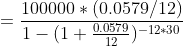

Please do rate me and mention doubts, if any, in the comments section.
Add Answer to:
1. Suppose that you are considering a conventional, fixed-rate
30-year mortgage loan for $100,000. The lender...
Suppose that you are considering a conventional, fixed-rate 30-year mortgage loan for $100,000. The lender quotes...
Suppose that you are considering a conventional, fixed-rate 30-year mortgage loan for $100,000. The lender quotes an APR of 3.28%, compounded monthly; mortgage payments would be monthly, beginning one month after the closing on your home purchase. After 10 years of payments, what is the balance outstanding on your loan? Do not round at intermediate steps in your calculation. Round your answer to the nearest penny. Do not type the $ symbol.
Suppose that you are considering a conventional, fixed-rate 30-year mortgage loan for $100,000. The lender quotes...
Suppose that you are considering a conventional, fixed-rate 30-year mortgage loan for $100,000. The lender quotes an APR of 4.71%, compounded monthly; mortgage payments would be monthly, beginning one month after the closing on your home purchase. What would be your monthly mortgage payment?
8 pts Question 6 Suppose that you are just about to retire, and you just turned...
 8 pts Question 6 Suppose that you are just about to retire, and you just turned 65. Your personal and family health history is such that you forecast that you will live to age 78. In retirement, you would like to have purchasing power of $60,000 (i.e., real dollars) before taxes. Suppose, for our example, that you anticipate receiving $20,000 in inflation-adjusted Social Security payments each year. Hence, your portfolio will need to provide $40,000 in real dollars each year....
1. Suppose that you are age 25 today and plan on retiring at age 65. You...
1. Suppose that you are age 25 today and plan on retiring at age 65. You determined that you need to have saved $659754 in real dollars by the time you retire. How much must you contribute (in real dollars) each year to your retirement account to achieve your goal? Assume the following: you make annual contributions; each contribution is the same amount in real dollars; the first contribution will be one year from today; your last contribution will be...
Suppose that you are age 25 today and plan on retiring at age 65. You determined...
Suppose that you are age 25 today and plan on retiring at age 65. You determined that you need to have saved $437485 in real dollars by the time you retire. How much must you contribute (in real dollars) each year to your retirement account to achieve your goal? Assume the following: you make annual contributions; each contribution is the same amount in real dollars; the first contribution will be one year from today; your last contribution will be at...
Suppose that you are just about to retire, and you just turned 65. Your personal and...
Suppose that you are just about to retire, and you just turned 65. Your personal and family health history is such that you forecast that you will live to age 88. In retirement, you would like to have purchasing power of $60,000 (i.e., real dollars) before taxes. Suppose, for our example, that you anticipate receiving $20,000 in inflation-adjusted Social Security payments each year. Hence, your portfolio will need to provide $40,000 in real dollars each year. Assume that each payment...
suppose you took a $100,000 15 year fixed-rate mortgage at 4.5% (APR) 3 years ago. Now...
suppose you took a $100,000 15 year fixed-rate mortgage at 4.5% (APR) 3 years ago. Now the market interest rate has dropped to 4%, and you are considering refinance your mortgage. (1) What was the original monthly payment? (2) Suppose you just made the 36th monthly payments. What is the remaining mortgage balance? (3) If you refinance with mortgage with another bank and keep the remaining term (that is, 12 years until the mortgage is paid off), what would the...
The interest rate for the first five years of an $100,000 mortgage loan is 9.4% compounded...
The interest rate for the first five years of an $100,000 mortgage loan is 9.4% compounded semiannually. Monthly payments are calculated using a 20-year amortization. a. What will be the principal balance at the end of the five-year term? (Do not round intermediate calculations and round your final answer to 2 decimal places.) Principal balance $ b. What will be the monthly payments if the loan is renewed at 6.8% compounded semiannually (and the original amortization period is continued)?...
Five years ago you took out a 5/1 adjustable rate mortgage and the five-year fixed rate...
 Five years ago you took out a 5/1 adjustable rate mortgage and the five-year fixed rate period has just expired. The loan was originally for $302,000 with 360 payments at 4.3% APR, compounded monthly a. Now that you have made 60 payments, what is the remaining balance on the loan? b. If the interest rate increases by 1.1%, to 5.4% APR, compounded monthly, what will be your new payments? a. Now that you have made 60 payments, what is the...
You bought a house worth $900,000 and the loan is a 30-year fixed rate mortgage with...
You bought a house worth $900,000 and the loan is a 30-year fixed rate mortgage with 4.5% annual interest rate. What is your monthly payment? Your monthly payment is $__________. (Round to the nearest dollar.)
 8 pts Question 6 Suppose that you are just about to retire, and you just turned 65. Your personal and family health history is such that you forecast that you will live to age 78. In retirement, you would like to have purchasing power of $60,000 (i.e., real dollars) before taxes. Suppose, for our example, that you anticipate receiving $20,000 in inflation-adjusted Social Security payments each year. Hence, your portfolio will need to provide $40,000 in real dollars each year....
 Five years ago you took out a 5/1 adjustable rate mortgage and the five-year fixed rate period has just expired. The loan was originally for $302,000 with 360 payments at 4.3% APR, compounded monthly a. Now that you have made 60 payments, what is the remaining balance on the loan? b. If the interest rate increases by 1.1%, to 5.4% APR, compounded monthly, what will be your new payments? a. Now that you have made 60 payments, what is the...
Most questions answered within 3 hours.
-
Where is the error in this code sequence?
String s1 = "Hello";
String s2 = "ello";...
asked 10 months ago -
Financial data for Joel de Paris, Inc., for last year
follow:
Joel de Paris, Inc.
Balance...
asked 10 months ago -
Consider this reaction:
Al2(SO4)3 (aq)+ BaCl3
(aq) Al2Cl6 (aq)- +
3BaSO4(s) . What is the...
asked 10 months ago -
Suppose that Savneet is considering increasing her
recent random sample from 20 car rentals to 40...
asked 10 months ago -
Trucks arrive at an unloading terminal at an average rate of 120
per hour.
Trucks arrive...
asked 10 months ago -
Why are methanol and ethanol completely soluble in water while
octanol is not very little soluble....
asked 10 months ago -
A facilities manager at a university reads in a research report
that the mean amount of...
asked 10 months ago -
When the CuSO4 is rehydrated by adding water to the anhydrous
compound, is this an endothermic...
asked 10 months ago -
A ray of sunlight is passing from diamond into crown glass; the
angle of incidence is...
asked 10 months ago -
A block of mass 0.249 kg is placed on top of a light, vertical
spring of...
asked 10 months ago -
how do the kidneys compensate in the presences of acidosis
a) trigger hyperventilate
b) reserve acid...
asked 10 months ago -
Question 501 pts
The rental rate of capital to the firm increases. Which of the
following...
asked 10 months ago