Show the calculation for preparing a set of 0.1 , 0.3, 0.5 and 1.0 molar sugar...
Homework Answers

Add Answer to:
Show the calculation for preparing a set of 0.1 , 0.3, 0.5 and
1.0 molar sugar...
1. The solubility of a gaseous solute in water is by an increase in pressure. Increased...
 1. The solubility of a gaseous solute in water is by an increase in pressure. Increased decreased not affected 2. A supersaturated solution may be prepared by slowly cooling down a solution saturated at an elevated temperature. TRUE FALSE 3. A dilution is a solution made by adding a solvent to a supersaturated solution. TRUE FALSE 4. When sugar & water are mixed, a clear liquid results. In this scenario, the sugar is considered a Solute Solution Solvent All of...
Preparing Dilutions 0.6355 grams of primary standard sodium chloride (MM = 58.4428 g/mol, 39.3372% Na+, 60.6628%...
 Preparing Dilutions 0.6355 grams of primary standard sodium chloride (MM = 58.4428 g/mol, 39.3372% Na+, 60.6628% Cl") was dissolved in a 500.00 mL volumetric flask. os en el pro yectandard sodium chloride (- S8 428 qmov, a Determine the molar concentration of the SODIUM ION in this stock solution. Show all work and units.
Show calculations for finding these ratios to create dilutions given the concentrations. Part A How many...
 Show calculations for finding these ratios to create dilutions
given the concentrations.
Part A How many mL of H2O needed in these dilutions? Vol of 1mM HCI (ml) Vol H20 needed (ml) Dilution 1 to 2 1 to 10 1 to 5 1 to 4 1 to 12 0.5 0.3 0.8 Part B You are given 50 mL solution of NaCl with a concentration of 2M. Find the dilutions needed and the volumes needed of NaCI with the info given...
Show calculations for finding these ratios to create dilutions
given the concentrations.
Part A How many mL of H2O needed in these dilutions? Vol of 1mM HCI (ml) Vol H20 needed (ml) Dilution 1 to 2 1 to 10 1 to 5 1 to 4 1 to 12 0.5 0.3 0.8 Part B You are given 50 mL solution of NaCl with a concentration of 2M. Find the dilutions needed and the volumes needed of NaCI with the info given...
3. Experimental Procedure, Part A.1. For preparing a set of standard solutions of FeNCS, the equilibrium...
 3. Experimental Procedure, Part A.1. For preparing a set of standard solutions of FeNCS, the equilibrium molar con- centration of FeNCS is assumed to equal the initial molar concentration of the SCN in the reaction mixture. Why is this assumption valid? A. A Set of Standard Solutions to Establish a The set of standard solutions is used to determine the absorbance of known molar con- centrations of FeNCS2. A plot of the data, known as a calibration curve, is used...
Sugar is easily soluble in water and has a molar mass of 342.30 g/mol. What is...
 Sugar is easily soluble in water and has a molar mass of 342.30 g/mol. What is the molar concentration of a 245.6 mL aqueous solution prepared with 78.3 g of sugar? Suppose you have 350.0 mL of a 0.450 M sodium hydroxide solution. How many moles of sodium hydroxide are in the solution? Calculate the percent by mass of a solution made from 17 g NaCl (the solute) and 67 g water. Suppose you need to prepare 141.5 mL of...
a.)Suppose you were preparing 1.0 L of a bleaching solution in a volumetric flask, and it...
a.)Suppose you were preparing 1.0 L of a bleaching solution in a volumetric flask, and it calls for 0.26 mol of NaOCl. If all you had available was a jug of bleach that contained 0.74 M NaOCl, what volume of bleach would you need to add to the volumetric flask before you added enough water to reach the 1.0 L line? Express the volume in milliliters to two significant figures b.) You need to prepare a 2.40 M solution of...
Question 4 Status: Not yet answered | Points possible: 1.00 Glucose (molar mass 180.16 g/mol) is...
 Question 4 Status: Not yet answered | Points possible: 1.00 Glucose (molar mass 180.16 g/mol) is a simple, soluble sugar. Glucose solutions are used to treat patients with low blood sugar. Suppose you prepare a glucose solution using the described procedure. Step 1: Dissolve 294.4 g of glucose in enough water to make 500.0 mL of solution. Step 2: Transfer 18.6 mL of the solution to a new flask and add enough water to make 250.0 mL of dilute solution....
Red Food Coloring Absorption Spectrum 1.000 0.800 0 600 0.400 0 200 400 450 500 Sso...
 Red Food Coloring Absorption Spectrum 1.000 0.800 0 600 0.400 0 200 400 450 500 Sso 600 650 3a. If the molar absorptivity constant at the optimum wavelength for the red dye solution is 5.56x10⁴ M-lcm1, calculate the molarity of the red dye solution based on the absorbance value you obtained in question #2. You may assume L-1.22cm. Hint: A-ELC Molar mass of FD&C #3 = 879.86 g/mol b. Convert the molarity in part a to w/v00. Show your work....
Combine approximately 0.25 grams of the green Co(en) Cl, l' and 20 mL of 1.0 M...
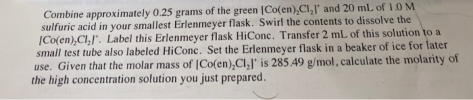 Combine approximately 0.25 grams of the green Co(en) Cl, l' and 20 mL of 1.0 M sulfuric acid in your smallest Erlenmeyer flask. Swirl the contents to dissolve the Co(en),C1,1". Label this Erlenmeyer flask HiConc. Transfer 2 mL of this solution to a small test tube also labeled HiConc. Set the Erlenmeyer flask in a beaker of ice for later use. Given that the molar mass of Co(en),CII' is 285.49 g/mol, calculate the molarity of the high concentration solution you...
Show all calculation to receive credit for an answer. Be sure to indicate your final answer...
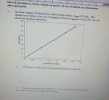 Show all calculation to receive credit for an answer. Be sure to indicate your final answer where appropriate L 1. An amine complex of cobalt(III) is yellow-orange and has a beau of 475 nm. The standard curve below is for a set of standards measured at ay in a 1.8 cm cell. Use it to answer the questions that follow. 0.3 0.7 0.6 0.5 Absorbance 04 0.3 0.2 01 0 0 0.05 0.1 015 02 Concentration Com 0.25 0.3 0.35...
 1. The solubility of a gaseous solute in water is by an increase in pressure. Increased decreased not affected 2. A supersaturated solution may be prepared by slowly cooling down a solution saturated at an elevated temperature. TRUE FALSE 3. A dilution is a solution made by adding a solvent to a supersaturated solution. TRUE FALSE 4. When sugar & water are mixed, a clear liquid results. In this scenario, the sugar is considered a Solute Solution Solvent All of...
 Preparing Dilutions 0.6355 grams of primary standard sodium chloride (MM = 58.4428 g/mol, 39.3372% Na+, 60.6628% Cl") was dissolved in a 500.00 mL volumetric flask. os en el pro yectandard sodium chloride (- S8 428 qmov, a Determine the molar concentration of the SODIUM ION in this stock solution. Show all work and units.
 Show calculations for finding these ratios to create dilutions
given the concentrations.
Part A How many mL of H2O needed in these dilutions? Vol of 1mM HCI (ml) Vol H20 needed (ml) Dilution 1 to 2 1 to 10 1 to 5 1 to 4 1 to 12 0.5 0.3 0.8 Part B You are given 50 mL solution of NaCl with a concentration of 2M. Find the dilutions needed and the volumes needed of NaCI with the info given...
Show calculations for finding these ratios to create dilutions
given the concentrations.
Part A How many mL of H2O needed in these dilutions? Vol of 1mM HCI (ml) Vol H20 needed (ml) Dilution 1 to 2 1 to 10 1 to 5 1 to 4 1 to 12 0.5 0.3 0.8 Part B You are given 50 mL solution of NaCl with a concentration of 2M. Find the dilutions needed and the volumes needed of NaCI with the info given...
 3. Experimental Procedure, Part A.1. For preparing a set of standard solutions of FeNCS, the equilibrium molar con- centration of FeNCS is assumed to equal the initial molar concentration of the SCN in the reaction mixture. Why is this assumption valid? A. A Set of Standard Solutions to Establish a The set of standard solutions is used to determine the absorbance of known molar con- centrations of FeNCS2. A plot of the data, known as a calibration curve, is used...
 Sugar is easily soluble in water and has a molar mass of 342.30 g/mol. What is the molar concentration of a 245.6 mL aqueous solution prepared with 78.3 g of sugar? Suppose you have 350.0 mL of a 0.450 M sodium hydroxide solution. How many moles of sodium hydroxide are in the solution? Calculate the percent by mass of a solution made from 17 g NaCl (the solute) and 67 g water. Suppose you need to prepare 141.5 mL of...
 Question 4 Status: Not yet answered | Points possible: 1.00 Glucose (molar mass 180.16 g/mol) is a simple, soluble sugar. Glucose solutions are used to treat patients with low blood sugar. Suppose you prepare a glucose solution using the described procedure. Step 1: Dissolve 294.4 g of glucose in enough water to make 500.0 mL of solution. Step 2: Transfer 18.6 mL of the solution to a new flask and add enough water to make 250.0 mL of dilute solution....
 Red Food Coloring Absorption Spectrum 1.000 0.800 0 600 0.400 0 200 400 450 500 Sso 600 650 3a. If the molar absorptivity constant at the optimum wavelength for the red dye solution is 5.56x10⁴ M-lcm1, calculate the molarity of the red dye solution based on the absorbance value you obtained in question #2. You may assume L-1.22cm. Hint: A-ELC Molar mass of FD&C #3 = 879.86 g/mol b. Convert the molarity in part a to w/v00. Show your work....
 Combine approximately 0.25 grams of the green Co(en) Cl, l' and 20 mL of 1.0 M sulfuric acid in your smallest Erlenmeyer flask. Swirl the contents to dissolve the Co(en),C1,1". Label this Erlenmeyer flask HiConc. Transfer 2 mL of this solution to a small test tube also labeled HiConc. Set the Erlenmeyer flask in a beaker of ice for later use. Given that the molar mass of Co(en),CII' is 285.49 g/mol, calculate the molarity of the high concentration solution you...
 Show all calculation to receive credit for an answer. Be sure to indicate your final answer where appropriate L 1. An amine complex of cobalt(III) is yellow-orange and has a beau of 475 nm. The standard curve below is for a set of standards measured at ay in a 1.8 cm cell. Use it to answer the questions that follow. 0.3 0.7 0.6 0.5 Absorbance 04 0.3 0.2 01 0 0 0.05 0.1 015 02 Concentration Com 0.25 0.3 0.35...
Most questions answered within 3 hours.
-
Where is the error in this code sequence?
String s1 = "Hello";
String s2 = "ello";...
asked 10 months ago -
Financial data for Joel de Paris, Inc., for last year
follow:
Joel de Paris, Inc.
Balance...
asked 10 months ago -
Consider this reaction:
Al2(SO4)3 (aq)+ BaCl3
(aq) Al2Cl6 (aq)- +
3BaSO4(s) . What is the...
asked 10 months ago -
Suppose that Savneet is considering increasing her
recent random sample from 20 car rentals to 40...
asked 10 months ago -
Trucks arrive at an unloading terminal at an average rate of 120
per hour.
Trucks arrive...
asked 10 months ago -
Why are methanol and ethanol completely soluble in water while
octanol is not very little soluble....
asked 10 months ago -
A facilities manager at a university reads in a research report
that the mean amount of...
asked 10 months ago -
When the CuSO4 is rehydrated by adding water to the anhydrous
compound, is this an endothermic...
asked 10 months ago -
A ray of sunlight is passing from diamond into crown glass; the
angle of incidence is...
asked 10 months ago -
A block of mass 0.249 kg is placed on top of a light, vertical
spring of...
asked 10 months ago -
how do the kidneys compensate in the presences of acidosis
a) trigger hyperventilate
b) reserve acid...
asked 10 months ago -
Question 501 pts
The rental rate of capital to the firm increases. Which of the
following...
asked 10 months ago