If I double the concentration of A in the reaction A + B -> AB, and...
- If I double the concentration of A in the reaction A + B -> AB, and the reaction proceeds at the same rate, what is the order with respect to A?
Homework Answers
Request Answer!
We need at least 10 more requests to produce the answer.
0 / 10 have requested this problem solution
The more requests, the faster the answer.
Add Answer to:
If I double the concentration of A in the reaction A
+ B -> AB, and...
3. The following table shows how the concentration of AB varies in the reaction: 2 AB(g)...
3. The following table shows how the concentration of AB varies in the reaction: 2 AB(g) → A2(g) +B2(g). Time (s) 0 1000 2000 3000 4000 [AB] (mol/L) 1.00 0.112 0.061 0.041 0.031 Determine: a) The global reaction order. b) The kinetic constant for the rate of disappearance of AB. c) The kinetic constant for the rate law (independent of the reactant). Use trial end error using excel.
The following reaction was monitored as a function of time: AB→A+B A plot of 1/[AB] versus...
The following reaction was monitored as a function of time: AB→A+B A plot of 1/[AB] versus time yields a straight line with slope 5.7×10⁻² (M⋅s)−1 . 1) What is the value of the rate constant (k) for this reaction at this temperature? Express your answer using two significant figures. _____M-1S-1 2)Write the rate law for the reaction. Rate=k Rate=k[AB] Rate=k[AB]2 Rate=k[AB]3 3) What is the half-life when the initial concentration is 0.57 M ? Express your answer using two significant...
The reaction below was monitored as a function of time: AB A + B A plot...
The reaction below was monitored as a function of time: AB A + B A plot of ln[AB] vs. time yields a straight line with slope = -0.0025 sec-1 . a) What is the value of the rate constant (k) for this reaction at this temperature? b) Write the rate law for this reaction. c) What is the half-life (t1/2)? d) If the initial concentration of AB is 0.500 M, what is the concentration after 300 sec?
Consider the first order reaction, AB2 -> AB + B, which has a first order reaction...
 Consider the first order reaction, AB2 -> AB + B, which has a first order reaction rate constant of 0.00920 s'. If[AB2] = 0.0100 M at the beginning of the reaction, how many seconds will it take for the concentration to drop to 0.00250 M? a) 151 s b) 75.5 s c) 38.0 s d) 302 s Оа Ob Ос C
A + B -> C : Derive the rate law for the reaction based on the...
A + B -> C : Derive the rate law for the reaction based on the following information. What would happen if I double the concentration of A and double the concentration of B, the reaction rate increase 32 times. How about if I triple the concentration of A and keep the concentration of B the same, the reaction process 9 times faster.
Question 2 If the rate does not change when we double the concentration, therefore, the reaction...
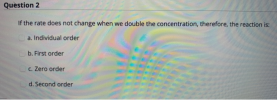 Question 2 If the rate does not change when we double the concentration, therefore, the reaction is: a. Individual order b. First order C. Zero order d. Second order
Review | Constants Periodic Table Leaming Goal: To understand reaction order and rate constants. For the...
 Review | Constants Periodic Table Leaming Goal: To understand reaction order and rate constants. For the general equation A+B+C+ dD. the rate law is expressed as follows: ratek AB" where mand n indicate the order of the reaction with respect to each reactant and must be determined experimentally and kis the rate constant, which is specific to each reaction Order For a particular reaction, aA +bB+CD the rate law was experimentally determined to be rate - KABC -- EBC2 A....
(a)The reaction A(aq) → B(aq) is a first order reaction with respect to A(aq). The concentration...
(a)The reaction A(aq) → B(aq) is a first order reaction with respect to A(aq). The concentration of A(aq) after 100.0 seconds of reaction is 0.970 M and the concentration of A(aq) after 400.0 seconds of reaction is 0.715 M. What will be the concentration of A(aq) after 817.6 seconds of reaction? (b) The reaction A(aq) → B(aq) + C(aq) is a first order reaction with respect to A(aq). The half-life of A(aq) is 81.8 s at 25.0oC. Its activation energy...
f doubling the concentration of bromide ion in the reaction above causes the rate of reaction...
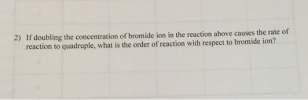 f doubling the concentration of bromide ion in the reaction above causes the rate of reaction to quadruple, what is the order of reaction with respect to bromide ion? 2) I
The following reaction was monitored as a function of time: AB→A+B A plot of 1/[AB] versus...
The following reaction was monitored as a function of time: AB→A+B A plot of 1/[AB] versus time yields a straight line with slope 5.8×10⁻² (M⋅s)−1 . You may want to reference (Page) section 13.4 while completing this problem. Part A Part complete What is the value of the rate constant (k) for this reaction at this temperature? Express your answer using two significant figures. -- SubmitPrevious AnswersRequest Answer Part B Part complete Write the rate law for the reaction. --...
 Consider the first order reaction, AB2 -> AB + B, which has a first order reaction rate constant of 0.00920 s'. If[AB2] = 0.0100 M at the beginning of the reaction, how many seconds will it take for the concentration to drop to 0.00250 M? a) 151 s b) 75.5 s c) 38.0 s d) 302 s Оа Ob Ос C
 Question 2 If the rate does not change when we double the concentration, therefore, the reaction is: a. Individual order b. First order C. Zero order d. Second order
 Review | Constants Periodic Table Leaming Goal: To understand reaction order and rate constants. For the general equation A+B+C+ dD. the rate law is expressed as follows: ratek AB" where mand n indicate the order of the reaction with respect to each reactant and must be determined experimentally and kis the rate constant, which is specific to each reaction Order For a particular reaction, aA +bB+CD the rate law was experimentally determined to be rate - KABC -- EBC2 A....
 f doubling the concentration of bromide ion in the reaction above causes the rate of reaction to quadruple, what is the order of reaction with respect to bromide ion? 2) I
Most questions answered within 3 hours.
-
Where is the error in this code sequence?
String s1 = "Hello";
String s2 = "ello";...
asked 11 months ago -
Financial data for Joel de Paris, Inc., for last year
follow:
Joel de Paris, Inc.
Balance...
asked 11 months ago -
Consider this reaction:
Al2(SO4)3 (aq)+ BaCl3
(aq) Al2Cl6 (aq)- +
3BaSO4(s) . What is the...
asked 11 months ago -
Suppose that Savneet is considering increasing her
recent random sample from 20 car rentals to 40...
asked 11 months ago -
Trucks arrive at an unloading terminal at an average rate of 120
per hour.
Trucks arrive...
asked 11 months ago -
Why are methanol and ethanol completely soluble in water while
octanol is not very little soluble....
asked 11 months ago -
A facilities manager at a university reads in a research report
that the mean amount of...
asked 11 months ago -
When the CuSO4 is rehydrated by adding water to the anhydrous
compound, is this an endothermic...
asked 11 months ago -
A ray of sunlight is passing from diamond into crown glass; the
angle of incidence is...
asked 11 months ago -
A block of mass 0.249 kg is placed on top of a light, vertical
spring of...
asked 11 months ago -
how do the kidneys compensate in the presences of acidosis
a) trigger hyperventilate
b) reserve acid...
asked 11 months ago -
Question 501 pts
The rental rate of capital to the firm increases. Which of the
following...
asked 11 months ago