1. What is the key step of redox calculations? 2. What is the relationship between normality...
1. What is the key step of redox calculations?
2. What is the relationship between normality and molarity? What is the relationship between equivalent and mole? What is the relationship between formula mass and equivalent mass?
Homework Answers
Ouestion 1
Key step of redox calculations is the determination of half reactions (Oxidation half and reduction half reaction) and this is done by observing the change in oxidation state. This change of oxidation state will determine the number of electrons which are being transferred from reducing agent to oxidizing agent. Without it, the equation cannot be balanced. Let us take an example:

In this Iron changes its oxidation state from +2 to +3 and chromium changes from +6 to +3. Now to balance:
Let us take another example in which Manganese is silutaneously oxidised and reduced

Question 2
For this let me introduce n factor. It is the ratio of molar mass to equivalent mass.
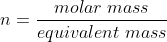
In an acid, n factor is its basicity. For example for H2SO4 n=2.
In a base, n factor is its acidity. For example for KOH n=1.
In a salt, n factor is total positive or negative charge. For example Na2SO4 n=2.
n establishes the required relationships asked in the question.
Normality = Molarity X n
equivalent = mole X n
Formula mass = Equivalent mass X n
For example 1.42 g Na2SO4 dissolved in 1L water. For Na2SO4n=2.
Formula mass= 142 g/mol.
Equvalent mass= 71 g/eq.
mole = 1.42/142 = 0.01 mol.
equivalent = 1.42/71 = 0.02 eq.
Molarity= 0.01/1 mol/L = 0.01 mol/L or 0.01 M.
Normality = 0.02/1 eq/L = 0.02 eq/L or 0.02 N.
Add Answer to:
1. What is the key step of redox calculations?
2. What is the relationship between normality...
1. How can you differentiate between a precipitation titration and a redox titration? Give an example...
1. How can you differentiate between a precipitation titration and a redox titration? Give an example for each. 2. Define and explain normality, equivalent, and equivalent mass.
Networking class question... What is the relationship between the private key and public key? Who uses...
Networking class question... What is the relationship between the private key and public key? Who uses the public key and who uses the private key?
What is the relationship between ecofeminism and environmental ethics? What are some of the key points?...
What is the relationship between ecofeminism and environmental ethics? What are some of the key points? How do technologies related to microorganisms suggest ethical conflicts? How do these conflicts relate to social justic
1. In titrations, what is the difference between the equivalence point and the endpoint? 2. In...
 1. In titrations, what is the difference between the equivalence point and the endpoint? 2. In a titration reaction, 45.6 mL of 0.047 N NaOH was needed to neutralize 30.1 mL of H,SO4. Calculate the following measures of concentration. a. The normality of the acid solution b. The molarity of the acid solution
Viewing a scatter plot is an important step in understanding the relationship between two interval variables....
 Viewing a scatter plot is an important step in understanding the
relationship between two interval variables.
In a curvilinear relationship, the correlation alone can mask
the relationship between variables.
How would you calculate r and plot the scores in order
to see if your calculations accurately reflect the scatter
plot?
XY 10 Respondent 10
Viewing a scatter plot is an important step in understanding the
relationship between two interval variables.
In a curvilinear relationship, the correlation alone can mask
the relationship between variables.
How would you calculate r and plot the scores in order
to see if your calculations accurately reflect the scatter
plot?
XY 10 Respondent 10
CHEM 2 (Step by step explanation please prefer if it were handwritten) A 100 mL aqueous...
CHEM 2 (Step by step explanation please prefer if it were handwritten) A 100 mL aqueous solution of methanol is 40% CH3OH by mass A) The molality of methanol in the solution B) Mole fraction of methanol in the solution C)Molarity of methanol in the solution
What is the relationship between the following molecules? Question 1 1 pts What is the relationship...
 What is the relationship between the following molecules?
Question 1 1 pts What is the relationship between the following molecules? 1 Br > ll Br No relationship Enantiomers Identical Constitutional Isomers • Diastereomers Question 2 1 pts What is the relationship between the following molecules? OH CH3 CH3 Diastereomers Constitutional Isomers Enantiomers Identical No relationship
What is the relationship between the following molecules?
Question 1 1 pts What is the relationship between the following molecules? 1 Br > ll Br No relationship Enantiomers Identical Constitutional Isomers • Diastereomers Question 2 1 pts What is the relationship between the following molecules? OH CH3 CH3 Diastereomers Constitutional Isomers Enantiomers Identical No relationship
1g. What is the relationship between an enol and its enolate? (2 pts) 1h. What are...
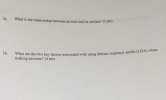 1g. What is the relationship between an enol and its enolate? (2 pts) 1h. What are the two key factors associated with using lithium isopropyl amide (LDA) when making enolates? (4 pts)
1. what is the mole ratio for trial 1 and 2? 2. whats the average mole...
 1. what is the mole ratio for trial 1 and 2?
2. whats the average mole ratio for trial 1 and
2?
3. whats the average deviation for trial 1 and 2?
* please include the steps if you dont mind*
ng down the equation ahd an example calculation, The example calculation only needs to be done for one trial. The results of the remaining trials can be written down in a table in your notebook. (Part 1)) Determine the...
1. what is the mole ratio for trial 1 and 2?
2. whats the average mole ratio for trial 1 and
2?
3. whats the average deviation for trial 1 and 2?
* please include the steps if you dont mind*
ng down the equation ahd an example calculation, The example calculation only needs to be done for one trial. The results of the remaining trials can be written down in a table in your notebook. (Part 1)) Determine the...
Show step by step Balance the following redox reaction if it occurs in basic solution. What...
 Show step by step
Balance the following redox reaction if it occurs in basic solution. What are the coefficients in front of ClO2 and H2O in the balanced reaction? H2O2(1) + ClO2(aq) → ClO2 (aq) + O2(g)
Show step by step
Balance the following redox reaction if it occurs in basic solution. What are the coefficients in front of ClO2 and H2O in the balanced reaction? H2O2(1) + ClO2(aq) → ClO2 (aq) + O2(g)
 1. In titrations, what is the difference between the equivalence point and the endpoint? 2. In a titration reaction, 45.6 mL of 0.047 N NaOH was needed to neutralize 30.1 mL of H,SO4. Calculate the following measures of concentration. a. The normality of the acid solution b. The molarity of the acid solution
 Viewing a scatter plot is an important step in understanding the
relationship between two interval variables.
In a curvilinear relationship, the correlation alone can mask
the relationship between variables.
How would you calculate r and plot the scores in order
to see if your calculations accurately reflect the scatter
plot?
XY 10 Respondent 10
Viewing a scatter plot is an important step in understanding the
relationship between two interval variables.
In a curvilinear relationship, the correlation alone can mask
the relationship between variables.
How would you calculate r and plot the scores in order
to see if your calculations accurately reflect the scatter
plot?
XY 10 Respondent 10
 What is the relationship between the following molecules?
Question 1 1 pts What is the relationship between the following molecules? 1 Br > ll Br No relationship Enantiomers Identical Constitutional Isomers • Diastereomers Question 2 1 pts What is the relationship between the following molecules? OH CH3 CH3 Diastereomers Constitutional Isomers Enantiomers Identical No relationship
What is the relationship between the following molecules?
Question 1 1 pts What is the relationship between the following molecules? 1 Br > ll Br No relationship Enantiomers Identical Constitutional Isomers • Diastereomers Question 2 1 pts What is the relationship between the following molecules? OH CH3 CH3 Diastereomers Constitutional Isomers Enantiomers Identical No relationship
 1g. What is the relationship between an enol and its enolate? (2 pts) 1h. What are the two key factors associated with using lithium isopropyl amide (LDA) when making enolates? (4 pts)
 1. what is the mole ratio for trial 1 and 2?
2. whats the average mole ratio for trial 1 and
2?
3. whats the average deviation for trial 1 and 2?
* please include the steps if you dont mind*
ng down the equation ahd an example calculation, The example calculation only needs to be done for one trial. The results of the remaining trials can be written down in a table in your notebook. (Part 1)) Determine the...
1. what is the mole ratio for trial 1 and 2?
2. whats the average mole ratio for trial 1 and
2?
3. whats the average deviation for trial 1 and 2?
* please include the steps if you dont mind*
ng down the equation ahd an example calculation, The example calculation only needs to be done for one trial. The results of the remaining trials can be written down in a table in your notebook. (Part 1)) Determine the...
 Show step by step
Balance the following redox reaction if it occurs in basic solution. What are the coefficients in front of ClO2 and H2O in the balanced reaction? H2O2(1) + ClO2(aq) → ClO2 (aq) + O2(g)
Show step by step
Balance the following redox reaction if it occurs in basic solution. What are the coefficients in front of ClO2 and H2O in the balanced reaction? H2O2(1) + ClO2(aq) → ClO2 (aq) + O2(g)
Most questions answered within 3 hours.
-
Where is the error in this code sequence?
String s1 = "Hello";
String s2 = "ello";...
asked 11 months ago -
Financial data for Joel de Paris, Inc., for last year
follow:
Joel de Paris, Inc.
Balance...
asked 11 months ago -
Consider this reaction:
Al2(SO4)3 (aq)+ BaCl3
(aq) Al2Cl6 (aq)- +
3BaSO4(s) . What is the...
asked 11 months ago -
Suppose that Savneet is considering increasing her
recent random sample from 20 car rentals to 40...
asked 11 months ago -
Trucks arrive at an unloading terminal at an average rate of 120
per hour.
Trucks arrive...
asked 11 months ago -
Why are methanol and ethanol completely soluble in water while
octanol is not very little soluble....
asked 11 months ago -
A facilities manager at a university reads in a research report
that the mean amount of...
asked 11 months ago -
When the CuSO4 is rehydrated by adding water to the anhydrous
compound, is this an endothermic...
asked 11 months ago -
A ray of sunlight is passing from diamond into crown glass; the
angle of incidence is...
asked 11 months ago -
A block of mass 0.249 kg is placed on top of a light, vertical
spring of...
asked 11 months ago -
how do the kidneys compensate in the presences of acidosis
a) trigger hyperventilate
b) reserve acid...
asked 11 months ago -
Question 501 pts
The rental rate of capital to the firm increases. Which of the
following...
asked 11 months ago