The drawing shows a top view of a hockey puck as it slides across frictionless ice....
The drawing shows a top view of a hockey puck as it slides across frictionless ice. Three forces act on the puck, and it is in equilibrium. The force F is applied at the center and has a magnitude of 31 N. The force F1 is applied at the top edge, and F2 is applied half way between the center and the bottom edge. Find the magnitude of F1 and F2.
Homework Answers

Add Answer to:
The drawing shows a top view of a hockey puck as it slides
across frictionless ice....
A circular air hockey puck of radius t slides across
 Problem 5: A circular air hockey puck of radius t slides across a frictionless air hockey table and is subjected to several forces as shown below. The magnitude and direction of each force is given. Forces are applied at either the center of mass of the puck the outer edge (a distance from the center)
A 1.25kg hockey puck (puck A) slides across a frictionless sheet of ice and collides with...
A 1.25kg hockey puck (puck A) slides across a frictionless sheet of ice and collides with a puck of unknown mass (puck B) head on. The collision is completely elastic, which means no kinetic enegy is lost in the collision. After the collision, puck A moves in the opposite direction at half of its initial speed. Find the mass of puck B.
A hockey puck slides across an ice rink. Consider the origin to be at the center...
A hockey puck slides across an ice rink. Consider the origin to be at the center of the rink; the plane of the rink is the xz plane. At time t=0.0 s a hockey puck is observed to be at location <-6, 0,-5> m. At time t=0.2 sec, the puck is observed at location <6, 0, 2> m. a) What is the average velocity of the hockey puck during this time interval? b) What is the magnitude of the average...
A hockey puck slides on ice (looking down on the ice from above; blue arrows are...
 A hockey puck slides on ice (looking down on the ice from above; blue arrows are momentum, red line shows path); friction and air resistance are negligible. When the puck reaches location 2 it is struck hard by a hockey stick; the contact lasts a very short time. It then travels from 2 to 3 at nearly constant momentum. The magnitude of the puck's momentum is the same at locations 1 and 3. Which green arrow best indicates the direction of...
An ice hockey puck of mass 120 g is acted on by two equal forces Fi...
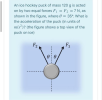 An ice hockey puck of mass 120 g is acted on by two equal forces Fi = F2 = 7 N, as shown in the figure, where 0 = 35°. What is the acceleration of the puck (in units of m/s?)? (the figure shows a top view of the puck on ice) F2
Two forces are acting on a 0.150-kg hockey puck as it slides along the ice. The...
Two forces are acting on a 0.150-kg hockey puck as it slides along the ice. The first force has a magnitude of 0.405 N and points 25.0° north of east. The second force has a magnitude of 0.525 N and points 55.0° north of east. If these are the only two forces acting on the puck, what will be the magnitude and direction of the puck's acceleration?
Two forces are acting on a 0.150-kg hockey puck as it slides along the ice. The...
Two forces are acting on a 0.150-kg hockey puck as it slides along the ice. The first force has a magnitude of 0.405 N and points 35.0° north of east. The second force has a magnitude of 0.605 N and points 55.0° north of east. If these are the only two forces acting on the puck, what will be the magnitude and direction of the puck\'s acceleration? Enter the direction as an angle measured in degrees counterclockwise from due east....
An 160.0 g hockey puck slides along an essentially frictionless ice rink with speed 4.70 m/s....
An 160.0 g hockey puck slides along an essentially frictionless ice rink with speed 4.70 m/s. A hockey player uses her stick to do –1.20 J of work on the puck. What is the puck's speed after she has done this work? A. 0 m/s B. 2.66 m/s C. 3.50 m/s D. 4.53 m/s
A 0.3 kg hockey puck is gliding across a patch of ice (where friction can be...
A 0.3 kg hockey puck is gliding across a patch of ice (where friction can be neglected) at a constant speed of 16m/s. If the puck is to be stopped in 4 seconds, what stopping force must be applied to it?
The drawing shows the top view of two doors. The doors are uniform and identical. Door...
 The drawing shows the top view of two doors. The doors are uniform and identical. Door A rotates about an axis through its left edge, and door B rotates about an axis through its center. The same force is applied perpendicular to each door at its right edge, and the force remains perpendicular as the door turns. No other force affects the rotation of either door. Starting from rest, door A rotates through a certain angle in 3.05 s. How...
 An ice hockey puck of mass 120 g is acted on by two equal forces Fi = F2 = 7 N, as shown in the figure, where 0 = 35°. What is the acceleration of the puck (in units of m/s?)? (the figure shows a top view of the puck on ice) F2
 The drawing shows the top view of two doors. The doors are uniform and identical. Door A rotates about an axis through its left edge, and door B rotates about an axis through its center. The same force is applied perpendicular to each door at its right edge, and the force remains perpendicular as the door turns. No other force affects the rotation of either door. Starting from rest, door A rotates through a certain angle in 3.05 s. How...
Most questions answered within 3 hours.
-
Where is the error in this code sequence?
String s1 = "Hello";
String s2 = "ello";...
asked 11 months ago -
Financial data for Joel de Paris, Inc., for last year
follow:
Joel de Paris, Inc.
Balance...
asked 11 months ago -
Consider this reaction:
Al2(SO4)3 (aq)+ BaCl3
(aq) Al2Cl6 (aq)- +
3BaSO4(s) . What is the...
asked 11 months ago -
Suppose that Savneet is considering increasing her
recent random sample from 20 car rentals to 40...
asked 11 months ago -
Trucks arrive at an unloading terminal at an average rate of 120
per hour.
Trucks arrive...
asked 11 months ago -
Why are methanol and ethanol completely soluble in water while
octanol is not very little soluble....
asked 11 months ago -
A facilities manager at a university reads in a research report
that the mean amount of...
asked 11 months ago -
When the CuSO4 is rehydrated by adding water to the anhydrous
compound, is this an endothermic...
asked 11 months ago -
A ray of sunlight is passing from diamond into crown glass; the
angle of incidence is...
asked 11 months ago -
A block of mass 0.249 kg is placed on top of a light, vertical
spring of...
asked 11 months ago -
how do the kidneys compensate in the presences of acidosis
a) trigger hyperventilate
b) reserve acid...
asked 11 months ago -
Question 501 pts
The rental rate of capital to the firm increases. Which of the
following...
asked 11 months ago