Company A and Company B have the same degree of leverage, but A has a higher...
Company A and Company B have the same degree of leverage, but A has a higher profit margin than B. What conditions have to be in place for Company B to have a higher return on equity than company A, if possible?
Homework Answers
Return on equity =profit margin / total equity
If the company B has a lower total equity as compared to A , then only company B can have higher return on equity. This is because company A has higher profit margin than company B, so to make it possible for company B to have higher Return on equity, the total equity should be lower than that of company A.
Add Answer to:
Company A and Company B have the same degree of leverage, but A
has a higher...
20) If Company A has an operating leverage of 3.2 and Company B has an operating...
20) If Company A has an operating leverage of 3.2 and Company B has an operating leverage of 1.0, which of the following is true? A) Company A has higher sales than Company B B) Company B has lower contribution margin per unit than Company A C) Company A is structured better to withstand a downturn in sales than Company B D) Company B is structured better to withstand a downturn in sales than Company A
a) Degree of operating leverage = Contribution margin / profit Degree of operating leverage = 15,600,000...
a) Degree of operating leverage = Contribution margin / profit Degree of operating leverage = 15,600,000 / 6,000,000 = 1.625 Sales = 1200000 x 24 = 28800000 Less: Variable cost = 1200000 x 11 = 13200000 Contribution Margin = 28800000 - 13200000 = 15,600,000 Less: Fixed cost = 9,600,000 Profit = 15600000-9600000 = 6000000 b) Break even units Contribution margin per unit = Selling price - variable cost = $24 - $11 = $13 Break even units = Fixed cost...
Two hypothetical firms have the same net income and the same total assets. One firm has...
Two hypothetical firms have the same net income and the same total assets. One firm has much higher Return on Equity (ROE). It must be true that: The firm with the higher ROE must have less leverage in the capital structure The firm with the higher ROE must have more leverage in the capital structure All else equal, differences in leverage will not affect ROE Increased leverage can only decrease risk, but not increase returns None of the above
Question 25 4 pts company A company with a lower degree of operating leverage will be...
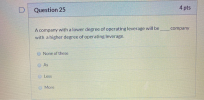 Question 25 4 pts company A company with a lower degree of operating leverage will be with a higher degree of operating leverage. None of these O As Less More
Degree of Operating Leverage, Percent Change in Profit Ringsmith Company is considering two different processes to...
Degree of Operating Leverage, Percent Change in Profit Ringsmith Company is considering two different processes to make its product—process 1 and process 2. Process 1 requires Ringsmith to manufacture subcomponents of the product in-house. As a result, materials are less expensive, but fixed overhead is higher. Process 2 involves purchasing all subcomponents from outside suppliers. The direct materials costs are higher, but fixed factory overhead is considerably lower. Relevant data for a sales level of 37,000 units follow: Process...
Degree of Operating Leverage, Percent Change in Profit Ringsmith Company is considering two different processes to...
Degree of Operating Leverage, Percent Change in Profit Ringsmith Company is considering two different processes to make its product—process 1 and process 2. Process 1 requires Ringsmith to manufacture subcomponents of the product in-house. As a result, materials are less expensive, but fixed overhead is higher. Process 2 involves purchasing all subcomponents from outside suppliers. The direct materials costs are higher, but fixed factory overhead is considerably lower. Relevant data for a sales level of 40,000 units follow: Process...
Degree of Operating Leverage, Percent Change in Profit Ringsmith Company is considering two different processes to...
 Degree of Operating Leverage, Percent Change in Profit Ringsmith Company is considering two different processes to make its product-process 1 and process 2. Process 1 requires Ringsmith to manufacture subcomponents of the product in-house. As a result, materials are less expensive, but fixed overhead is higher. Process 2 involves purchasing all subcomponents from outside suppliers. The direct materials costs are higher, but fixed factory overhead is considerably lower. Relevant data for a sales level of 37,000 units follow: Process 1...
13.What is the degree of operating leverage? 14.Using the degree of operating leverage, what is the...
 13.What is the degree of operating leverage?
14.Using the degree of operating leverage, what is the
estimated percent increase in net operating income of a 5% increase
in sales?
15.Assume that the amounts of the company’s total variable
expenses and total fixed expenses were reversed. In other words,
assume that the total variable expenses are $8,400 and the total
fixed expenses are $21,000. Under this scenario and assuming that
total sales remain the same, what is the degree of operating...
13.What is the degree of operating leverage?
14.Using the degree of operating leverage, what is the
estimated percent increase in net operating income of a 5% increase
in sales?
15.Assume that the amounts of the company’s total variable
expenses and total fixed expenses were reversed. In other words,
assume that the total variable expenses are $8,400 and the total
fixed expenses are $21,000. Under this scenario and assuming that
total sales remain the same, what is the degree of operating...
13.What is the degree of operating leverage? 14.Using the degree of operating leverage, what is the...
 13.What is the degree of operating leverage?
14.Using the degree of operating leverage, what is the
estimated percent increase in net operating income of a 5% increase
in sales?
15.Assume that the amounts of the company’s total variable
expenses and total fixed expenses were reversed. In other words,
assume that the total variable expenses are $8,400 and the total
fixed expenses are $21,000. Under this scenario and assuming that
total sales remain the same, what is the degree of operating...
13.What is the degree of operating leverage?
14.Using the degree of operating leverage, what is the
estimated percent increase in net operating income of a 5% increase
in sales?
15.Assume that the amounts of the company’s total variable
expenses and total fixed expenses were reversed. In other words,
assume that the total variable expenses are $8,400 and the total
fixed expenses are $21,000. Under this scenario and assuming that
total sales remain the same, what is the degree of operating...
If a company has a degree of operating leverage of 3 and sales increase by 35%, then profit will increase by 70% to...
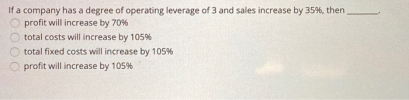 If a company has a degree of operating leverage of 3 and sales increase by 35%, then profit will increase by 70% total costs will increase by 105% total fixed costs will increase by 105% profit will increase by 105%
 Question 25 4 pts company A company with a lower degree of operating leverage will be with a higher degree of operating leverage. None of these O As Less More
 Degree of Operating Leverage, Percent Change in Profit Ringsmith Company is considering two different processes to make its product-process 1 and process 2. Process 1 requires Ringsmith to manufacture subcomponents of the product in-house. As a result, materials are less expensive, but fixed overhead is higher. Process 2 involves purchasing all subcomponents from outside suppliers. The direct materials costs are higher, but fixed factory overhead is considerably lower. Relevant data for a sales level of 37,000 units follow: Process 1...
 13.What is the degree of operating leverage?
14.Using the degree of operating leverage, what is the
estimated percent increase in net operating income of a 5% increase
in sales?
15.Assume that the amounts of the company’s total variable
expenses and total fixed expenses were reversed. In other words,
assume that the total variable expenses are $8,400 and the total
fixed expenses are $21,000. Under this scenario and assuming that
total sales remain the same, what is the degree of operating...
13.What is the degree of operating leverage?
14.Using the degree of operating leverage, what is the
estimated percent increase in net operating income of a 5% increase
in sales?
15.Assume that the amounts of the company’s total variable
expenses and total fixed expenses were reversed. In other words,
assume that the total variable expenses are $8,400 and the total
fixed expenses are $21,000. Under this scenario and assuming that
total sales remain the same, what is the degree of operating...
 13.What is the degree of operating leverage?
14.Using the degree of operating leverage, what is the
estimated percent increase in net operating income of a 5% increase
in sales?
15.Assume that the amounts of the company’s total variable
expenses and total fixed expenses were reversed. In other words,
assume that the total variable expenses are $8,400 and the total
fixed expenses are $21,000. Under this scenario and assuming that
total sales remain the same, what is the degree of operating...
13.What is the degree of operating leverage?
14.Using the degree of operating leverage, what is the
estimated percent increase in net operating income of a 5% increase
in sales?
15.Assume that the amounts of the company’s total variable
expenses and total fixed expenses were reversed. In other words,
assume that the total variable expenses are $8,400 and the total
fixed expenses are $21,000. Under this scenario and assuming that
total sales remain the same, what is the degree of operating...
 If a company has a degree of operating leverage of 3 and sales increase by 35%, then profit will increase by 70% total costs will increase by 105% total fixed costs will increase by 105% profit will increase by 105%
Most questions answered within 3 hours.
-
Where is the error in this code sequence?
String s1 = "Hello";
String s2 = "ello";...
asked 11 months ago -
Financial data for Joel de Paris, Inc., for last year
follow:
Joel de Paris, Inc.
Balance...
asked 11 months ago -
Consider this reaction:
Al2(SO4)3 (aq)+ BaCl3
(aq) Al2Cl6 (aq)- +
3BaSO4(s) . What is the...
asked 11 months ago -
Suppose that Savneet is considering increasing her
recent random sample from 20 car rentals to 40...
asked 11 months ago -
Trucks arrive at an unloading terminal at an average rate of 120
per hour.
Trucks arrive...
asked 11 months ago -
Why are methanol and ethanol completely soluble in water while
octanol is not very little soluble....
asked 11 months ago -
A facilities manager at a university reads in a research report
that the mean amount of...
asked 11 months ago -
When the CuSO4 is rehydrated by adding water to the anhydrous
compound, is this an endothermic...
asked 11 months ago -
A ray of sunlight is passing from diamond into crown glass; the
angle of incidence is...
asked 11 months ago -
A block of mass 0.249 kg is placed on top of a light, vertical
spring of...
asked 11 months ago -
how do the kidneys compensate in the presences of acidosis
a) trigger hyperventilate
b) reserve acid...
asked 11 months ago -
Question 501 pts
The rental rate of capital to the firm increases. Which of the
following...
asked 11 months ago