Q4: P (Z ≥ 1.08 │Z ≥ -.26) = ? I know the answer I was...
Q4: P (Z ≥ 1.08 │Z ≥ -.26) = ?
I know the answer I was just wondering if someone could show the process, thanks
Homework Answers

Hi! I was just wondering if someonw could help me on how to calculate #6. I...
 Hi! I was just wondering if someonw could help me on how to
calculate #6. I was given the answer by the teacher, but not how to
get it. Can someone show me how to calculate to get that
70ml?
Hi! I was just wondering if someonw could help me on how to
calculate #6. I was given the answer by the teacher, but not how to
get it. Can someone show me how to calculate to get that
70ml?
I have the solution and I know that It is E E and Z. Can someone...
 I
have the solution and I know that
It is E E and Z.
Can someone please show me how to determine that on all
three
5. Label each as E or Z CH2OH CH2CO2H CH OH CIH-CH H3C H2NH2
I
have the solution and I know that
It is E E and Z.
Can someone please show me how to determine that on all
three
5. Label each as E or Z CH2OH CH2CO2H CH OH CIH-CH H3C H2NH2
= = = = = =I have the answer, but I don't know how to get...
 =
=
=
=
=
=I have the answer, but I don't know how to get it. Please show
me how to do. thanks
I have the answer, but I don't know how to get it. Please show
me how to do. thanks
I have the answer, but I don't know how to get it. Please show
me how to do. thanks
I have the answer, but I don't know how to get it. Please show
me how to do....
=
=
=
=
=
=I have the answer, but I don't know how to get it. Please show
me how to do. thanks
I have the answer, but I don't know how to get it. Please show
me how to do. thanks
I have the answer, but I don't know how to get it. Please show
me how to do. thanks
I have the answer, but I don't know how to get it. Please show
me how to do....
I know that the answer is a but what are the steps of solving it?? Q4...
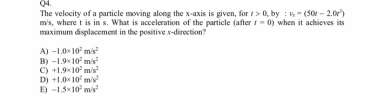 I know that the answer is a but what are the steps of
solving it??
Q4 The velocity of a particle moving along the x-axis is given, for0, by (50r - 2.0r') m/s, where is in s. What is acceleration of the particle (after0) when it achieves its maximum displacement in the positivex-direction? A) -1.0x10² m/s2 B) -1.9x10² m/s2 C) +1.9x10² m/s2 D) +1.0x10² m/s2 E) -1.5x10² m/s2
I know that the answer is a but what are the steps of
solving it??
Q4 The velocity of a particle moving along the x-axis is given, for0, by (50r - 2.0r') m/s, where is in s. What is acceleration of the particle (after0) when it achieves its maximum displacement in the positivex-direction? A) -1.0x10² m/s2 B) -1.9x10² m/s2 C) +1.9x10² m/s2 D) +1.0x10² m/s2 E) -1.5x10² m/s2
9The middle area between z1 and z2 is 0.7500 P(z1<z<z2) - 0.7500 1.04 1.08 1.15 1.04...
 9The middle area between z1 and z2 is 0.7500 P(z1<z<z2) - 0.7500 1.04 1.08 1.15 1.04 1.08 1.15 1.20 10 The middle area between z1 and z2 is 0.8000 P(z1<z<z2) - 0.8000 1.28 1.34 1.41 1.48 1.34 1.41
Hi! I know I don't include the data set I am working with in SAS 9.4,...
Hi! I know I don't include the data set I am working with in SAS 9.4, but I was wondering if someone could show me an example as to how this would look. I know from the directions that I am supposed to have an output statement, but I'm honestly not sure how to find the min, median, mean, and max using proc univariate. Any help would be appreciated. 4. Use a procedure to create summary statistics for the working...
I know the answer is A, just don't know how to get there. Please show full...
 I know the answer is A, just don't know how to get there. Please
show full solution! Thanks
8. 0.625 Pi A billiard ball is moving along the tx axis with constant speed. It collides with a second similar ball which is at rest. After the collision each ball possesses 62.5% of the initial amount of momentum, Pi (see diagram). - - -- X 0.625 Pi Find the angle e. (a) 36.90 (b) 53.1° c ) Neither of these
I know the answer is A, just don't know how to get there. Please
show full solution! Thanks
8. 0.625 Pi A billiard ball is moving along the tx axis with constant speed. It collides with a second similar ball which is at rest. After the collision each ball possesses 62.5% of the initial amount of momentum, Pi (see diagram). - - -- X 0.625 Pi Find the angle e. (a) 36.90 (b) 53.1° c ) Neither of these
You HAPPEN TO KNOW THAT 20% OF ALL THE STUDENTS HAVE BLUE EYES. YOU GATHER A...
You HAPPEN TO KNOW THAT 20% OF ALL THE STUDENTS HAVE BLUE EYES. YOU GATHER A RANDOM SAMPLE OF 50 STUDENTS. FIND A VALUE SUCH THAT THERE IS A 95% PROBABILITY THAT THE SAMPLE PROPORTION WOULD BE GREATER THAN THAT VALUE. PLEASE SHOW WORK SO I CAN TRY AND UNDERSTAND THIS.... someone answered for me but doing the match calculations it just is not working. If someone could break it down for me that would be great. Trying to teach...
I know that the answer to the question is D I just need to know how...
 I know that the answer to the question is D I just need to know
how to work out the problem by hand. Thanks for any and all
help!
7. The return on the risky portfolio is 15%. The risk-free rate as well as the investor's borrowing rate is 10%. The standard deviation of return on the risky portfolio is 20%. If the standard deviation on the complete portfolio is 25%, the expected return on the complete portfolio is A)...
I know that the answer to the question is D I just need to know
how to work out the problem by hand. Thanks for any and all
help!
7. The return on the risky portfolio is 15%. The risk-free rate as well as the investor's borrowing rate is 10%. The standard deviation of return on the risky portfolio is 20%. If the standard deviation on the complete portfolio is 25%, the expected return on the complete portfolio is A)...
Calculate the pH of the solution with 0.050M HNO3. I know the answer is 1.30 but...
Calculate the pH of the solution with 0.050M HNO3. I know the answer is 1.30 but i do not know how to do the work someone please show work and explain.
 Hi! I was just wondering if someonw could help me on how to
calculate #6. I was given the answer by the teacher, but not how to
get it. Can someone show me how to calculate to get that
70ml?
Hi! I was just wondering if someonw could help me on how to
calculate #6. I was given the answer by the teacher, but not how to
get it. Can someone show me how to calculate to get that
70ml?
 I
have the solution and I know that
It is E E and Z.
Can someone please show me how to determine that on all
three
5. Label each as E or Z CH2OH CH2CO2H CH OH CIH-CH H3C H2NH2
I
have the solution and I know that
It is E E and Z.
Can someone please show me how to determine that on all
three
5. Label each as E or Z CH2OH CH2CO2H CH OH CIH-CH H3C H2NH2
 =
=
=
=
=
=I have the answer, but I don't know how to get it. Please show
me how to do. thanks
I have the answer, but I don't know how to get it. Please show
me how to do. thanks
I have the answer, but I don't know how to get it. Please show
me how to do. thanks
I have the answer, but I don't know how to get it. Please show
me how to do....
=
=
=
=
=
=I have the answer, but I don't know how to get it. Please show
me how to do. thanks
I have the answer, but I don't know how to get it. Please show
me how to do. thanks
I have the answer, but I don't know how to get it. Please show
me how to do. thanks
I have the answer, but I don't know how to get it. Please show
me how to do....
 I know that the answer is a but what are the steps of
solving it??
Q4 The velocity of a particle moving along the x-axis is given, for0, by (50r - 2.0r') m/s, where is in s. What is acceleration of the particle (after0) when it achieves its maximum displacement in the positivex-direction? A) -1.0x10² m/s2 B) -1.9x10² m/s2 C) +1.9x10² m/s2 D) +1.0x10² m/s2 E) -1.5x10² m/s2
I know that the answer is a but what are the steps of
solving it??
Q4 The velocity of a particle moving along the x-axis is given, for0, by (50r - 2.0r') m/s, where is in s. What is acceleration of the particle (after0) when it achieves its maximum displacement in the positivex-direction? A) -1.0x10² m/s2 B) -1.9x10² m/s2 C) +1.9x10² m/s2 D) +1.0x10² m/s2 E) -1.5x10² m/s2
 9The middle area between z1 and z2 is 0.7500 P(z1<z<z2) - 0.7500 1.04 1.08 1.15 1.04 1.08 1.15 1.20 10 The middle area between z1 and z2 is 0.8000 P(z1<z<z2) - 0.8000 1.28 1.34 1.41 1.48 1.34 1.41
 I know the answer is A, just don't know how to get there. Please
show full solution! Thanks
8. 0.625 Pi A billiard ball is moving along the tx axis with constant speed. It collides with a second similar ball which is at rest. After the collision each ball possesses 62.5% of the initial amount of momentum, Pi (see diagram). - - -- X 0.625 Pi Find the angle e. (a) 36.90 (b) 53.1° c ) Neither of these
I know the answer is A, just don't know how to get there. Please
show full solution! Thanks
8. 0.625 Pi A billiard ball is moving along the tx axis with constant speed. It collides with a second similar ball which is at rest. After the collision each ball possesses 62.5% of the initial amount of momentum, Pi (see diagram). - - -- X 0.625 Pi Find the angle e. (a) 36.90 (b) 53.1° c ) Neither of these
 I know that the answer to the question is D I just need to know
how to work out the problem by hand. Thanks for any and all
help!
7. The return on the risky portfolio is 15%. The risk-free rate as well as the investor's borrowing rate is 10%. The standard deviation of return on the risky portfolio is 20%. If the standard deviation on the complete portfolio is 25%, the expected return on the complete portfolio is A)...
I know that the answer to the question is D I just need to know
how to work out the problem by hand. Thanks for any and all
help!
7. The return on the risky portfolio is 15%. The risk-free rate as well as the investor's borrowing rate is 10%. The standard deviation of return on the risky portfolio is 20%. If the standard deviation on the complete portfolio is 25%, the expected return on the complete portfolio is A)...
Most questions answered within 3 hours.
-
Where is the error in this code sequence?
String s1 = "Hello";
String s2 = "ello";...
asked 11 months ago -
Financial data for Joel de Paris, Inc., for last year
follow:
Joel de Paris, Inc.
Balance...
asked 11 months ago -
Consider this reaction:
Al2(SO4)3 (aq)+ BaCl3
(aq) Al2Cl6 (aq)- +
3BaSO4(s) . What is the...
asked 11 months ago -
Suppose that Savneet is considering increasing her
recent random sample from 20 car rentals to 40...
asked 11 months ago -
Trucks arrive at an unloading terminal at an average rate of 120
per hour.
Trucks arrive...
asked 11 months ago -
Why are methanol and ethanol completely soluble in water while
octanol is not very little soluble....
asked 11 months ago -
A facilities manager at a university reads in a research report
that the mean amount of...
asked 11 months ago -
When the CuSO4 is rehydrated by adding water to the anhydrous
compound, is this an endothermic...
asked 11 months ago -
A ray of sunlight is passing from diamond into crown glass; the
angle of incidence is...
asked 11 months ago -
A block of mass 0.249 kg is placed on top of a light, vertical
spring of...
asked 11 months ago -
how do the kidneys compensate in the presences of acidosis
a) trigger hyperventilate
b) reserve acid...
asked 11 months ago -
Question 501 pts
The rental rate of capital to the firm increases. Which of the
following...
asked 11 months ago