Draw a picture of the graph with vertices {v1, v2, v3} and edges {(v1, v1), (v1,...
Draw a picture of the graph with vertices {v1, v2, v3} and edges {(v1, v1), (v1, v2), (v2, v3), (v2, v1), (v3, v1)}. (2 Points)
Homework Answers
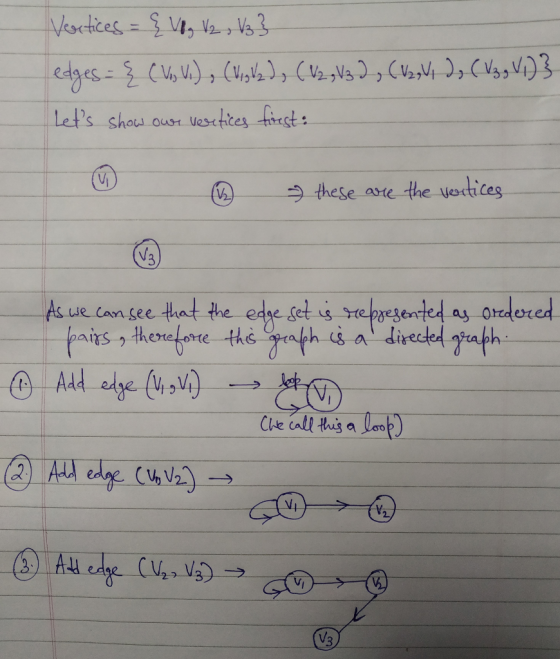
The picture of the graph is drawn and is provided in the photos below, so see the photos carefully in order to understand the answer.
Each edge and each vertex is shown in the graph and each edge is added to the graph one by one.
You can see in the photos, how the graph is drawn.
You will also get to know whether the graph is directed or undirected.
Please see the photos below.

Add Answer to:
Draw a picture of the graph with vertices {v1, v2, v3} and edges
{(v1, v1), (v1,...
Consider the following graph. V(G) = {v1, v2, v3, v4}, e(G) = {e1, e2, e3, e4,...
 Consider the following graph. V(G) = {v1, v2, v3, v4}, e(G) = {e1, e2, e3, e4, e5}, E(G) = {(e1,[v1,v2]),(e2,[v2,v3]),(e3,[v3,v4]), (e4, (v4,v1)), (e5,[v1,v3])} Draw a picture of the graph on scratch paper to help you answer the following two questions. How many edges are in a spanning tree for graph G? What is the weight of a minimum-weight spanning tree for the graph G if the weight of an edge is defined to be W (ei) L]?
Graphs (15 points) 14. For the following graph (8 points): a. Find all the edges that...
 Graphs (15 points) 14. For the following graph (8 points): a. Find all the edges that are incident of v1: b. Find all the vertices that are adjacent to v3: C. Find all the edges that are adjacent to e1: d. Find all the loops: e. Find all the parallel edges: f. Find all the isolated vertices: g. Find the degree of v3: h. Find the total degree of the graph: e3 e2 V2 VI 26 e4 e7 es 05...
Let V1 = (1,2,0)^T, V2 = (2,4,2)^T, and V3 = (0,2,7)T and A = [V1,V2,V3] 5)...
 Let V1 = (1,2,0)^T, V2 = (2,4,2)^T, and V3 = (0,2,7)T and A =
[V1,V2,V3]
5) (20 points) Let vi = (1,2,0)T, v2 = (2,4, 2)T and v3 = (0, 2.7)T and A- [v1, v2, v3 a) Find an orthonormal basis for the Col(A) b) Find a QR factorization of A. c) Show that A is symmetric and find the quadratic form whose standard matrix is A
Let V1 = (1,2,0)^T, V2 = (2,4,2)^T, and V3 = (0,2,7)T and A =
[V1,V2,V3]
5) (20 points) Let vi = (1,2,0)T, v2 = (2,4, 2)T and v3 = (0, 2.7)T and A- [v1, v2, v3 a) Find an orthonormal basis for the Col(A) b) Find a QR factorization of A. c) Show that A is symmetric and find the quadratic form whose standard matrix is A
Suppose V1, V2, V3 is an orthogonal set of vectors in R5. Let w be a vector in span(V1, V2, V3) such that
Suppose V1, V2, V3 is an orthogonal set of vectors in R5. Let w be a vector in span(V1, V2, V3) such that (V1, V1) = 51, (V2, V2) = 638, (V3, V3) = 36, (w, V1) = 153, (w, v2) = 4466, (w, V3) = -36, then W = _______ V1 + _______ V2+ _______ V3.
Discrete Mathematics 6: A: Draw a graph with 5 vertices and the requisite number of edges...
 Discrete Mathematics
6: A: Draw a graph with 5 vertices and the requisite number of edges to show that if four of the vertices have degree 2, it would be impossible for the 5 vertex to have degree 1. Repetition of edges is not permitted. (There may not be two different bridges connecting the same pair of vertices.) B: Draw a graph with 4 vertices and determine the largest number of edges the graph can have, assuming repetition of edges...
Discrete Mathematics
6: A: Draw a graph with 5 vertices and the requisite number of edges to show that if four of the vertices have degree 2, it would be impossible for the 5 vertex to have degree 1. Repetition of edges is not permitted. (There may not be two different bridges connecting the same pair of vertices.) B: Draw a graph with 4 vertices and determine the largest number of edges the graph can have, assuming repetition of edges...
Draw a graph with 5 vertices, ten edges and no cycles
Draw a graph with 5 vertices, ten edges and no cycles
Let H = Span{V1, V2} and K = Span{V3,V4}, where V1, V2, V3, and V4 are...
 Let H = Span{V1, V2} and K = Span{V3,V4}, where V1, V2, V3, and V4 are given below. 1 V1 V2 V4 - 10 7 9 3 -6 Then Hand K are subspaces of R3. In fact, H and K are planes in R3 through the origin, and they intersect in a line through 0. Find a nonzero vector w that generates that line. W= [Hint: w can be written as C1 V2 + c2V2 and also as c3 V3...
1) Determine if w is in the subspace spanned by v1, v2, v3 2) Are the...
 1) Determine if w is in the subspace spanned by v1, v2,
v3
2) Are the vectors v1, v2, v3 linearly dependent or
independent? justify your answer
Question 2. (15 pts) Let vi=(-3 0 6)", v2= (-2 2 3]", V3= (0 - 6 37, and w= [1 11 9". (1). Determine if w is in the subspace spanned by V1, V2, V3. (2). Are the vectors V1, V2, V3 linearly dependent or independent? Justify your answer
1) Determine if w is in the subspace spanned by v1, v2,
v3
2) Are the vectors v1, v2, v3 linearly dependent or
independent? justify your answer
Question 2. (15 pts) Let vi=(-3 0 6)", v2= (-2 2 3]", V3= (0 - 6 37, and w= [1 11 9". (1). Determine if w is in the subspace spanned by V1, V2, V3. (2). Are the vectors V1, V2, V3 linearly dependent or independent? Justify your answer
Consider the following graph G: v2 v3 v1 v4 v5 Is the following statement true or...
 Consider the following graph G: v2 v3 v1 v4 v5 Is the following statement true or false: G is connected. True False
- Given: V1 = H. V2 = - - - , V3 = Show that S...
 - Given: V1 = H. V2 = - - - , V3 = Show that S = {V1, V2, V3} is a basis for Rº and then construct an orthonormal basis {U1, U2, U3}.
 Consider the following graph. V(G) = {v1, v2, v3, v4}, e(G) = {e1, e2, e3, e4, e5}, E(G) = {(e1,[v1,v2]),(e2,[v2,v3]),(e3,[v3,v4]), (e4, (v4,v1)), (e5,[v1,v3])} Draw a picture of the graph on scratch paper to help you answer the following two questions. How many edges are in a spanning tree for graph G? What is the weight of a minimum-weight spanning tree for the graph G if the weight of an edge is defined to be W (ei) L]?
 Graphs (15 points) 14. For the following graph (8 points): a. Find all the edges that are incident of v1: b. Find all the vertices that are adjacent to v3: C. Find all the edges that are adjacent to e1: d. Find all the loops: e. Find all the parallel edges: f. Find all the isolated vertices: g. Find the degree of v3: h. Find the total degree of the graph: e3 e2 V2 VI 26 e4 e7 es 05...
 Let V1 = (1,2,0)^T, V2 = (2,4,2)^T, and V3 = (0,2,7)T and A =
[V1,V2,V3]
5) (20 points) Let vi = (1,2,0)T, v2 = (2,4, 2)T and v3 = (0, 2.7)T and A- [v1, v2, v3 a) Find an orthonormal basis for the Col(A) b) Find a QR factorization of A. c) Show that A is symmetric and find the quadratic form whose standard matrix is A
Let V1 = (1,2,0)^T, V2 = (2,4,2)^T, and V3 = (0,2,7)T and A =
[V1,V2,V3]
5) (20 points) Let vi = (1,2,0)T, v2 = (2,4, 2)T and v3 = (0, 2.7)T and A- [v1, v2, v3 a) Find an orthonormal basis for the Col(A) b) Find a QR factorization of A. c) Show that A is symmetric and find the quadratic form whose standard matrix is A
 Discrete Mathematics
6: A: Draw a graph with 5 vertices and the requisite number of edges to show that if four of the vertices have degree 2, it would be impossible for the 5 vertex to have degree 1. Repetition of edges is not permitted. (There may not be two different bridges connecting the same pair of vertices.) B: Draw a graph with 4 vertices and determine the largest number of edges the graph can have, assuming repetition of edges...
Discrete Mathematics
6: A: Draw a graph with 5 vertices and the requisite number of edges to show that if four of the vertices have degree 2, it would be impossible for the 5 vertex to have degree 1. Repetition of edges is not permitted. (There may not be two different bridges connecting the same pair of vertices.) B: Draw a graph with 4 vertices and determine the largest number of edges the graph can have, assuming repetition of edges...
 Let H = Span{V1, V2} and K = Span{V3,V4}, where V1, V2, V3, and V4 are given below. 1 V1 V2 V4 - 10 7 9 3 -6 Then Hand K are subspaces of R3. In fact, H and K are planes in R3 through the origin, and they intersect in a line through 0. Find a nonzero vector w that generates that line. W= [Hint: w can be written as C1 V2 + c2V2 and also as c3 V3...
 1) Determine if w is in the subspace spanned by v1, v2,
v3
2) Are the vectors v1, v2, v3 linearly dependent or
independent? justify your answer
Question 2. (15 pts) Let vi=(-3 0 6)", v2= (-2 2 3]", V3= (0 - 6 37, and w= [1 11 9". (1). Determine if w is in the subspace spanned by V1, V2, V3. (2). Are the vectors V1, V2, V3 linearly dependent or independent? Justify your answer
1) Determine if w is in the subspace spanned by v1, v2,
v3
2) Are the vectors v1, v2, v3 linearly dependent or
independent? justify your answer
Question 2. (15 pts) Let vi=(-3 0 6)", v2= (-2 2 3]", V3= (0 - 6 37, and w= [1 11 9". (1). Determine if w is in the subspace spanned by V1, V2, V3. (2). Are the vectors V1, V2, V3 linearly dependent or independent? Justify your answer
 Consider the following graph G: v2 v3 v1 v4 v5 Is the following statement true or false: G is connected. True False
 - Given: V1 = H. V2 = - - - , V3 = Show that S = {V1, V2, V3} is a basis for Rº and then construct an orthonormal basis {U1, U2, U3}.
Most questions answered within 3 hours.
-
Where is the error in this code sequence?
String s1 = "Hello";
String s2 = "ello";...
asked 11 months ago -
Financial data for Joel de Paris, Inc., for last year
follow:
Joel de Paris, Inc.
Balance...
asked 11 months ago -
Consider this reaction:
Al2(SO4)3 (aq)+ BaCl3
(aq) Al2Cl6 (aq)- +
3BaSO4(s) . What is the...
asked 11 months ago -
Suppose that Savneet is considering increasing her
recent random sample from 20 car rentals to 40...
asked 11 months ago -
Trucks arrive at an unloading terminal at an average rate of 120
per hour.
Trucks arrive...
asked 11 months ago -
Why are methanol and ethanol completely soluble in water while
octanol is not very little soluble....
asked 11 months ago -
A facilities manager at a university reads in a research report
that the mean amount of...
asked 11 months ago -
When the CuSO4 is rehydrated by adding water to the anhydrous
compound, is this an endothermic...
asked 11 months ago -
A ray of sunlight is passing from diamond into crown glass; the
angle of incidence is...
asked 11 months ago -
A block of mass 0.249 kg is placed on top of a light, vertical
spring of...
asked 11 months ago -
how do the kidneys compensate in the presences of acidosis
a) trigger hyperventilate
b) reserve acid...
asked 11 months ago -
Question 501 pts
The rental rate of capital to the firm increases. Which of the
following...
asked 11 months ago