Which linkages present in nucleic acids are subject to hydrolysis? a. base-sugar b. sugar-phosphate c. phosphate-phosphate...
Which linkages present in nucleic acids are subject to hydrolysis?
a. base-sugar
b. sugar-phosphate
c. phosphate-phosphate
d. sugar-amino acid
Homework Answers

Add Answer to:
Which linkages present in nucleic acids are subject to
hydrolysis?
a. base-sugar
b. sugar-phosphate
c. phosphate-phosphate...
A8. Which of the following describes carbohydrates? (a) a base, a sugar, and a phosphate b)...
 A8. Which of the following describes carbohydrates? (a) a base, a sugar, and a phosphate b) aldchydes and ketones with two or more hydroxyl groups. c) acids with two or more hydroxyl groups. d) amines with two or more hydroxyl groups. e) always contain a phosphate group. A9. Which of the following is NOT correct regarding reducing sugars? a) Sugars that react with oxidizing agents are called reducing sugars. b) The cyclic form of a monosaccharide reacts with oxidizing agents....
Art-Labeling Activity: Structure of the nucleic acids DNA and RNA Reset Double-helical DNA Sugar-phosphate backbone (RNA)...
 Art-Labeling Activity: Structure of the nucleic acids DNA and RNA Reset Double-helical DNA Sugar-phosphate backbone (RNA) Hydrogen bonds Complementary base pairing Phosphate group Deoxyribose Single-stranded RNA Sugar-phosphate backbone (DNA) Base uracil in place of thymine OR AO
4. Which of the following statements best describes why the sugar phosphate nucleic acid backbone is...
 4. Which of the following statements best describes why the sugar phosphate nucleic acid backbone is on the outer part of the DNA double helix while the nitrogen bases are on the inside of the double helix? A) The sugar phosphate backbone is hydrophilic while the bases are hydrophobic. B) The sugar phosphate backbone is hydrophobic while the bases are hydrophilic. C) The sugar phosphate backbones of the two strands are bonded together. D) The nitrogen bases are covalently bonded...
60) Lipids are composed of: c) fatty acids and glycerol amino acids and glycerol nucleic acids...
 60) Lipids are composed of: c) fatty acids and glycerol amino acids and glycerol nucleic acids and glycerol fatty acids and water fatty acids and sugar e) 61) The bond between two amino acids is a: a) hydrogen bond b) covalent bond c) peptide bond d) b and c e) none of the above 62) Hemoglobin has which tertiary structure: a) fibrous b) globular c) four subunits--two alpha chains, two beta chains d) alpha helix e) none of the above...
3. A Nucleic acid is a polymer made up of which kind of monomers? a) modified...
 3. A Nucleic acid is a polymer made up of which kind of monomers? a) modified glucose and phosphate. b) a modified sugar, a phosphate and an amino acids, c), a 5-C sugar and phosphate groups, d) fatty acids and glycerol, e) a nucleotides. 4. WhenCV and H' react to form CH, the number of electrons involved in bonding is? a) 1, b) 2, c) 6. d) 8. e) 4. 5. Serine is an amino acid in which the elements...
Question 1 (0.5 points) Saved Proteins are formed by joining together. carboxylic acids fatty acids amino...
 Question 1 (0.5 points) Saved Proteins are formed by joining together. carboxylic acids fatty acids amino acids none of the above Question 2 (0.5 points) Which two functional groups does an amino acid contain? amine and carboxylic acid carboxylic acid and amide amide and heterocyclic ring heterocyclic ring and amine Question 3 (0.5 points) Do amino acids commonly exist in nature as neutral molecules with all uncharged atoms? Yes No Question 1 (0.5 points) What is a protein? A polymer...
15. In the nucleotides found in nucleic acids, the linkage between the bases and the sugar...
 15. In the nucleotides found in nucleic acids, the linkage between the bases and the sugar involve: A. N-1 of pyrimidines and C-1 of the sugar B. N-3 of pyrimidines and C-l of the sugar C. N-1 of purines and C-5 of the sugar D. N-9 of purines and C-2 of the sugar 25. A common feature of membrane lipids is their amphipathic nature. For each of the membrane lipids, name and draw the components that serve as the hydrophobic...
The monomeric units of nucleic acids are which of these? Select one: a. Purines b. Nucleotides...
The monomeric units of nucleic acids are which of these? Select one: a. Purines b. Nucleotides c. Phosphate ions d. D-ribose or 2-deoxy-D-ribose e. Nucleosides
Which of the following statements regarding nucleic acids is correct? A. mRNA codes for proteins. B....
Which of the following statements regarding nucleic acids is correct? A. mRNA codes for proteins. B. tRNA makes lipids C. mRNA codes for DNA D. tRNA makes amino acids
Which characteristic of nucleotides is essential for genetic recombination to occur? a sugar-phosphate hydrogen bonds O...
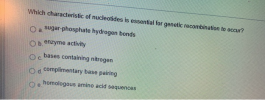 Which characteristic of nucleotides is essential for genetic recombination to occur? a sugar-phosphate hydrogen bonds O b. enzyme activity c bases containing nitrogen od complimentary base pairing be homologous amino acid sequences
 A8. Which of the following describes carbohydrates? (a) a base, a sugar, and a phosphate b) aldchydes and ketones with two or more hydroxyl groups. c) acids with two or more hydroxyl groups. d) amines with two or more hydroxyl groups. e) always contain a phosphate group. A9. Which of the following is NOT correct regarding reducing sugars? a) Sugars that react with oxidizing agents are called reducing sugars. b) The cyclic form of a monosaccharide reacts with oxidizing agents....
 Art-Labeling Activity: Structure of the nucleic acids DNA and RNA Reset Double-helical DNA Sugar-phosphate backbone (RNA) Hydrogen bonds Complementary base pairing Phosphate group Deoxyribose Single-stranded RNA Sugar-phosphate backbone (DNA) Base uracil in place of thymine OR AO
 4. Which of the following statements best describes why the sugar phosphate nucleic acid backbone is on the outer part of the DNA double helix while the nitrogen bases are on the inside of the double helix? A) The sugar phosphate backbone is hydrophilic while the bases are hydrophobic. B) The sugar phosphate backbone is hydrophobic while the bases are hydrophilic. C) The sugar phosphate backbones of the two strands are bonded together. D) The nitrogen bases are covalently bonded...
 60) Lipids are composed of: c) fatty acids and glycerol amino acids and glycerol nucleic acids and glycerol fatty acids and water fatty acids and sugar e) 61) The bond between two amino acids is a: a) hydrogen bond b) covalent bond c) peptide bond d) b and c e) none of the above 62) Hemoglobin has which tertiary structure: a) fibrous b) globular c) four subunits--two alpha chains, two beta chains d) alpha helix e) none of the above...
 3. A Nucleic acid is a polymer made up of which kind of monomers? a) modified glucose and phosphate. b) a modified sugar, a phosphate and an amino acids, c), a 5-C sugar and phosphate groups, d) fatty acids and glycerol, e) a nucleotides. 4. WhenCV and H' react to form CH, the number of electrons involved in bonding is? a) 1, b) 2, c) 6. d) 8. e) 4. 5. Serine is an amino acid in which the elements...
 Question 1 (0.5 points) Saved Proteins are formed by joining together. carboxylic acids fatty acids amino acids none of the above Question 2 (0.5 points) Which two functional groups does an amino acid contain? amine and carboxylic acid carboxylic acid and amide amide and heterocyclic ring heterocyclic ring and amine Question 3 (0.5 points) Do amino acids commonly exist in nature as neutral molecules with all uncharged atoms? Yes No Question 1 (0.5 points) What is a protein? A polymer...
 15. In the nucleotides found in nucleic acids, the linkage between the bases and the sugar involve: A. N-1 of pyrimidines and C-1 of the sugar B. N-3 of pyrimidines and C-l of the sugar C. N-1 of purines and C-5 of the sugar D. N-9 of purines and C-2 of the sugar 25. A common feature of membrane lipids is their amphipathic nature. For each of the membrane lipids, name and draw the components that serve as the hydrophobic...
 Which characteristic of nucleotides is essential for genetic recombination to occur? a sugar-phosphate hydrogen bonds O b. enzyme activity c bases containing nitrogen od complimentary base pairing be homologous amino acid sequences
Most questions answered within 3 hours.
-
Where is the error in this code sequence?
String s1 = "Hello";
String s2 = "ello";...
asked 10 months ago -
Financial data for Joel de Paris, Inc., for last year
follow:
Joel de Paris, Inc.
Balance...
asked 10 months ago -
Consider this reaction:
Al2(SO4)3 (aq)+ BaCl3
(aq) Al2Cl6 (aq)- +
3BaSO4(s) . What is the...
asked 10 months ago -
Suppose that Savneet is considering increasing her
recent random sample from 20 car rentals to 40...
asked 10 months ago -
Trucks arrive at an unloading terminal at an average rate of 120
per hour.
Trucks arrive...
asked 10 months ago -
Why are methanol and ethanol completely soluble in water while
octanol is not very little soluble....
asked 10 months ago -
A facilities manager at a university reads in a research report
that the mean amount of...
asked 10 months ago -
When the CuSO4 is rehydrated by adding water to the anhydrous
compound, is this an endothermic...
asked 10 months ago -
A ray of sunlight is passing from diamond into crown glass; the
angle of incidence is...
asked 10 months ago -
A block of mass 0.249 kg is placed on top of a light, vertical
spring of...
asked 10 months ago -
how do the kidneys compensate in the presences of acidosis
a) trigger hyperventilate
b) reserve acid...
asked 10 months ago -
Question 501 pts
The rental rate of capital to the firm increases. Which of the
following...
asked 10 months ago