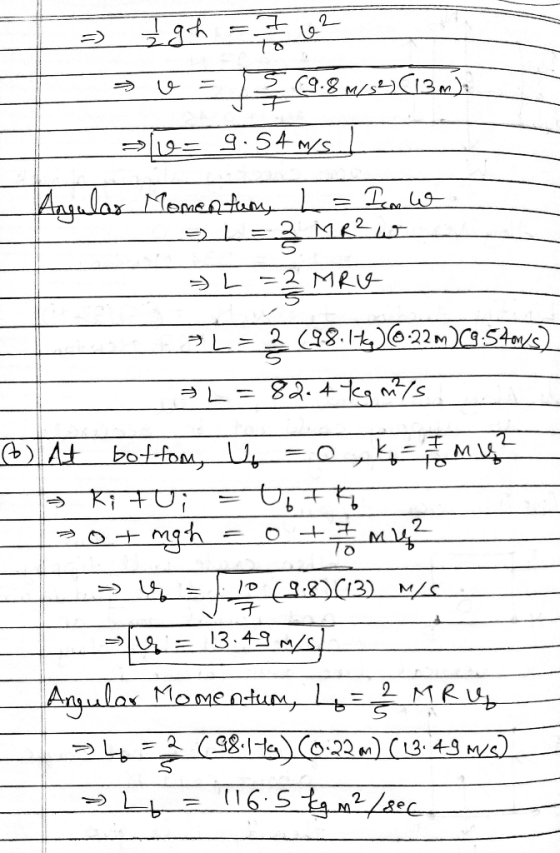
A spherical boulder of mass 98.1 kg and radius 22 cm rolls without slipping down a...
A spherical boulder of mass 98.1 kg and radius 22 cm rolls
without slipping down a hill 13 m high from rest.
(a)What is its angular momentum about its center when it is half
way down the hill?
Ans: 82.4 kg. m2/s
(b)What is its angular momentum about its center when it is at
the bottom?
Ans: 116 kg. m2/s
please show work thank you
Homework Answers
Here we apply concept of rotational kinetic energy and mechanical energy conservation.

Add Answer to:
A spherical boulder of mass 98.1 kg and radius 22 cm rolls
without slipping down a...
A spherical boulder of mass 147 kg and radius 26 cm rolls without slipping down a...
A spherical boulder of mass 147 kg and radius 26 cm rolls without slipping down a hill 13 m high from rest. (a) What is its angular momentum about its center when it is half way down the hill? (Enter the magnitude in kg · m2/s.) 90.4 Incorrect: Your answer is incorrect. kg · m2/s (b) What is its angular momentum about its center when it is at the bottom? (Enter the magnitude in kg · m2/s.)
A cylinder of mass 11.0 kg and radius 0.260m rolls without slipping on a horizontal surface....
A cylinder of mass 11.0 kg and radius 0.260m rolls without slipping on a horizontal surface. At a particular instant, its center of mass has a speed of 7.30 m/s. Its rotational kinetic energy about its center of mass is then 147J. a) What is in kg m2 its moment of inertia about its center of mass? b) What is in J its linear kinetic energy at that instant? c) What is in J its total kinetic energy at that...
A 3 kg hollow sphere with a radius of 15 cm rolls without slipping down a...
A 3 kg hollow sphere with a radius of 15 cm rolls without slipping down a rough incline of 35 angle. If the sphere rolls from rest, from a height of 45 cm, determine its angular speed at the bottom of the incline.
A solid sphere of mass 1.5 kg and radius 15 cm rolls without slipping down...
A solid sphere of mass 1.5 kg and radius 15 cm rolls without slipping down a 35° incline that is 7.9 m long. Assume it started from rest. The moment of inertia of a sphere is given by I = 2/5MR2. (a) Calculate the linear speed of the sphere when it reaches the bottom of the incline. (b) Determine the angular speed of the sphere at the bottom of the incline.
A solid disk (radius R=2.5 cm , mass M =0.35 kg) rolls without slipping down an...
A solid disk (radius R=2.5 cm , mass M =0.35 kg) rolls without slipping down an 30 degree-incline. If the incline is 4.2 m long and the disk starts from rest, what is the linear velocity of its center of mass at the bottom of the incline (in m/s)?
A 1.9 m radius cylinder with a mass of 531.1 kg rolls without slipping down a...
A 1.9 m radius cylinder with a mass of 531.1 kg rolls without slipping down a hill which is 56.5 meters high. At the bottom of the hill, what fraction of its total kinetic energy is invested in rotational kinetic energy?
A 1.2 m radius cylinder with a mass of 8.8 kg rolls without slipping down a...
A 1.2 m radius cylinder with a mass of 8.8 kg rolls without slipping down a hill which is 5.7 meters high. At the bottom of the hill, what percentage of its total kinetic energy is invested in rotational kinetic energy?
A 1.2 m radius cylinder with a mass of 5.9 kg rolls without slipping down a...
A 1.2 m radius cylinder with a mass of 5.9 kg rolls without slipping down a hill which is 8.2 meters high. At the bottom of the hill, what fraction of its total kinetic energy is invested in rotational kinetic energy?
1) A solid ball of mass M and radius R rolls without slipping down a hill...
1) A solid ball of mass M and radius R rolls without slipping down a hill with slope tan θ. (That is θ is the angle of the hill relative to the horizontal direction.) What is the static frictional force acting on it? It is possible to solve this question in a fairly simple way using two ingredients: a) As derived in the worksheet when an object of moment of inertia I, mass M and radius R starts at rest...
Most questions answered within 3 hours.
-
Where is the error in this code sequence?
String s1 = "Hello";
String s2 = "ello";...
asked 11 months ago -
Financial data for Joel de Paris, Inc., for last year
follow:
Joel de Paris, Inc.
Balance...
asked 11 months ago -
Consider this reaction:
Al2(SO4)3 (aq)+ BaCl3
(aq) Al2Cl6 (aq)- +
3BaSO4(s) . What is the...
asked 11 months ago -
Suppose that Savneet is considering increasing her
recent random sample from 20 car rentals to 40...
asked 11 months ago -
Trucks arrive at an unloading terminal at an average rate of 120
per hour.
Trucks arrive...
asked 11 months ago -
Why are methanol and ethanol completely soluble in water while
octanol is not very little soluble....
asked 11 months ago -
A facilities manager at a university reads in a research report
that the mean amount of...
asked 11 months ago -
When the CuSO4 is rehydrated by adding water to the anhydrous
compound, is this an endothermic...
asked 11 months ago -
A ray of sunlight is passing from diamond into crown glass; the
angle of incidence is...
asked 11 months ago -
A block of mass 0.249 kg is placed on top of a light, vertical
spring of...
asked 11 months ago -
how do the kidneys compensate in the presences of acidosis
a) trigger hyperventilate
b) reserve acid...
asked 11 months ago -
Question 501 pts
The rental rate of capital to the firm increases. Which of the
following...
asked 11 months ago