What is the difference between a radiopharmaceutical and a radioisotope?
What is the difference between a radiopharmaceutical and a radioisotope?
Homework Answers
Radiopharmaceuticals have been defined as radioactive drugs that, when used for the purpose of diagnosis or therapy, typically elicit no physiological response from the patient. This definition is strongly supported by the Nuclear Medicine community's collective experience in administering radiopharmaceuticals: most practitioners, in their entire careers, have not observed a physiological response or an adverse reaction following administration of a radiopharmaceutical.
The design of these compounds is based solely upon physiological function of the target organ. Unlike radiographic procedures, which depend almost entirely upon tissue density differences, external imaging of radiopharmaceuticals is essentially independent of the density of the target organ. The mechanism of localization of a radiopharmaceutical in a particular target organ can be as simple as the physical trapping of particles or as sophisticated as an antigen-antibody reaction or chemisorption of an inorganic phosphate on the hydroxyapatite crystals deposited in an acute myocardial infarction.
There is a significant difference between a radioisotope (a radionuclide whose chemical form is unknown) and a radiopharmaceutical whose chemical form is usually precisely known. For example, I-123 is a radioisotope with a characteristic physical half-life. Reference to a biological half-life or an effective half-life for I-123 is meaningless since we don't know the chemical form. On the other hand, I-123 NaI is a compound with known biodistribution and clearance rates and is associated with both biological and effective half-lives.
Add Answer to:
What is the difference between a radiopharmaceutical and a
radioisotope?
Please show steps, thank you If a radiopharmaceutical has an effective half life of 75 seconds...
 Please show steps, thank you
If a radiopharmaceutical has an effective half life of 75 seconds and a biological half life of 6 minutes what is the physical half life in minutes? If a radiopharmaceutical has an effective half life of 190 seconds and a physical half life of 42 minutes what is the biological half life in minutes? If a radiopharmaceutical has an effective half life of 110 minutes and a physical half life of 150 minutes what is...
Please show steps, thank you
If a radiopharmaceutical has an effective half life of 75 seconds and a biological half life of 6 minutes what is the physical half life in minutes? If a radiopharmaceutical has an effective half life of 190 seconds and a physical half life of 42 minutes what is the biological half life in minutes? If a radiopharmaceutical has an effective half life of 110 minutes and a physical half life of 150 minutes what is...
22) Aradioactive compound used for the diagnosis and treatment of disease is called a 23) The...
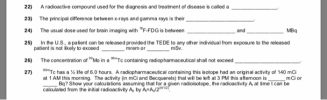 22) Aradioactive compound used for the diagnosis and treatment of disease is called a 23) The principal difference between x-rays and gamma rays is their 24) The usual dose used for brain imaging with F-FDG is between 25) n the U.S., a patient can be released provided the TEDE to any other individual from exposure to the released and MBq patient is not ikely to exceedmrem or mSv 26) The concentration of Mo in a Tc containing radiopharmaceutical shall not...
What is the difference between test of controls and substantive test? What is the difference between...
What is the difference between test of controls and substantive test? What is the difference between audit risk and risk of material misstatement? What is the difference between a controls reliance audit and a substantive audit? What is the purpose of COSO? What is the role of the PCAOB, SEC, and AICPA?
What is the difference between competitive and irreversible inhibitors? What is the difference between a suicide...
What is the difference between competitive and irreversible inhibitors? What is the difference between a suicide inhibitor and a competitive inhibitor?
A. What is the difference between homomorphic and heteromorphic chromosomes? B. What is the difference between...
A. What is the difference between homomorphic and heteromorphic chromosomes? B. What is the difference between homogametic and heterogametic sexes? C. Relate these terms to human sex determination.
Review Problem5 * The half value layer of lead is o.27cm for 1131. If a radiopharmaceutical dose is producing 125mR...
 Review Problem5 * The half value layer of lead is o.27cm for 1131. If a radiopharmaceutical dose is producing 125mR/hr, what will be the exposure rate if the dose is placed in a lead shield that has a thickness of 4mm?
Review Problem5 * The half value layer of lead is o.27cm for 1131. If a radiopharmaceutical dose is producing 125mR/hr, what will be the exposure rate if the dose is placed in a lead shield that has a thickness...
Review Problem5 * The half value layer of lead is o.27cm for 1131. If a radiopharmaceutical dose is producing 125mR/hr, what will be the exposure rate if the dose is placed in a lead shield that has a thickness of 4mm?
Review Problem5 * The half value layer of lead is o.27cm for 1131. If a radiopharmaceutical dose is producing 125mR/hr, what will be the exposure rate if the dose is placed in a lead shield that has a thickness...
1. Choose one of the radioisotopes from the list or find a radioisotope that is not...
1. Choose one of the radioisotopes from the list or find a radioisotope that is not on the list but interests you. 2. Using your book and Internet resources, find five interesting pieces of information on the radioisotope you selected. Suggested pieces of information may include: -How is the radioisotope formed in nature (type of decay)? -Risks associated with the radioisotope -Number of subatomic nucleons present -Stability of the radioisotope -How this radioisotope is used. -Is the radioisotope used as...
Show steps please If a radiopharmaceutical has an effective half life of 36 hours and a...
 Show steps please
If a radiopharmaceutical has an effective half life of 36 hours and a biological half life of 8 days what is the physical half life in hours?
Show steps please
If a radiopharmaceutical has an effective half life of 36 hours and a biological half life of 8 days what is the physical half life in hours?
What is the difference between a benign and a malignant tumor? What is the difference between...
What is the difference between a benign and a malignant tumor? What is the difference between a benign and a malignant tumor? Benign tumors are not the result of a failure of a cell cycle control system; malignant tumors are. Benign tumors do not form lumps; malignant tumors do form lumps. Benign tumors are composed of cancer cells; malignant tumors are not. Benign tumors do not metastasize; malignant tumors do.
What is the difference between P(A|B) and P(A|B=x)? What is the difference between RVs and events?
What is the difference between P(A|B) and P(A|B=x)? What is the difference between RVs and events?
 Please show steps, thank you
If a radiopharmaceutical has an effective half life of 75 seconds and a biological half life of 6 minutes what is the physical half life in minutes? If a radiopharmaceutical has an effective half life of 190 seconds and a physical half life of 42 minutes what is the biological half life in minutes? If a radiopharmaceutical has an effective half life of 110 minutes and a physical half life of 150 minutes what is...
Please show steps, thank you
If a radiopharmaceutical has an effective half life of 75 seconds and a biological half life of 6 minutes what is the physical half life in minutes? If a radiopharmaceutical has an effective half life of 190 seconds and a physical half life of 42 minutes what is the biological half life in minutes? If a radiopharmaceutical has an effective half life of 110 minutes and a physical half life of 150 minutes what is...
 22) Aradioactive compound used for the diagnosis and treatment of disease is called a 23) The principal difference between x-rays and gamma rays is their 24) The usual dose used for brain imaging with F-FDG is between 25) n the U.S., a patient can be released provided the TEDE to any other individual from exposure to the released and MBq patient is not ikely to exceedmrem or mSv 26) The concentration of Mo in a Tc containing radiopharmaceutical shall not...
 Review Problem5 * The half value layer of lead is o.27cm for 1131. If a radiopharmaceutical dose is producing 125mR/hr, what will be the exposure rate if the dose is placed in a lead shield that has a thickness of 4mm?
Review Problem5 * The half value layer of lead is o.27cm for 1131. If a radiopharmaceutical dose is producing 125mR/hr, what will be the exposure rate if the dose is placed in a lead shield that has a thickness...
Review Problem5 * The half value layer of lead is o.27cm for 1131. If a radiopharmaceutical dose is producing 125mR/hr, what will be the exposure rate if the dose is placed in a lead shield that has a thickness of 4mm?
Review Problem5 * The half value layer of lead is o.27cm for 1131. If a radiopharmaceutical dose is producing 125mR/hr, what will be the exposure rate if the dose is placed in a lead shield that has a thickness...
 Show steps please
If a radiopharmaceutical has an effective half life of 36 hours and a biological half life of 8 days what is the physical half life in hours?
Show steps please
If a radiopharmaceutical has an effective half life of 36 hours and a biological half life of 8 days what is the physical half life in hours?
Most questions answered within 3 hours.
-
Where is the error in this code sequence?
String s1 = "Hello";
String s2 = "ello";...
asked 10 months ago -
Financial data for Joel de Paris, Inc., for last year
follow:
Joel de Paris, Inc.
Balance...
asked 10 months ago -
Consider this reaction:
Al2(SO4)3 (aq)+ BaCl3
(aq) Al2Cl6 (aq)- +
3BaSO4(s) . What is the...
asked 10 months ago -
Suppose that Savneet is considering increasing her
recent random sample from 20 car rentals to 40...
asked 10 months ago -
Trucks arrive at an unloading terminal at an average rate of 120
per hour.
Trucks arrive...
asked 10 months ago -
Why are methanol and ethanol completely soluble in water while
octanol is not very little soluble....
asked 10 months ago -
A facilities manager at a university reads in a research report
that the mean amount of...
asked 10 months ago -
When the CuSO4 is rehydrated by adding water to the anhydrous
compound, is this an endothermic...
asked 10 months ago -
A ray of sunlight is passing from diamond into crown glass; the
angle of incidence is...
asked 10 months ago -
A block of mass 0.249 kg is placed on top of a light, vertical
spring of...
asked 10 months ago -
how do the kidneys compensate in the presences of acidosis
a) trigger hyperventilate
b) reserve acid...
asked 10 months ago -
Question 501 pts
The rental rate of capital to the firm increases. Which of the
following...
asked 10 months ago