17.3 #1 Which of the following transformations represent an increase in the entropy of the system....
17.3 #1
Which of the following transformations represent an
increase in the entropy of the system.
Choose all that apply
1 mol Xe (0.810 atm, 215K) ->1 mol Xe (0.810 atm, 430K)
33 g Hg (liquid, 239K) -> 33 g Hg (liquid, 625K)
5 mol H2 (8.87 L, 214K) -> 5 mol H2 (17.7 L, 214K)
33 g Hg (gas, 630K) -> 33 g Hg (liquid, 630K)
49 g Pb (liquid, 601.0K) -> 49 g Pb (solid, 601.0K)
Homework Answers
Solution: Options A , B and C
Entropy is a measurement of disorder or randomness. Increase in temperature increases randomness. Increase in volume also increases randomness.
Thus, the transformations which tends to increase entropy are:
A) 1 mol Xe (0.810,atm, 215 K) = 1 mol Xe(0.810 atm, 430 K)
B) 33 g Hg (liquid,239K) = 33 g Hg (liquid, 625 K)
C) 5 mol H2(8.87 L, 214K) = 5 mol H2 (17.7 L, 214 K)
Options D and E are tends to decrease entropy because conversion of gas into liquid and liquid into solid decreases randomness, hence it tend to decrease entropy.
Add Answer to:
17.3 #1
Which of the following transformations represent an
increase in the entropy of the system....
help with these please Which of the following transformations represent an increase in the entropy of...
 help with these please
Which of the following transformations represent an increase in the entropy of the system. Choose all that apply 4 mol CO2 (0.727 atm, 498K) 4 mol CO2 (0.727 atm, 249K) 38 g Sb (liquid, 904.0K) 38 g Sb (solid, 904.0K) 46 g C,H,OC Hg (liquid, 172K) 46 g CHOC2Hs (liquid, 293K) 1 mol H2 (8.39 L, 216K) 1 mol H2 (16.8 L, 216K) 46 g C2H5OC2H5 (liquid, 308K) 46 g C2H30C2H5 (gas, 308K) Consider the reaction:...
help with these please
Which of the following transformations represent an increase in the entropy of the system. Choose all that apply 4 mol CO2 (0.727 atm, 498K) 4 mol CO2 (0.727 atm, 249K) 38 g Sb (liquid, 904.0K) 38 g Sb (solid, 904.0K) 46 g C,H,OC Hg (liquid, 172K) 46 g CHOC2Hs (liquid, 293K) 1 mol H2 (8.39 L, 216K) 1 mol H2 (16.8 L, 216K) 46 g C2H5OC2H5 (liquid, 308K) 46 g C2H30C2H5 (gas, 308K) Consider the reaction:...
Which of the following transformations represent an increase in the entropy of the system. Choose all...
 Which of the following transformations represent an increase in the entropy of the system. Choose all that apply 4 mol Ar (8.44 L, 249K) 4 mol Ar (16.9 L, 249K) 28 g C,H,OH (liquid, 352K) 28 g C,HOH (gas, 352K) 27 g Al (liquid, 933.0K) 27 g Al (solid, 933.0K) 28 g C,H,OH (liquid, 171K) 28 g C,H,OH (liquid, 340K) 3 mol CO2 (0.855 atm, 413K) *3 mol CO2 (0.855 atm, 206K) Submit Answer Retry Entire Group 4 pre group...
For which of the following reactions is AS° >0. Choose all that apply. NH4Cl(s) + NH3(g)...
 For which of the following reactions is AS° >0. Choose all that apply. NH4Cl(s) + NH3(g) + HCl(g) 2C2H6(g) + 702(g) + 4CO2(g) + 6H2O(g) 2NH3(g) + 2O2(g) → N2O(g) + 3H2O(1) N2(g) + 202(g) + 2NO2(g) C2H2(g) + 4H2O(g) + 2CO2(g) + 5H2(g) Which of the following transformations represent an increase in the entropy of the system. Choose all that apply 20 g Hg (liquid, 244K) 20 g Hg (liquid, 620K) 1 mol CO2 (0.874 atm, 440K) 1 mol...
For which of the following reactions is AS™ > 0. Choose all that apply 2NO(g) +...
 For which of the following reactions is AS™ > 0. Choose all that apply 2NO(g) + 2H2(g) + N2(g) + 2H2O(1) H2(g) + C2H4(9) + CH (9) D NHI(s)+ NH4(g) + HI(g) 2002(g) + N2(g) 2CO(g) + 2NO(g) 4NH3(9) +502(9)→ 4NO(g) + 6H20(g) Submit Answer Retry Entire Group 3 more group attempts remaining Which of the following transformations represent an increase in the entropy of the system. Choose all that apply 44 g Ag (liquid, 1.234x10°K) 44 g Ag (solid,...
For the reaction 4NH3(g)+502(g 4NO() +6H20(g) ΔΗ'--905.2 kJ and ΔS°-180.5 JK The maximum amount of work that...
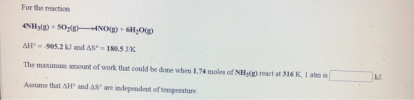 For the reaction 4NH3(g)+502(g 4NO() +6H20(g) ΔΗ'--905.2 kJ and ΔS°-180.5 JK The maximum amount of work that could be done when 1.74 moles of NH (g) react at 316 K, 1 atm is kJ and ΔSo are independent of temperature. Assume that Consider the reactiodn The standard free energy chanpe for this reaction is 461.9 kJ The free energy change whea 2.00 moles of BrF() react at standard condition k3 What u the masimium omouet of wetual work: thit the...
Which system has the greatest entropy? A. 1 mol of H2(g) at STP B. 1 mol...
Which system has the greatest entropy? A. 1 mol of H2(g) at STP B. 1 mol of H2(g) at 100∘C 0.5 atm C. 1 mol of H2O(s) at 0∘C D. 1 mol of H2O(l) at 25∘C
Question 22 (1 point) (c) (d) Which transition represents a decrease in entropy of the system?...
 Question 22 (1 point) (c) (d) Which transition represents a decrease in entropy of the system? (b) → (c) O (d) - (c) (a) → (c) (c) → (b) Question 20 (1 point) Ethanol melts at -114 °C and boils at 78 °C at a constant pressure of 1 atm. What state of matter must a sample of ethanol be in at 100°C and 1 atm? solid and liquid in equilibrium gas liquid O solid liquid and gas in equilibrium...
24) Which of the following represent STP (Standard Temperature and Pressure) conditions? A) T -0 K...
 24) Which of the following represent STP (Standard Temperature and Pressure) conditions? A) T -0 K and P = 1 atm B) T=0°C and P 760 atm C) T= 273 K and P = 0 atm D) T-273 K and P-1 atm E) T = 1 K and P = 1 atm 25) Which of the following is TRUE for a liquid that is placed in a sealed container? A) Condensation of the evaporated molecules in the jar can only...
1. Which of the following is in the correct order of standard state entropy? I. Liquid...
 1. Which of the following is in the correct order of standard state entropy? I. Liquid water < gaseous water II. Liquid water < solid water III. NH; <H3 a. I only b. II only III only d. I and II only e. I and III only c. 2. Which of the following will have the greatest standard molar entropy (Sº)? a. NH3(g) d. H2O(1) b. He(g) CaCO3(s) c. C(s, graphite) e. 3. Indicate which of the following has the...
please do all. thanks. 1. a. A weather balloon is filled to the volume of 105...
please do all. thanks. 1. a. A weather balloon is filled to the volume of 105 L on a day when the temperature is 25°C. If no gases escaped, what would be the volume of the weather balloon after it rises to an altitude where the temperature is -9°C? Volume = L? b A 203-mL sample of a gas exerts a pressure of 2.55 atm at 19.5°C. What volume would it occupy at 1.85 atm and 190.°C? Volume = ?mL...
 help with these please
Which of the following transformations represent an increase in the entropy of the system. Choose all that apply 4 mol CO2 (0.727 atm, 498K) 4 mol CO2 (0.727 atm, 249K) 38 g Sb (liquid, 904.0K) 38 g Sb (solid, 904.0K) 46 g C,H,OC Hg (liquid, 172K) 46 g CHOC2Hs (liquid, 293K) 1 mol H2 (8.39 L, 216K) 1 mol H2 (16.8 L, 216K) 46 g C2H5OC2H5 (liquid, 308K) 46 g C2H30C2H5 (gas, 308K) Consider the reaction:...
help with these please
Which of the following transformations represent an increase in the entropy of the system. Choose all that apply 4 mol CO2 (0.727 atm, 498K) 4 mol CO2 (0.727 atm, 249K) 38 g Sb (liquid, 904.0K) 38 g Sb (solid, 904.0K) 46 g C,H,OC Hg (liquid, 172K) 46 g CHOC2Hs (liquid, 293K) 1 mol H2 (8.39 L, 216K) 1 mol H2 (16.8 L, 216K) 46 g C2H5OC2H5 (liquid, 308K) 46 g C2H30C2H5 (gas, 308K) Consider the reaction:...
 Which of the following transformations represent an increase in the entropy of the system. Choose all that apply 4 mol Ar (8.44 L, 249K) 4 mol Ar (16.9 L, 249K) 28 g C,H,OH (liquid, 352K) 28 g C,HOH (gas, 352K) 27 g Al (liquid, 933.0K) 27 g Al (solid, 933.0K) 28 g C,H,OH (liquid, 171K) 28 g C,H,OH (liquid, 340K) 3 mol CO2 (0.855 atm, 413K) *3 mol CO2 (0.855 atm, 206K) Submit Answer Retry Entire Group 4 pre group...
 For which of the following reactions is AS° >0. Choose all that apply. NH4Cl(s) + NH3(g) + HCl(g) 2C2H6(g) + 702(g) + 4CO2(g) + 6H2O(g) 2NH3(g) + 2O2(g) → N2O(g) + 3H2O(1) N2(g) + 202(g) + 2NO2(g) C2H2(g) + 4H2O(g) + 2CO2(g) + 5H2(g) Which of the following transformations represent an increase in the entropy of the system. Choose all that apply 20 g Hg (liquid, 244K) 20 g Hg (liquid, 620K) 1 mol CO2 (0.874 atm, 440K) 1 mol...
 For which of the following reactions is AS™ > 0. Choose all that apply 2NO(g) + 2H2(g) + N2(g) + 2H2O(1) H2(g) + C2H4(9) + CH (9) D NHI(s)+ NH4(g) + HI(g) 2002(g) + N2(g) 2CO(g) + 2NO(g) 4NH3(9) +502(9)→ 4NO(g) + 6H20(g) Submit Answer Retry Entire Group 3 more group attempts remaining Which of the following transformations represent an increase in the entropy of the system. Choose all that apply 44 g Ag (liquid, 1.234x10°K) 44 g Ag (solid,...
 For the reaction 4NH3(g)+502(g 4NO() +6H20(g) ΔΗ'--905.2 kJ and ΔS°-180.5 JK The maximum amount of work that could be done when 1.74 moles of NH (g) react at 316 K, 1 atm is kJ and ΔSo are independent of temperature. Assume that Consider the reactiodn The standard free energy chanpe for this reaction is 461.9 kJ The free energy change whea 2.00 moles of BrF() react at standard condition k3 What u the masimium omouet of wetual work: thit the...
 Question 22 (1 point) (c) (d) Which transition represents a decrease in entropy of the system? (b) → (c) O (d) - (c) (a) → (c) (c) → (b) Question 20 (1 point) Ethanol melts at -114 °C and boils at 78 °C at a constant pressure of 1 atm. What state of matter must a sample of ethanol be in at 100°C and 1 atm? solid and liquid in equilibrium gas liquid O solid liquid and gas in equilibrium...
 24) Which of the following represent STP (Standard Temperature and Pressure) conditions? A) T -0 K and P = 1 atm B) T=0°C and P 760 atm C) T= 273 K and P = 0 atm D) T-273 K and P-1 atm E) T = 1 K and P = 1 atm 25) Which of the following is TRUE for a liquid that is placed in a sealed container? A) Condensation of the evaporated molecules in the jar can only...
 1. Which of the following is in the correct order of standard state entropy? I. Liquid water < gaseous water II. Liquid water < solid water III. NH; <H3 a. I only b. II only III only d. I and II only e. I and III only c. 2. Which of the following will have the greatest standard molar entropy (Sº)? a. NH3(g) d. H2O(1) b. He(g) CaCO3(s) c. C(s, graphite) e. 3. Indicate which of the following has the...
Most questions answered within 3 hours.
-
Where is the error in this code sequence?
String s1 = "Hello";
String s2 = "ello";...
asked 10 months ago -
Financial data for Joel de Paris, Inc., for last year
follow:
Joel de Paris, Inc.
Balance...
asked 10 months ago -
Consider this reaction:
Al2(SO4)3 (aq)+ BaCl3
(aq) Al2Cl6 (aq)- +
3BaSO4(s) . What is the...
asked 10 months ago -
Suppose that Savneet is considering increasing her
recent random sample from 20 car rentals to 40...
asked 10 months ago -
Trucks arrive at an unloading terminal at an average rate of 120
per hour.
Trucks arrive...
asked 10 months ago -
Why are methanol and ethanol completely soluble in water while
octanol is not very little soluble....
asked 10 months ago -
A facilities manager at a university reads in a research report
that the mean amount of...
asked 10 months ago -
When the CuSO4 is rehydrated by adding water to the anhydrous
compound, is this an endothermic...
asked 10 months ago -
A ray of sunlight is passing from diamond into crown glass; the
angle of incidence is...
asked 10 months ago -
A block of mass 0.249 kg is placed on top of a light, vertical
spring of...
asked 10 months ago -
how do the kidneys compensate in the presences of acidosis
a) trigger hyperventilate
b) reserve acid...
asked 10 months ago -
Question 501 pts
The rental rate of capital to the firm increases. Which of the
following...
asked 10 months ago