Due to expectations of lower inflation in the future, we would typically expect the supply of...
Due to expectations of lower inflation in the future, we would typically expect the supply of loanable funds to ____ and the demand for loanable funds to ____.
| a. |
increase; increase |
|
| b. |
increase; decrease |
|
| c. |
decrease; decrease |
|
| d. |
decrease; increase |
Homework Answers

Add Answer to:
Due to expectations of lower inflation in the future, we would
typically expect the supply of...
For some reason, the expectations for future inflation increases dramatically. what effect would this have on...
 For some reason, the expectations for future inflation increases
dramatically. what effect would this have on the loanable funds
market?
A. The demand for loanable funds would increase thus increasing
the interest rate level.
B, The demand for loanable funds would decrease thus increasing
the interest rate level.
C. The Supply for loanable funds would increase thus increasing
the interest rate level.
D. The Supply for loanable funds would decrease thus decreasing
the interest rate level.
2. For some reason,...
For some reason, the expectations for future inflation increases
dramatically. what effect would this have on the loanable funds
market?
A. The demand for loanable funds would increase thus increasing
the interest rate level.
B, The demand for loanable funds would decrease thus increasing
the interest rate level.
C. The Supply for loanable funds would increase thus increasing
the interest rate level.
D. The Supply for loanable funds would decrease thus decreasing
the interest rate level.
2. For some reason,...
We expect real interest rates to rise when a. the supply of loanable funds is greater...
We expect real interest rates to rise when a. the supply of loanable funds is greater than the demand b. output is less than the natural rate c. None of the listed options is correct. d. inflation is less than the Fed’s target rate
How might expectations of lower global oil prices affect the demand for loanable funds, the supply...
How might expectations of lower global oil prices affect the demand for loanable funds, the supply of loanable funds, and interest rates in the United States? Will this affect the interest rates of other countries in the same way? Explain
22) Which of the following would not increase the supply curve of loanable funds? A) A...
 22) Which of the following would not increase the supply curve of loanable funds? A) A Federal Reserve purchase does of U.S. Government securities from commercial banks. B) A higher interest rate. C) An increase in the nation's real income D) All of the above shift the supply. 23) In Keynes's liquidity preference framework, A) the demand for bonds must equal the supply of money B) the demand for money must equal the supply of bonds. C) an excess demand...
QUESTION 16 Event: Firms expect the price of oil will rise in the future due to...
QUESTION 16 Event: Firms expect the price of oil will rise in the future due to unrest in the Middle East. (Long Run) Question: What is the change in aggregate demand (AD)? a. Increase b. Decrease c. No change d. Indeterminate QUESTION 17 Event: Firms expect the price of oil will rise in the future due to unrest in the Middle East. (Long Run) Question: What is the change in short run aggregate supply (SRAS)? a. Increase b. Decrease c....
The Federal Reserve issues a report indicating that future inflation will increase from 3% to 4%....
The Federal Reserve issues a report indicating that future inflation will increase from 3% to 4%. As a result... A) the demand for loanable funds shifts right. B) the supply curve for bonds shifts left. C) the equilibrium interest rate falls. D) the equilibrium price of bonds rises.
In Freedonia, there is a supply and demand for loanable funds. Suddenly, consumer confidence decreases. This...
In Freedonia, there is a supply and demand for loanable funds. Suddenly, consumer confidence decreases. This decrease causes consumers to spend less of their income on goods and services. At the same time, firms’ demand for loanable funds increases due to expectations of the future. What happens to interest rates, the quantity of loanable funds, Investment, and GDP? Use graphs to explain when possible.
QUESTION 40 The demand curve for loanable funds is A upward sloping, indicating that lower interest...
QUESTION 40 The demand curve for loanable funds is A upward sloping, indicating that lower interest rates are associated with a lower demand for loanable funds. B downward sloping, indicating that businesses will increase their demand at lower interest rates, but that consumers will probably decrease the supply of loanable funds at lower interest rates. C downward sloping, indicating that both businesses and consumers will increase the quantity demanded of loanable funds as the interest rate decreases. D horizontal at...
2A) Aggregate supply shifts to the left when: A. input prices rise. B. producer subsidies are higher. C. inflation expectations are lower D. there is a decrease m burdensome regulations. B) Which of...
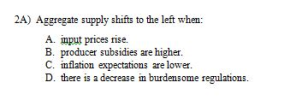 2A) Aggregate supply shifts to the left when: A. input prices rise. B. producer subsidies are higher. C. inflation expectations are lower D. there is a decrease m burdensome regulations. B) Which of these fiscal policy measures will NOT increase aggregate supply? A. B. C. D. increased infrastructurespending reduced taxes on businesses investment tax credits increase in business regulation Aggregate Ouput C) ff there is a decrease in inputprices, the short-runageregate supply cuve will shift from SRAS to and theprice...
 For some reason, the expectations for future inflation increases
dramatically. what effect would this have on the loanable funds
market?
A. The demand for loanable funds would increase thus increasing
the interest rate level.
B, The demand for loanable funds would decrease thus increasing
the interest rate level.
C. The Supply for loanable funds would increase thus increasing
the interest rate level.
D. The Supply for loanable funds would decrease thus decreasing
the interest rate level.
2. For some reason,...
For some reason, the expectations for future inflation increases
dramatically. what effect would this have on the loanable funds
market?
A. The demand for loanable funds would increase thus increasing
the interest rate level.
B, The demand for loanable funds would decrease thus increasing
the interest rate level.
C. The Supply for loanable funds would increase thus increasing
the interest rate level.
D. The Supply for loanable funds would decrease thus decreasing
the interest rate level.
2. For some reason,...
 22) Which of the following would not increase the supply curve of loanable funds? A) A Federal Reserve purchase does of U.S. Government securities from commercial banks. B) A higher interest rate. C) An increase in the nation's real income D) All of the above shift the supply. 23) In Keynes's liquidity preference framework, A) the demand for bonds must equal the supply of money B) the demand for money must equal the supply of bonds. C) an excess demand...
 2A) Aggregate supply shifts to the left when: A. input prices rise. B. producer subsidies are higher. C. inflation expectations are lower D. there is a decrease m burdensome regulations. B) Which of these fiscal policy measures will NOT increase aggregate supply? A. B. C. D. increased infrastructurespending reduced taxes on businesses investment tax credits increase in business regulation Aggregate Ouput C) ff there is a decrease in inputprices, the short-runageregate supply cuve will shift from SRAS to and theprice...
Most questions answered within 3 hours.
-
Where is the error in this code sequence?
String s1 = "Hello";
String s2 = "ello";...
asked 11 months ago -
Financial data for Joel de Paris, Inc., for last year
follow:
Joel de Paris, Inc.
Balance...
asked 11 months ago -
Consider this reaction:
Al2(SO4)3 (aq)+ BaCl3
(aq) Al2Cl6 (aq)- +
3BaSO4(s) . What is the...
asked 11 months ago -
Suppose that Savneet is considering increasing her
recent random sample from 20 car rentals to 40...
asked 11 months ago -
Trucks arrive at an unloading terminal at an average rate of 120
per hour.
Trucks arrive...
asked 11 months ago -
Why are methanol and ethanol completely soluble in water while
octanol is not very little soluble....
asked 11 months ago -
A facilities manager at a university reads in a research report
that the mean amount of...
asked 11 months ago -
When the CuSO4 is rehydrated by adding water to the anhydrous
compound, is this an endothermic...
asked 11 months ago -
A ray of sunlight is passing from diamond into crown glass; the
angle of incidence is...
asked 11 months ago -
A block of mass 0.249 kg is placed on top of a light, vertical
spring of...
asked 11 months ago -
how do the kidneys compensate in the presences of acidosis
a) trigger hyperventilate
b) reserve acid...
asked 11 months ago -
Question 501 pts
The rental rate of capital to the firm increases. Which of the
following...
asked 11 months ago