Using the "Example Dataset" and SPSS, apply the t-test to assess the following statement: "Men and...
Using the "Example Dataset" and SPSS, apply the t-test to assess the following statement: "Men and women have different incomes in this city."
- Describe what t-test is the most appropriate and explain why. Discuss whether you used a one-tailed or two-tailed test and explain why.
- Using SPSS, calculate the t-test and provide the test statistic and critical value assuming an alpha of .05.
- Calculate the effect size using r2.
| Sex |
| Female |
| Male |
| Female |
| Male |
| Female |
| Female |
| Female |
| Male |
| Female |
| Male |
| Female |
| Male |
| Female |
| Male |
| Male |
| Male |
| Female |
| Male |
| Male |
| Female |
| Female |
| Female |
| Male |
| Male |
| Female |
| Male |
| Female |
| Female |
| Male |
| Male |
| Annual_Income* |
| 51000 |
| 23000 |
| 35000 |
| 10000 |
| 28000 |
| 5000 |
| 46000 |
| 36000 |
| 51000 |
| 12000 |
| 78000 |
| 34000 |
| 15000 |
| 28000 |
| 28000 |
| 24000 |
| 55000 |
| 62000 |
| 32000 |
| 7000 |
| 17000 |
| 64000 |
| 5000 |
| 14000 |
| 20000 |
| 72000 |
| 85000 |
| 15000 |
| 64000 |
| 27000 |
Homework Answers
A t-test for two means with unknown population variances and two independent samples is a hypothesis test that attempts to make a claim about the population means (μ2).
More specifically, a t-test uses sample information to assess how plausible it is for the population means μ1 and μ2 to be equal. The test has two non-overlapping hypotheses, the null and the alternative hypothesis.
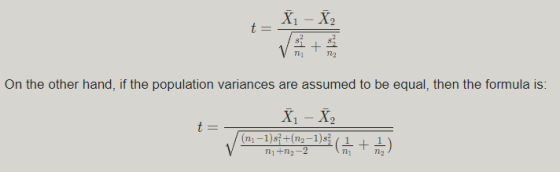
The formula for a t-statistic for two population means
Steps to be followed in SPSS
1) Enter the data in Data view with variable named as Annual Income and Gender
2) Go to analyse--> compare means-->independent sample t- test
3) Test variable = Annual_income, Grouping variable = Gender
4) define group as 1 and 2 for male and female.
5) click on ok
|
Annual_income |
Gender |
|
51000.00 |
Female |
|
23000.00 |
Male |
|
35000.00 |
Female |
|
10000.00 |
Male |
|
28000.00 |
Female |
|
5000.00 |
Female |
|
46000.00 |
Female |
|
36000.00 |
Male |
|
51000.00 |
Female |
|
12000.00 |
Male |
|
78000.00 |
Female |
|
34000.00 |
Male |
|
15000.00 |
Female |
|
28000.00 |
Male |
|
28000.00 |
Male |
|
24000.00 |
Male |
|
55000.00 |
Female |
|
62000.00 |
Male |
|
32000.00 |
Male |
|
7000.00 |
Female |
|
17000.00 |
Female |
|
64000.00 |
Female |
|
5000.00 |
Male |
|
14000.00 |
Male |
|
20000.00 |
Female |
|
72000.00 |
Male |
|
85000.00 |
Female |
|
15000.00 |
Female |
|
64000.00 |
Male |
|
27000.00 |
Male |
|
Group Statistics |
|||||
|
Gender |
N |
Mean |
Std. Deviation |
Std. Error Mean |
|
|
Annual_income |
Male |
15 |
31400.0000 |
20138.09468 |
5199.63369 |
|
Female |
15 |
38133.3333 |
25575.84426 |
6603.65459 |
|
|
Independent Samples Test |
||||||||||
|
Levene's Test for Equality of Variances |
t-test for Equality of Means |
|||||||||
|
F |
Sig. |
t |
df |
Sig. (2-tailed) |
Mean Difference |
Std. Error Difference |
95% Confidence Interval of the Difference |
|||
|
Lower |
Upper |
|||||||||
|
Annual_income |
Equal variances assumed |
2.236 |
.146 |
-.801 |
28 |
.430 |
-6733.33333 |
8405.02495 |
-23950.24647 |
10483.57981 |
|
Equal variances not assumed |
-.801 |
26.540 |
.430 |
-6733.33333 |
8405.02495 |
-23993.03136 |
10526.36470 |
|||
From the above table p value for t-test for Equality of Means is 0.430 which is greater than 0.05 (i.e. 5% level of significance ) so we fail to reject the null hypothesis and conclude that there is no significant difference between the annual income of female and male.
Effective size
Cohen's d = (M2 - M1) ⁄ SDpooled
SDpooled = √((SD12 + SD22) ⁄ 2)

Cohen's d = (38133.33 - 31400) ⁄ 23018.104402 = 0.292523.
Gates' delta = (38133.33 - 31400) ⁄ 20138.09 = 0.334358.
Hedges' g = (38133.33 - 31400) ⁄ 23018.104402 = 0.292523.
answer
Add Answer to:
Using the "Example Dataset" and SPSS, apply the t-test to assess
the following statement: "Men and...
Most questions answered within 3 hours.
-
Where is the error in this code sequence?
String s1 = "Hello";
String s2 = "ello";...
asked 10 months ago -
Financial data for Joel de Paris, Inc., for last year
follow:
Joel de Paris, Inc.
Balance...
asked 10 months ago -
Consider this reaction:
Al2(SO4)3 (aq)+ BaCl3
(aq) Al2Cl6 (aq)- +
3BaSO4(s) . What is the...
asked 10 months ago -
Suppose that Savneet is considering increasing her
recent random sample from 20 car rentals to 40...
asked 10 months ago -
Trucks arrive at an unloading terminal at an average rate of 120
per hour.
Trucks arrive...
asked 10 months ago -
Why are methanol and ethanol completely soluble in water while
octanol is not very little soluble....
asked 10 months ago -
A facilities manager at a university reads in a research report
that the mean amount of...
asked 10 months ago -
When the CuSO4 is rehydrated by adding water to the anhydrous
compound, is this an endothermic...
asked 10 months ago -
A ray of sunlight is passing from diamond into crown glass; the
angle of incidence is...
asked 10 months ago -
A block of mass 0.249 kg is placed on top of a light, vertical
spring of...
asked 10 months ago -
how do the kidneys compensate in the presences of acidosis
a) trigger hyperventilate
b) reserve acid...
asked 10 months ago -
Question 501 pts
The rental rate of capital to the firm increases. Which of the
following...
asked 10 months ago