Using python, complete function def link(d1, d2) d1: {'A': {'Comment': 'Good', 'Math': '100', 'English': '80', 'Science':...
Using python, complete function def link(d1, d2)
d1: {'A': {'Comment': 'Good', 'Math': '100', 'English': '80', 'Science': '70', 'History': '60'}, 'B': {'Comment': 'Satisfactory', 'Math': '70', 'English': '80', 'Science': '80', 'History': '70'}, 'C': {'Comment': 'Good', 'Math': '80', 'English': '80', 'Science': '80', 'History': '70'}, 'D': {'Comment': 'TBD', 'Math': '50', 'English': '60', 'Science': '80', 'History': '60'}}
d2: {'Math': '90', 'English': '80', 'Science': '80', 'History': '80', 'Comment': 'Good'}
Add totals from each respective subject and divide by 2 for student A and student from d2, for student B and student from d2 and so on.
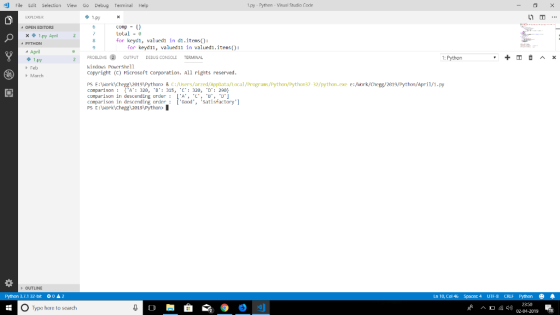
Example: For the above dictionaries function, comparison returns {'A': 320, 'B': 315, 'C': 320, 'D': 290}
Calculations - Student A and d2:
Math: (100 + 90) / 2 = 95
English: (80 +80) / 2 = 80
Science: (70 + 80) / 2 = 75
History: (60 + 80) / 2 = 70
Total = 320
Same is done for Student B and d2, then Student C and d2, and so on.
Function rank returns {'A', 'C', 'B', 'D'} which is comparison in descending order.
Function link should return the comments that were found in function rank in descending order according to their assocaited value.
From above example, def link should return ['Good', 'Satisfactory']
Since comments for student A and C are the same it is only recorded once. Also, comment 'TBD' is ignored as a comment for that student is yet to be decided.
Homework Answers
SourceCode:
# Defing the dictinaries
d1 = {'A': {'Comment': 'Good', 'Math': '100', 'English': '80', 'Science': '70', 'History': '60'},
      'B': {'Comment': 'Satisfactory', 'Math': '70', 'English': '80', 'Science': '80', 'History': '70'},
      'C': {'Comment': 'Good', 'Math': '80', 'English': '80', 'Science': '80', 'History': '70'},
      'D': {'Comment': 'TBD', 'Math': '50', 'English': '60', 'Science': '80', 'History': '60'}}
d2 = {'Math': '90', 'English': '80', 'Science': '80', 'History': '80', 'Comment': 'Good'}


def comparison(d1, d2):
  # looping thorugh the dictionaries
  comp = {}
  total = 0
  for keyd1, valued1 in d1.items():
    for keyd11, valued11 in valued1.items():
      for keyd2, valued2 in d2.items():
        if keyd11 != 'Comment':
          if keyd11 == keyd2:
            # calculating the marks
            total = total + ((int(valued11) + int(valued2)) // 2)
    # adding the calculated marks to the dictionary
    comp[keyd1] = total
    total = 0
  return comp


def rank(comp_dict):
  # sorting the dictionary
  dict_keys = []
  sorted_comp_dict = sorted(comp_dict.items(), key=lambda kv: (-kv[1], kv[0]))
  # exctratcing the keys
  for key, value in sorted_comp_dict:
    dict_keys.append(key)
  return dict_keys


def link(sorted_comp_dict):
  comments = []
  temp_comments = []
  # getting the comments
  for key, value in d1.items():
    if value['Comment'] != 'TBD':
      temp_comments.append(value['Comment'])
  temp_comments = set(temp_comments)
  for i in temp_comments:
    comments.append(i)
  return comments


# Displaying the result
comp_dict = comparison(d1, d2)
print("comparison : ", comp_dict)
sorted_comp_dict = rank(comp_dict)
print("comparison in descending order : ", sorted_comp_dict)
comments = link(sorted_comp_dict)
print("comparison in descending order : ", comments)
OUTPUT:
Add Answer to:
Using python, complete function def link(d1,
d2)
d1: {'A': {'Comment': 'Good', 'Math': '100', 'English': '80',
'Science':...
Designing functions Reminder: When designing functions, follow the given steps to reinforce good software development p...
 Designing functions Reminder: When designing functions, follow the given steps to reinforce good software development practices and problem solving strategies: a) Start by writing the documentation for the function. Use docstrings shown in lecture and lab. b) Write test calls to the function in your main function for the different cases of input the function will encounter. This will help you understand the behavior of the function and later behave as tests for your function. c) Define the function d)...
 Designing functions Reminder: When designing functions, follow the given steps to reinforce good software development practices and problem solving strategies: a) Start by writing the documentation for the function. Use docstrings shown in lecture and lab. b) Write test calls to the function in your main function for the different cases of input the function will encounter. This will help you understand the behavior of the function and later behave as tests for your function. c) Define the function d)...
Most questions answered within 3 hours.
-
Where is the error in this code sequence?
String s1 = "Hello";
String s2 = "ello";...
asked 11 months ago -
Financial data for Joel de Paris, Inc., for last year
follow:
Joel de Paris, Inc.
Balance...
asked 11 months ago -
Consider this reaction:
Al2(SO4)3 (aq)+ BaCl3
(aq) Al2Cl6 (aq)- +
3BaSO4(s) . What is the...
asked 11 months ago -
Suppose that Savneet is considering increasing her
recent random sample from 20 car rentals to 40...
asked 11 months ago -
Trucks arrive at an unloading terminal at an average rate of 120
per hour.
Trucks arrive...
asked 11 months ago -
Why are methanol and ethanol completely soluble in water while
octanol is not very little soluble....
asked 11 months ago -
A facilities manager at a university reads in a research report
that the mean amount of...
asked 11 months ago -
When the CuSO4 is rehydrated by adding water to the anhydrous
compound, is this an endothermic...
asked 11 months ago -
A ray of sunlight is passing from diamond into crown glass; the
angle of incidence is...
asked 11 months ago -
A block of mass 0.249 kg is placed on top of a light, vertical
spring of...
asked 11 months ago -
how do the kidneys compensate in the presences of acidosis
a) trigger hyperventilate
b) reserve acid...
asked 11 months ago -
Question 501 pts
The rental rate of capital to the firm increases. Which of the
following...
asked 11 months ago