implement the following function:MV is a list of integers that are>=0,Return the minimum value in MV...
implement the following function:MV is a list of integers that
are>=0,Return the minimum value in MV that is>0
if all value in L are 0,return-1.
def cal_min(MV):
Homework Answers
`Hey,
Note: Brother in case of any queries, just comment in box I would be very happy to assist all your queries
Note: Brother sometimes while uploading on HomeworkLib the indentations change. So, I request you to verify it with screenshot once. This is the link where I have saved the code too
https://onlinegdb.com/H1vH2cpCE
def cal_min(MV):
min=0;
for i in range(len(MV)):
if(MV[i]>0 and min==0):
min=MV[i];
if(MV[i]<min and MV[i]!=0):
min=MV[i];
if(min==0):
return -1;
return min;
print(cal_min([0,0,3,2,0]));
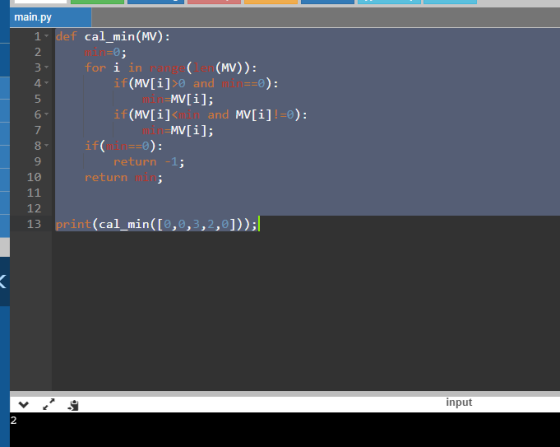
Kindly revert for any queries
Thanks.
Add Answer to:
implement the following function:MV is a list of integers that
are>=0,Return the minimum value in MV...
Implement function allEven() that takes a list of integers and returns True if all integers in...
Implement function allEven() that takes a list of integers and returns True if all integers in the list are even, and False otherwise. >>> allEven([8, 0, -2, 4, -6, 10]) True >>> allEven([8, 0, -1, 4, -6, 10]) False
Write function all_coprime_pairs( ) which takes as input a list, L, with positive unique integers (i.e....
Write function all_coprime_pairs( ) which takes as input a list, L, with positive unique integers (i.e. no duplicated integers), and should return: 1. List (of tuples) containing all pairs of numbers in L that are coprime. 2. Empty list, If no pair of numbers in L is coprime. Your solution must include a function call to the function coprime designed in the previous question. The order of the tuples or the order of the two numbers within the tuples is...
Write four functions: (IN PYTHON 3) 1) bound(l) - given a list of integers l, compute...
Write four functions: (IN PYTHON 3) 1) bound(l) - given a list of integers l, compute a tuple containing the minimum and maximum values (in that order) 2) span(l) - given a list of integers l, compute the difference between the minimum and maximum function. 3) mean(l) - given a list of integers l, compute the average. The return value will be a float. 4) stats(f, l) - given a function f and a list l, apply the function f...
Implement a Python function that prints integers from a to b. The main part of the...
 Implement a Python function that prints integers from a to b.
The main part of the program should ask the user to input a and b
and call the function.
# Display integers a, a+1, a+2, ..., b def display(a,b): ## complete your work here ## return a = int(input("Please prvide a value for a: ")) b = int(input("Please prvide a value for b: ")) display(a,b)
Implement a Python function that prints integers from a to b.
The main part of the program should ask the user to input a and b
and call the function.
# Display integers a, a+1, a+2, ..., b def display(a,b): ## complete your work here ## return a = int(input("Please prvide a value for a: ")) b = int(input("Please prvide a value for b: ")) display(a,b)
Given a list of integers, return a list where each integer is added to 1 and...
Given a list of integers, return a list where each integer is added to 1 and the result is multiplied by 10. You must use a list comprehension math1([1, 2, 3]) → [20, 30, 40] math1([6, 8, 6, 8, 1]) → [70, 90, 70, 90, 20] math1([10]) → [110] Complete in Python code the starter code is listed bellow def math1(lst): return lst print(math1([1, 2, 3])) # [20, 30, 40] print(math1([6, 8, 6, 8, 1])) # [70, 90, 70,...
Python: Create a function count_target_in_list that takes a list of integers and the target value then...
Python: Create a function count_target_in_list that takes a list of integers and the target value then counts and returns the number of times the target value appears in the list. Write program in that uses get_int_list_from_user method to get a list of 10 numbers, then calls the count_target_list method to get the count then prints the number of times the target was found in the list. def get_int_list_from_user(): lst=[] y = int(input("Enter number of numbers")) for x in range(y): lst.append(int(input("Enter...
write a Python function that takes in a list of integers and returns maximum and minimum values in the list as a tuple
1 write a Python function that takes in a list of integers and returns maximum and minimum values in the list as a tuple. Hint (can be done in one pass, you are not allowed to use built-on min and max functions.)max, min = find_max_min(my_list):2 write a Python function that takes in a list of integers (elements), and an integer number (num). The functions should count and return number of integers in elements greater than, less than, and equal to...
nonPrime_lst(L) accepts a list L of integers ( >1 ) and returns a list that contains...
nonPrime_lst(L) accepts a list L of integers ( >1 ) and returns a list that contains all the Nonprime numbers picked from L. For example, nonPrime_lst([2,4,5,7,10,11,12,15,19] should return [4,10,12,15]). in Python
Python recursive function: Given an ordered list L. A permutation of L is a rearrangement of...
 Python recursive function:
Given an ordered list L. A permutation of L is a rearrangement of its elements in some order. For example (1,3, 2) and (3, 2, 1) are two different permutations of L=(1,2,3). Implement the following function: def permutations (lst, low, high) The function is given a list 1st of integers, and two indices: low and high (lows high), which indicate the range of indices that need to be considered The function should return a list containing all...
Python recursive function:
Given an ordered list L. A permutation of L is a rearrangement of its elements in some order. For example (1,3, 2) and (3, 2, 1) are two different permutations of L=(1,2,3). Implement the following function: def permutations (lst, low, high) The function is given a list 1st of integers, and two indices: low and high (lows high), which indicate the range of indices that need to be considered The function should return a list containing all...
In Python class int Set (object): "" "An intSet is a set of integers The value...
 In Python
class int Set (object): "" "An intSet is a set of integers The value is represented by a list of ints, self.vals. Each int in the set occurs in self.vals exactly once. """ definit__(self): """Create an empty set of integers""" self.vals = 0 def insert (self, e): """Assumes e is an integer and inserts e into self""" if not e in self.vals: self.vals.append(e) def member (self, e): """Assumes e is an integer Returns True if e is in...
In Python
class int Set (object): "" "An intSet is a set of integers The value is represented by a list of ints, self.vals. Each int in the set occurs in self.vals exactly once. """ definit__(self): """Create an empty set of integers""" self.vals = 0 def insert (self, e): """Assumes e is an integer and inserts e into self""" if not e in self.vals: self.vals.append(e) def member (self, e): """Assumes e is an integer Returns True if e is in...
 Implement a Python function that prints integers from a to b.
The main part of the program should ask the user to input a and b
and call the function.
# Display integers a, a+1, a+2, ..., b def display(a,b): ## complete your work here ## return a = int(input("Please prvide a value for a: ")) b = int(input("Please prvide a value for b: ")) display(a,b)
Implement a Python function that prints integers from a to b.
The main part of the program should ask the user to input a and b
and call the function.
# Display integers a, a+1, a+2, ..., b def display(a,b): ## complete your work here ## return a = int(input("Please prvide a value for a: ")) b = int(input("Please prvide a value for b: ")) display(a,b)
 Python recursive function:
Given an ordered list L. A permutation of L is a rearrangement of its elements in some order. For example (1,3, 2) and (3, 2, 1) are two different permutations of L=(1,2,3). Implement the following function: def permutations (lst, low, high) The function is given a list 1st of integers, and two indices: low and high (lows high), which indicate the range of indices that need to be considered The function should return a list containing all...
Python recursive function:
Given an ordered list L. A permutation of L is a rearrangement of its elements in some order. For example (1,3, 2) and (3, 2, 1) are two different permutations of L=(1,2,3). Implement the following function: def permutations (lst, low, high) The function is given a list 1st of integers, and two indices: low and high (lows high), which indicate the range of indices that need to be considered The function should return a list containing all...
 In Python
class int Set (object): "" "An intSet is a set of integers The value is represented by a list of ints, self.vals. Each int in the set occurs in self.vals exactly once. """ definit__(self): """Create an empty set of integers""" self.vals = 0 def insert (self, e): """Assumes e is an integer and inserts e into self""" if not e in self.vals: self.vals.append(e) def member (self, e): """Assumes e is an integer Returns True if e is in...
In Python
class int Set (object): "" "An intSet is a set of integers The value is represented by a list of ints, self.vals. Each int in the set occurs in self.vals exactly once. """ definit__(self): """Create an empty set of integers""" self.vals = 0 def insert (self, e): """Assumes e is an integer and inserts e into self""" if not e in self.vals: self.vals.append(e) def member (self, e): """Assumes e is an integer Returns True if e is in...
Most questions answered within 3 hours.
-
Where is the error in this code sequence?
String s1 = "Hello";
String s2 = "ello";...
asked 10 months ago -
Financial data for Joel de Paris, Inc., for last year
follow:
Joel de Paris, Inc.
Balance...
asked 10 months ago -
Consider this reaction:
Al2(SO4)3 (aq)+ BaCl3
(aq) Al2Cl6 (aq)- +
3BaSO4(s) . What is the...
asked 10 months ago -
Suppose that Savneet is considering increasing her
recent random sample from 20 car rentals to 40...
asked 10 months ago -
Trucks arrive at an unloading terminal at an average rate of 120
per hour.
Trucks arrive...
asked 10 months ago -
Why are methanol and ethanol completely soluble in water while
octanol is not very little soluble....
asked 10 months ago -
A facilities manager at a university reads in a research report
that the mean amount of...
asked 10 months ago -
When the CuSO4 is rehydrated by adding water to the anhydrous
compound, is this an endothermic...
asked 10 months ago -
A ray of sunlight is passing from diamond into crown glass; the
angle of incidence is...
asked 10 months ago -
A block of mass 0.249 kg is placed on top of a light, vertical
spring of...
asked 10 months ago -
how do the kidneys compensate in the presences of acidosis
a) trigger hyperventilate
b) reserve acid...
asked 10 months ago -
Question 501 pts
The rental rate of capital to the firm increases. Which of the
following...
asked 10 months ago