1. Illustrate and describe the effects of expansionary monetary policy in a small open economy that...
1. Illustrate and describe the effects of expansionary monetary policy in a small open economy that allows their currency to float. What are the effects on r, e and Y?
Homework Answers
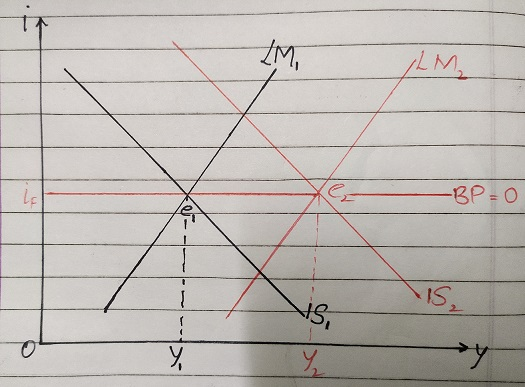
In the diagram, the LM curve shifts rightward as a result of expansionary monetary policy. Then the IS curve also eventually shifts to the right.
Under floating exchange rate, monetary policy is completely effective. This is because with monetary expansion, LM-curve shifts rightward and interest rate decreases. Due to this, there is outflow of capital which causes deficit in BOP account. With capital outflow, domestic currency depreciates. It means domestic goods become relatively cheaper and foreign goods relatively expensive. Therefore, net exports increases and IS shifts rightwards. So monetary policy is effective to increase output under flexible exchange rate system. Lastly, the interest rate remains the same.
Add Answer to:
1. Illustrate and describe the effects of expansionary monetary
policy in a small open economy that...
2. (12 marks) Use a AD/AS diagram to illustrate the use of expansionary monetary policy to...
 2. (12 marks) Use a AD/AS diagram to illustrate the use of expansionary monetary policy to close an expansionary gap. a. Label the axes. b. Label the lines. And show c. Show the new AD line after the expansionary monetary policy is applied. d. Briefly explain what your diagram shows. e. Explain what monetary policies impact. the expansionary gap with the LRAS. RAS SRAS
2. (12 marks) Use a AD/AS diagram to illustrate the use of expansionary monetary policy to...
 2. (12 marks) Use a AD/AS diagram to illustrate the use of expansionary monetary policy to close an expansionary gap. a. Label the axes. b. Label the lines. And show the expansionary gap with the LRAS c. Show the new AD line after the expansionary monetary policy is applied. d. Briefly explain what your diagram shows. e. Explain what monetary policies impact. LRAS SRAS Poh t AD2 recessiona
Illustrate expansionary monetary policy. Be sure to include the Federal Reserve, banks, and the impact of...
Illustrate expansionary monetary policy. Be sure to include the Federal Reserve, banks, and the impact of money and interest rates. Need assistance with graphing the expansionary monetary policy.
Compare the effectiveness of monetary policy in an open economy with mobile international capital to monetary...
Compare the effectiveness of monetary policy in an open economy with mobile international capital to monetary policy in a closed economy. Why is it different? Use an appropriate diagram to illustrate your answer.
Assuming that the economy is at full employment, demonstrate the effects of an expansionary fiscal policy...
Assuming that the economy is at full employment, demonstrate the effects of an expansionary fiscal policy of $700 on output/income and interest rates. What is the cost to the economy of an expansionary fiscal policy at full employment? Assume that the MPC in the economy is .45 and the MPM is .45 (Show results graphically (AE/Y, S=I(i), S+M=I+NX(y), and S-I=NX (Y)).
8. a) Explain what the Fed will do when implementing an expansionary monetary policy using open...
8. a) Explain what the Fed will do when implementing an expansionary monetary policy using open market operations. b) Be as specific as possible about the ways in which this policy will conditions in our economy.
Describe the effect of expansionary monetary policy in a recession. Contrast the results with no monetary...
Describe the effect of expansionary monetary policy in a recession. Contrast the results with no monetary policy action.
If the effects of expansionary fiscal policy hits when the economy is already expanding a. The...
If the effects of expansionary fiscal policy hits when the economy is already expanding a. The effects could lead to even deeper recession b. The policy will have no effect c. The policy is called an automatic stabilizer d. It may lead to excessive aggregate demand and inflation e. It will lead to stagflation
Use the money market and foreign exchange models to describe how the expansionary monetary policy in...
 Use the money market and foreign exchange models to describe how the expansionary monetary policy in Japan and the restrictive monetary policy in the U.S. affect the interest rates of these two countries i Japan and ius) and the nominal exchange rate between the Japanese Yen and the dollar (Eye). Assume that Japan is the domestic economy and the U.S. is the foreign economy and that these policies are temporary. Do not forget to use the U.I.P. equation and graphs...
Consider a small open economy with floating exchange rates. The LM curve of this economy is...
Consider a small open economy with floating exchange rates. The LM curve of this economy is given as ??=20,000???200+(????), and the IS curve is given as ??=500?20,000??+????, where ????=600?300??. Suppose that ??=1,??=100, and the world interest rate (???) is 0.025. 1) Find out the equilibrium values of output (Y), exchange rate (e), and net export (NX) of this economy. ANSWERS = Y = 400, NX = 400, e = 2/3. 2) Suppose the central bank increases the money supply to...
 2. (12 marks) Use a AD/AS diagram to illustrate the use of expansionary monetary policy to close an expansionary gap. a. Label the axes. b. Label the lines. And show c. Show the new AD line after the expansionary monetary policy is applied. d. Briefly explain what your diagram shows. e. Explain what monetary policies impact. the expansionary gap with the LRAS. RAS SRAS
 2. (12 marks) Use a AD/AS diagram to illustrate the use of expansionary monetary policy to close an expansionary gap. a. Label the axes. b. Label the lines. And show the expansionary gap with the LRAS c. Show the new AD line after the expansionary monetary policy is applied. d. Briefly explain what your diagram shows. e. Explain what monetary policies impact. LRAS SRAS Poh t AD2 recessiona
 Use the money market and foreign exchange models to describe how the expansionary monetary policy in Japan and the restrictive monetary policy in the U.S. affect the interest rates of these two countries i Japan and ius) and the nominal exchange rate between the Japanese Yen and the dollar (Eye). Assume that Japan is the domestic economy and the U.S. is the foreign economy and that these policies are temporary. Do not forget to use the U.I.P. equation and graphs...
Most questions answered within 3 hours.
-
Where is the error in this code sequence?
String s1 = "Hello";
String s2 = "ello";...
asked 11 months ago -
Financial data for Joel de Paris, Inc., for last year
follow:
Joel de Paris, Inc.
Balance...
asked 11 months ago -
Consider this reaction:
Al2(SO4)3 (aq)+ BaCl3
(aq) Al2Cl6 (aq)- +
3BaSO4(s) . What is the...
asked 11 months ago -
Suppose that Savneet is considering increasing her
recent random sample from 20 car rentals to 40...
asked 11 months ago -
Trucks arrive at an unloading terminal at an average rate of 120
per hour.
Trucks arrive...
asked 11 months ago -
Why are methanol and ethanol completely soluble in water while
octanol is not very little soluble....
asked 11 months ago -
A facilities manager at a university reads in a research report
that the mean amount of...
asked 11 months ago -
When the CuSO4 is rehydrated by adding water to the anhydrous
compound, is this an endothermic...
asked 11 months ago -
A ray of sunlight is passing from diamond into crown glass; the
angle of incidence is...
asked 11 months ago -
A block of mass 0.249 kg is placed on top of a light, vertical
spring of...
asked 11 months ago -
how do the kidneys compensate in the presences of acidosis
a) trigger hyperventilate
b) reserve acid...
asked 11 months ago -
Question 501 pts
The rental rate of capital to the firm increases. Which of the
following...
asked 11 months ago