Tritium (3H) decays by negative beta decay with a half-life of 12.26y. To what nucleus does...
- Tritium (3H) decays by negative beta decay with a half-life of
12.26y.
- To what nucleus does 3H decay to – show the equation for the decay mode;
- Calculate the number of Curies of activity in 1g of 3H.
Homework Answers
In negative beta decay ( ) decay The
mass number (A) remains same but atomic number increase by 1
) decay The
mass number (A) remains same but atomic number increase by 1
in negative beta decay 1 of the neutron is changing to 1 proton , electron and an anti-neutrino

General expression for negatron emission ( negative beta decay) is given by

Here we have Tritium 
A=3 and Z=1 so

So the nucleus to which the Tritium transforms by negative decay is Helium (3He)
PART B
Activity is given by the formula 
where R is the activity in Becquerel
N is the number of atoms/nucleus remaining
 is the decay
constant
is the decay
constant
Given half-life of tritium t1/2 as 12.26 years
we know 
so 
Given 1 gram of tritium number of atoms in 1 gram of tritium is
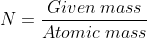
Atomic massof tritium is 3 amu 
therefore

Activity

Activity in terms of unit curie (Ci) is 
Therefore Activity of 1gram tritium is 

Add Answer to:
Tritium (3H) decays by negative beta decay with a half-life of
12.26y.
To what nucleus does...
Tritium, 31H, is a radioactive nucleus of hydrogen. It decays by beta emission with a 1/2...
Tritium, 31H, is a radioactive nucleus of hydrogen. It decays by beta emission with a 1/2 life of 12.3 years. What is the decay constant in (in/s)? What is the activity (in Ci) of a sample containing 2.5 micrograms of tritium? The atomic mass of 31H is 3.02 amu.
The nucleus 40K decays by emitting a Beta^- and a massless anti-neutrino, with a half life...
The nucleus 40K decays by emitting a Beta^- and a massless anti-neutrino, with a half life of 1.25*10^9 years. (a) Write the formula showing the products of this decay, identifying the daughter nucleus. (b) How much energy in MeV is released in the decay? (c) What fraction of the 40K that was present when the earth formed 3.5 billion years ago still remains?
1.) What is the missing particle? 2.) Carbon-14 decays by beta emission and has a half-life...
 1.) What is the missing particle?
2.) Carbon-14 decays by beta emission and has a half-life of
5,730 years
a.) Write the balanced equation for this reaction.
b.) What percentage of a
sample remains after 3,310 years?
3.) Bismuth-214 is an a-emitter with a half-life of 19.7 min.
How long does it take for 75.0% of
to decay?
1.) What is the missing particle?
2.) Carbon-14 decays by beta emission and has a half-life of
5,730 years
a.) Write the balanced equation for this reaction.
b.) What percentage of a
sample remains after 3,310 years?
3.) Bismuth-214 is an a-emitter with a half-life of 19.7 min.
How long does it take for 75.0% of
to decay?
7-(15 points) A nucleus decays into three channels with the relative 0.60, respectively. The half-life of...
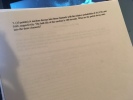 7-(15 points) A nucleus decays into three channels with the relative 0.60, respectively. The half-life of the nucleus is 180 into the three channels? probabilities 0.10,030, and seconds. What are the partial decay rates
thank u so much! 6. One form of nuclear radiation, beta decay, occurs when a neutron...
 thank u so much!
6. One form of nuclear radiation, beta decay, occurs when a neutron changes into a proton, an electron, and a neutral particle called an antineutrino: n → pt + e + De, where ve is the symbol for an antineutrino. When this change happens to a neutron within the nucleus of an atom, the proton remains behind in the nucleus while the electron and neutrino are ejected from the nucleus. The ejected electron is called a...
thank u so much!
6. One form of nuclear radiation, beta decay, occurs when a neutron changes into a proton, an electron, and a neutral particle called an antineutrino: n → pt + e + De, where ve is the symbol for an antineutrino. When this change happens to a neutron within the nucleus of an atom, the proton remains behind in the nucleus while the electron and neutrino are ejected from the nucleus. The ejected electron is called a...
What nucleus results from the negative beta decay of 66 Cu (29), What nucleus results from...
What nucleus results from the negative beta decay of 66 Cu (29), What nucleus results from the positive beta decay of 38 K(19)?
1. The half-life of 2211Na is 950 days. What is its decay constant? Express your answer...
1. The half-life of 2211Na is 950 days. What is its decay constant? Express your answer in s?1. 2.The isotope 8737Rb decays by beta emission. What nucleus is produced?
Part A: Tritium is a radioactive isotope of the element hydrogen. Tritium has a half-life of...
Part A: Tritium is a radioactive isotope of the element hydrogen. Tritium has a half-life of 12.5 years. How many years would it take until only 3.22% of a sample remain? Answer should be in years. Part B: Radioactive Carbon-11 has a half life of only 20.3 minutes and an atomic mass number of 11 u. Calculate the activity of 3.58 g of Carbon-11. Answer should be in Bq.
2 and 3 please! 2. Consider the beta decay of tritium (eq 2). H → He...
 2 and 3 please!
2. Consider the beta decay of tritium (eq 2). H → He + je As you did in Question 1 for the neutron decay of H-2, determine the following for the beta decay of H-3: (a) the rest mass of the reactant (in kg, with six significant figures); (b) the sum of rest masses of the products (in kg, with six significant figures); (c) the mass defect; and (d) the nuclear binding energy of tritium (in...
2 and 3 please!
2. Consider the beta decay of tritium (eq 2). H → He + je As you did in Question 1 for the neutron decay of H-2, determine the following for the beta decay of H-3: (a) the rest mass of the reactant (in kg, with six significant figures); (b) the sum of rest masses of the products (in kg, with six significant figures); (c) the mass defect; and (d) the nuclear binding energy of tritium (in...
studying for my final, help 13) (2 pts) The isotope, tritium, has a half-life of 12.3...
 studying for my final, help
13) (2 pts) The isotope, tritium, has a half-life of 12.3 years and atomic mass 3.016 amu. Assume we have 10 kg of the substance. What will be the initial decay rate, at t=0 (in decays/s)? a. 1.09 x 10¹⁴ decays/s b. 1.8 x 10⁻⁹ decays/s c. 5.6 x 10⁸ decays/s d. 3.6 x 10¹⁸ decays/s e. 3.6 x 10¹⁷ decays/s
studying for my final, help
13) (2 pts) The isotope, tritium, has a half-life of 12.3 years and atomic mass 3.016 amu. Assume we have 10 kg of the substance. What will be the initial decay rate, at t=0 (in decays/s)? a. 1.09 x 10¹⁴ decays/s b. 1.8 x 10⁻⁹ decays/s c. 5.6 x 10⁸ decays/s d. 3.6 x 10¹⁸ decays/s e. 3.6 x 10¹⁷ decays/s
 1.) What is the missing particle?
2.) Carbon-14 decays by beta emission and has a half-life of
5,730 years
a.) Write the balanced equation for this reaction.
b.) What percentage of a
sample remains after 3,310 years?
3.) Bismuth-214 is an a-emitter with a half-life of 19.7 min.
How long does it take for 75.0% of
to decay?
1.) What is the missing particle?
2.) Carbon-14 decays by beta emission and has a half-life of
5,730 years
a.) Write the balanced equation for this reaction.
b.) What percentage of a
sample remains after 3,310 years?
3.) Bismuth-214 is an a-emitter with a half-life of 19.7 min.
How long does it take for 75.0% of
to decay?
 7-(15 points) A nucleus decays into three channels with the relative 0.60, respectively. The half-life of the nucleus is 180 into the three channels? probabilities 0.10,030, and seconds. What are the partial decay rates
 thank u so much!
6. One form of nuclear radiation, beta decay, occurs when a neutron changes into a proton, an electron, and a neutral particle called an antineutrino: n → pt + e + De, where ve is the symbol for an antineutrino. When this change happens to a neutron within the nucleus of an atom, the proton remains behind in the nucleus while the electron and neutrino are ejected from the nucleus. The ejected electron is called a...
thank u so much!
6. One form of nuclear radiation, beta decay, occurs when a neutron changes into a proton, an electron, and a neutral particle called an antineutrino: n → pt + e + De, where ve is the symbol for an antineutrino. When this change happens to a neutron within the nucleus of an atom, the proton remains behind in the nucleus while the electron and neutrino are ejected from the nucleus. The ejected electron is called a...
 2 and 3 please!
2. Consider the beta decay of tritium (eq 2). H → He + je As you did in Question 1 for the neutron decay of H-2, determine the following for the beta decay of H-3: (a) the rest mass of the reactant (in kg, with six significant figures); (b) the sum of rest masses of the products (in kg, with six significant figures); (c) the mass defect; and (d) the nuclear binding energy of tritium (in...
2 and 3 please!
2. Consider the beta decay of tritium (eq 2). H → He + je As you did in Question 1 for the neutron decay of H-2, determine the following for the beta decay of H-3: (a) the rest mass of the reactant (in kg, with six significant figures); (b) the sum of rest masses of the products (in kg, with six significant figures); (c) the mass defect; and (d) the nuclear binding energy of tritium (in...
 studying for my final, help
13) (2 pts) The isotope, tritium, has a half-life of 12.3 years and atomic mass 3.016 amu. Assume we have 10 kg of the substance. What will be the initial decay rate, at t=0 (in decays/s)? a. 1.09 x 10¹⁴ decays/s b. 1.8 x 10⁻⁹ decays/s c. 5.6 x 10⁸ decays/s d. 3.6 x 10¹⁸ decays/s e. 3.6 x 10¹⁷ decays/s
studying for my final, help
13) (2 pts) The isotope, tritium, has a half-life of 12.3 years and atomic mass 3.016 amu. Assume we have 10 kg of the substance. What will be the initial decay rate, at t=0 (in decays/s)? a. 1.09 x 10¹⁴ decays/s b. 1.8 x 10⁻⁹ decays/s c. 5.6 x 10⁸ decays/s d. 3.6 x 10¹⁸ decays/s e. 3.6 x 10¹⁷ decays/s
Most questions answered within 3 hours.
-
Where is the error in this code sequence?
String s1 = "Hello";
String s2 = "ello";...
asked 10 months ago -
Financial data for Joel de Paris, Inc., for last year
follow:
Joel de Paris, Inc.
Balance...
asked 10 months ago -
Consider this reaction:
Al2(SO4)3 (aq)+ BaCl3
(aq) Al2Cl6 (aq)- +
3BaSO4(s) . What is the...
asked 10 months ago -
Suppose that Savneet is considering increasing her
recent random sample from 20 car rentals to 40...
asked 10 months ago -
Trucks arrive at an unloading terminal at an average rate of 120
per hour.
Trucks arrive...
asked 10 months ago -
Why are methanol and ethanol completely soluble in water while
octanol is not very little soluble....
asked 10 months ago -
A facilities manager at a university reads in a research report
that the mean amount of...
asked 10 months ago -
When the CuSO4 is rehydrated by adding water to the anhydrous
compound, is this an endothermic...
asked 10 months ago -
A ray of sunlight is passing from diamond into crown glass; the
angle of incidence is...
asked 10 months ago -
A block of mass 0.249 kg is placed on top of a light, vertical
spring of...
asked 10 months ago -
how do the kidneys compensate in the presences of acidosis
a) trigger hyperventilate
b) reserve acid...
asked 10 months ago -
Question 501 pts
The rental rate of capital to the firm increases. Which of the
following...
asked 10 months ago