Why is a large excess of Fe3+ added when preparing the standard solution. Why do you...
Why is a large excess of Fe3+ added when preparing the standard solution. Why do you not add a large excess of Fe3+ when preparing the equilibrium solution. Fe^3+ + SCN^- = FeSCN^2+?
Homework Answers


Add Answer to:
Why is a large excess of Fe3+ added when preparing the standard
solution. Why do you...
Why is a large excess of Fe3+ added when preparing the standard solution. But you not...
Why is a large excess of Fe3+ added when preparing the standard solution. But you not add a large excess of Fe3+ when preparing the equilibrium solution. Fe^3+ + SCN^- = FeSCN^2+
Part A of lab: pour 30 ml of 0.150 M Fe(NO3)3 into a 50 ml beaker...
Part A of lab: pour 30 ml of 0.150 M Fe(NO3)3 into a 50 ml beaker and pipette 10 ml of this solution into a 25 ml volumetric flask. This is the standard reagent blank Part B of lab: pour 30 ml of 1.50*10^-3 M Fe(NO3)3 into a 25 ml volumetric flask. This is the reagent blank. Why is a large excess of Fe3+ added to make the standard solution, and why do you NOT add a large excess of...
Fe3+ (aq) + ow does the equilibrium shift a) if you add more Fe* SCN (aq)...
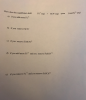 Fe3+ (aq) + ow does the equilibrium shift a) if you add more Fe* SCN (aq) = FeSCN2+ (aq) Fes b) if you remove SCN c) if you remove FeSCN+2 d) if you add more Fe" and you remove FeSCN2 e) if you remove Fe" and you remove FeSCN+2
Why is HCl added when preparing a stock solution of 10mM Fe3+? (1.62g of FeCl3 and...
Why is HCl added when preparing a stock solution of 10mM Fe3+? (1.62g of FeCl3 and 2ml of HCL stock solution is mixed and filled up to 1L with distilled water)
Doing a Chem Review, these are just study scenarios that I need to have a good...
 Doing a Chem Review, these are just study scenarios that I need
to have a good understanding of
6. To determine the concentration of SCN in our saliva, we reacted the SCN in the saliva with Fe' according to the following reaction: We measured the absorbance of the FeSCN and used the absorbance value of the FesCN2 to obtain the concentration of the FesCN2*. This was achieved by measuring the absorbance values of standard FeSCN2+ solutions and constructing a calibration...
Doing a Chem Review, these are just study scenarios that I need
to have a good understanding of
6. To determine the concentration of SCN in our saliva, we reacted the SCN in the saliva with Fe' according to the following reaction: We measured the absorbance of the FeSCN and used the absorbance value of the FesCN2 to obtain the concentration of the FesCN2*. This was achieved by measuring the absorbance values of standard FeSCN2+ solutions and constructing a calibration...
As you will do in lab, a student prepared the following 2 mixtures and recorded their absorbances...
 As you will do in lab, a student prepared the following 2 mixtures and recorded their absorbances in a cuvette with a 1.00 cm path length Table 1.Absorbance of iron (Il) thiocyanate Volume, ml Fe3- 10.0 0.020 M2.64 x 10M Absorbance SCN 10.0 10.0 Mix #1 0.20 M Fel 10.01 0.769 0.495 1. Write the balanced equilibrium reaction of Fe(aq) with SCN (aq) to form [FeSCNJ (aq). 2. Write the equilibrium formation constant expression for the reaction (Kyexpression) Determination of...
Lab Report: Determination of Kc for a Complex Ion Formation tube 2.00e-3 Fe3+ (mL) 2.00E-3M SCN-...
 Lab Report: Determination of Kc for a Complex Ion Formation
tube
2.00e-3 Fe3+ (mL)
2.00E-3M SCN- (mL)
water (mL)
initial conc. Fe3+
initial conc. SCN-
1
5.00
5.00
0
1.00e-3M
1.00E-3M
2
5.00
4.00
1.00
1.00E-3M
8.00E-3M
3
5.00
3.00
2.00
1.00E-3,
6.00E-3M
4
5.00
2.00
3.00
1.00E-3M
4.00E-3M
5
5.00
1.00
4.00
1.00E-3M
2.00E-3M
10ml of 0.200M Fe3+, 2.00ml of 0.00200M SCN-, AND 8.00ml of
water results in an eq. [FeSCN2+] IN Standard
Soln.:2.00E-4M
Could you please explain how...
Lab Report: Determination of Kc for a Complex Ion Formation
tube
2.00e-3 Fe3+ (mL)
2.00E-3M SCN- (mL)
water (mL)
initial conc. Fe3+
initial conc. SCN-
1
5.00
5.00
0
1.00e-3M
1.00E-3M
2
5.00
4.00
1.00
1.00E-3M
8.00E-3M
3
5.00
3.00
2.00
1.00E-3,
6.00E-3M
4
5.00
2.00
3.00
1.00E-3M
4.00E-3M
5
5.00
1.00
4.00
1.00E-3M
2.00E-3M
10ml of 0.200M Fe3+, 2.00ml of 0.00200M SCN-, AND 8.00ml of
water results in an eq. [FeSCN2+] IN Standard
Soln.:2.00E-4M
Could you please explain how...
In the calibration solutions, the very large excess of Fe3+ ion compared to the amount of...
In the calibration solutions, the very large excess of Fe3+ ion compared to the amount of NCS- ion used to prepare the the mixtures allows us to make what assumption about the concentration of product in the mixtures? Question 8 options: [Fe(NCS)2+]equilibrium = [NCS-]equilibrium [Fe(NCS)2+]equilibrium = [Fe3+]initial [Fe(NCS)2+]initial = [Fe3+]initial [Fe(NCS)2+]equilibrium = [Fe3+]equilibrium [Fe(NCS)2+]equilibrium = [NCS-]initial [Fe(NCS)2+]initial = [NCS-]initial
Iron thiocyanate (FeSCN2+) is a complex ion that appears orange-red in solution. Iron(III) (Fe3+) and thiocyanate...
Iron thiocyanate (FeSCN2+) is a complex ion that appears orange-red in solution. Iron(III) (Fe3+) and thiocyanate (SCN-) are both colorless in solution. FeSCN2+ (aq) --(equilibrium)-- Fe3+ (aq) + SCN- (aq) a) If you add Fe(NO3)3 to a solution of these ions at equilibrium, in which direction will the reaction run to reach a new equilibrium? b) Silver ions react with thiocyanate ions to form a white precipitate. If you add silver ions to a solution of these ions at equilibrium,...
A flask contains this equilibrium Fe3+(aq) + SCN'-(aq) <======> FeSCN'-(aq) Which direction should equilibrium shift when...
 A flask contains this equilibrium Fe3+(aq) + SCN'-(aq) <======> FeSCN'-(aq) Which direction should equilibrium shift when a few drops of iron(II) chloride is added? shift left no change b. shift right a. c.
 Fe3+ (aq) + ow does the equilibrium shift a) if you add more Fe* SCN (aq) = FeSCN2+ (aq) Fes b) if you remove SCN c) if you remove FeSCN+2 d) if you add more Fe" and you remove FeSCN2 e) if you remove Fe" and you remove FeSCN+2
 Doing a Chem Review, these are just study scenarios that I need
to have a good understanding of
6. To determine the concentration of SCN in our saliva, we reacted the SCN in the saliva with Fe' according to the following reaction: We measured the absorbance of the FeSCN and used the absorbance value of the FesCN2 to obtain the concentration of the FesCN2*. This was achieved by measuring the absorbance values of standard FeSCN2+ solutions and constructing a calibration...
Doing a Chem Review, these are just study scenarios that I need
to have a good understanding of
6. To determine the concentration of SCN in our saliva, we reacted the SCN in the saliva with Fe' according to the following reaction: We measured the absorbance of the FeSCN and used the absorbance value of the FesCN2 to obtain the concentration of the FesCN2*. This was achieved by measuring the absorbance values of standard FeSCN2+ solutions and constructing a calibration...
 As you will do in lab, a student prepared the following 2 mixtures and recorded their absorbances in a cuvette with a 1.00 cm path length Table 1.Absorbance of iron (Il) thiocyanate Volume, ml Fe3- 10.0 0.020 M2.64 x 10M Absorbance SCN 10.0 10.0 Mix #1 0.20 M Fel 10.01 0.769 0.495 1. Write the balanced equilibrium reaction of Fe(aq) with SCN (aq) to form [FeSCNJ (aq). 2. Write the equilibrium formation constant expression for the reaction (Kyexpression) Determination of...
 Lab Report: Determination of Kc for a Complex Ion Formation
tube
2.00e-3 Fe3+ (mL)
2.00E-3M SCN- (mL)
water (mL)
initial conc. Fe3+
initial conc. SCN-
1
5.00
5.00
0
1.00e-3M
1.00E-3M
2
5.00
4.00
1.00
1.00E-3M
8.00E-3M
3
5.00
3.00
2.00
1.00E-3,
6.00E-3M
4
5.00
2.00
3.00
1.00E-3M
4.00E-3M
5
5.00
1.00
4.00
1.00E-3M
2.00E-3M
10ml of 0.200M Fe3+, 2.00ml of 0.00200M SCN-, AND 8.00ml of
water results in an eq. [FeSCN2+] IN Standard
Soln.:2.00E-4M
Could you please explain how...
Lab Report: Determination of Kc for a Complex Ion Formation
tube
2.00e-3 Fe3+ (mL)
2.00E-3M SCN- (mL)
water (mL)
initial conc. Fe3+
initial conc. SCN-
1
5.00
5.00
0
1.00e-3M
1.00E-3M
2
5.00
4.00
1.00
1.00E-3M
8.00E-3M
3
5.00
3.00
2.00
1.00E-3,
6.00E-3M
4
5.00
2.00
3.00
1.00E-3M
4.00E-3M
5
5.00
1.00
4.00
1.00E-3M
2.00E-3M
10ml of 0.200M Fe3+, 2.00ml of 0.00200M SCN-, AND 8.00ml of
water results in an eq. [FeSCN2+] IN Standard
Soln.:2.00E-4M
Could you please explain how...
 A flask contains this equilibrium Fe3+(aq) + SCN'-(aq) <======> FeSCN'-(aq) Which direction should equilibrium shift when a few drops of iron(II) chloride is added? shift left no change b. shift right a. c.
Most questions answered within 3 hours.
-
Where is the error in this code sequence?
String s1 = "Hello";
String s2 = "ello";...
asked 10 months ago -
Financial data for Joel de Paris, Inc., for last year
follow:
Joel de Paris, Inc.
Balance...
asked 10 months ago -
Consider this reaction:
Al2(SO4)3 (aq)+ BaCl3
(aq) Al2Cl6 (aq)- +
3BaSO4(s) . What is the...
asked 10 months ago -
Suppose that Savneet is considering increasing her
recent random sample from 20 car rentals to 40...
asked 10 months ago -
Trucks arrive at an unloading terminal at an average rate of 120
per hour.
Trucks arrive...
asked 10 months ago -
Why are methanol and ethanol completely soluble in water while
octanol is not very little soluble....
asked 10 months ago -
A facilities manager at a university reads in a research report
that the mean amount of...
asked 10 months ago -
When the CuSO4 is rehydrated by adding water to the anhydrous
compound, is this an endothermic...
asked 10 months ago -
A ray of sunlight is passing from diamond into crown glass; the
angle of incidence is...
asked 10 months ago -
A block of mass 0.249 kg is placed on top of a light, vertical
spring of...
asked 10 months ago -
how do the kidneys compensate in the presences of acidosis
a) trigger hyperventilate
b) reserve acid...
asked 10 months ago -
Question 501 pts
The rental rate of capital to the firm increases. Which of the
following...
asked 10 months ago