Electroplating It takes 135.6 s for a 1.31-A current to plate 0.1907 g of a metallic...
Electroplating
It takes 135.6 s for a 1.31-A current to plate 0.1907 g of a metallic element from a solution containing M2+ ions.
What is the element (M)? Answer with the chemical symbol for the element.
Homework Answers

To determine the element (M), we need to use Faraday's Law of Electrolysis, which relates the amount of a substance produced at an electrode to the electric current and the time.
The equation is:
moles of M = (current x time) / (Faraday's constant x Molar mass of M)
First, we need to calculate the number of moles of M produced:
moles of M = (1.31 A x 135.6 s) / (96500 C/mol x n)
where n is the number of electrons transferred per ion during the electrolysis. We don't know the value of n yet, so we can leave it as a variable for now.
Next, we need to calculate the molar mass of M:
molar mass of M = mass of M / moles of M
We are given the mass of M produced (0.1907 g), so we can plug in the values and solve for the molar mass:
molar mass of M = 0.1907 g / moles of M
Now we can use the periodic table to find the element that has this molar mass. The closest match is silver (Ag), which has a molar mass of 107.87 g/mol.
So we have:
molar mass of M ≈ 0.1907 g / moles of M
molar mass of M ≈ 107.87 g/mol
Finally, we can solve for n using the oxidation state of the ion in the solution. Since we don't have that information, we can't determine n with certainty. However, for most common metallic elements, the oxidation state is either +1 or +2, which means that n is either 1 or 2. Using n = 1 and n = 2, we get:
n = 1: moles of M = (1.31 A x 135.6 s) / (96500 C/mol x 107.87 g/mol)
moles of M ≈ 0.000152
n = 2: moles of M = (1.31 A x 135.6 s) / (96500 C/mol x 2 x 107.87 g/mol)
moles of M ≈ 0.000305
The closest match to either value is silver (Ag), which has an oxidation state of +1 or +2, so the answer is:
M = Ag (silver)
Add Answer to:
Electroplating
It takes 135.6 s for a 1.31-A current to plate 0.1907 g of a
metallic...
Please show all work step by step and final answer. Electroplating It takes 100.9 s for...
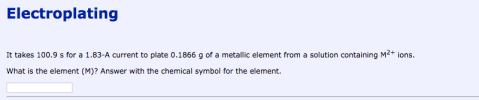 Please show all work step by step and final answer.
Electroplating It takes 100.9 s for a 1.83-A current to plate 0.1866 g of a metallic element from a solution containing M2+ ions. What is the element (M)? Answer with the chemical symbol for the element.
Please show all work step by step and final answer.
Electroplating It takes 100.9 s for a 1.83-A current to plate 0.1866 g of a metallic element from a solution containing M2+ ions. What is the element (M)? Answer with the chemical symbol for the element.
Please help me with the correct explanation and correct answer. Thanks Electroplating It takes 207.8 s...
 Please help me with the correct explanation and correct answer.
Thanks
Electroplating It takes 207.8 s for a 1.07-A current to plate 0.1368 g of a metallic element from a solution containing M2+ ions. What is the element (M)? Answer with the chemical symbol for the element.
Please help me with the correct explanation and correct answer.
Thanks
Electroplating It takes 207.8 s for a 1.07-A current to plate 0.1368 g of a metallic element from a solution containing M2+ ions. What is the element (M)? Answer with the chemical symbol for the element.
How many coulombs are required to plate a layer of chromium metal 0.27 mm thick on...
How many coulombs are required to plate a layer of chromium metal 0.27 mm thick on an auto bumper with a total area of 0.23 m2 from a solution containing CrO2−4? The density of chromium metal is 7.20 g/cm3. What current flow is required for this electroplating if the bumper is to be plated in 12.3 s ?
8 In the thermite reaction: 2 Al(s) + Fe2O3(s) ---> 2 Fe(s) + Al2O3(s) So much...
8 In the thermite reaction: 2 Al(s) + Fe2O3(s) ---> 2 Fe(s) + Al2O3(s) So much heat is generated that the iron initially formed is a molten liquid. Which of the following statements is consistant with the reaction? the reaction is endothermic; aluminum is oxidized and iron is reduced.the reaction is not an oxidation reduction reaction. the reaction is exothermic; aluminum is oxidized and iron is reduced.the reaction is endothermic; aluminum is reduced and iron is oxidized.the reaction is exothermic; aluminum...
1. The propellent used to help launch the space shuttle in the solid-fuel boosters attached to...
1. The propellent used to help launch the space shuttle in the solid-fuel boosters attached to the vehicle is 1.1 million pounds of ammonium perchlorate and powdered aluminum. The reaction generating the energy to blast the orbitor into space is: 3 NH4ClO4(s) + 3 Al(s) ---> Al2O3(s) + AlCl3(s) + 3 NO(g) + 6 H2O(g) The energy generated results from oxidation-reduction chemistry. Write the symbol for the metallic element that is oxidized in the reaction. Write the symbol for the...
It took 277 sec for a current of 2.00 amp to plate out 0.107 g of...
It took 277 sec for a current of 2.00 amp to plate out 0.107 g of an unknown metal M from a solution containing dissolved M(NO3)3. Identify the metal M. Al In Mo Sc Fe
Electroplating Postlab Questions 1. Suppose that you have the opportunity to be the first in the ...
 Electroplating Postlab Questions 1. Suppose that you have the opportunity to be the first in the world to come up witha your data for the number of Coulombs of charge passed and the number of moles of value of Faraday's constant -never mind we al ready know it is 96485 C/mol e. Using copper actually lost from the copper electrode in your experiment, what would you predict for the value of Faradays constant? Show your work. What is the percent...
• 18.55 A steady current was passed through molten CoSO4 until 2.35 g of metallic cobalt...
 • 18.55 A steady current was passed through molten CoSO4 until 2.35 g of metallic cobalt was pro- duced. Calculate the number of coulombs of elec- tricity used. • 18.59 The passage of a current of 0.750 A for 25.0 min deposited 0.369 g of copper from a CuSO4 solution. From this information, calculate the molar mass of copper. 18.87 In a certain electrolysis experiment involving Al+ ions, 60.2 g of Al is recovered when a current of 0.352 A...
Metallic magnesium can be made by the electrolysis of molten MgCl2. Metallic magnesium can be made...
 Metallic magnesium can be made by the electrolysis of molten
MgCl2.
Metallic magnesium can be made by the electrolysis of molten MgCl2. (a) What mass of Mg is formed by passing a current of 5.08 A through molten MgCl2 for 1.40 days? The unbalanced chemical reaction representing this electrolysis is shown below. MgCl2 → Mg + Cl2 g of Mg is formed by this electrolysis. (b) How many minutes are needed to plate out 16.00 g of Mg from molten...
Metallic magnesium can be made by the electrolysis of molten
MgCl2.
Metallic magnesium can be made by the electrolysis of molten MgCl2. (a) What mass of Mg is formed by passing a current of 5.08 A through molten MgCl2 for 1.40 days? The unbalanced chemical reaction representing this electrolysis is shown below. MgCl2 → Mg + Cl2 g of Mg is formed by this electrolysis. (b) How many minutes are needed to plate out 16.00 g of Mg from molten...
35. In the electrolysis of a solution containing Ni2+(aq), metallic Ni(s) deposits on the cathode. Using...
 35. In the electrolysis of a solution containing Ni2+(aq), metallic Ni(s) deposits on the cathode. Using a current of 0.150 A for 12.2 min, what mass of nickel will form? (a) 0.0580 g (b) 5.56 x 10⁴ g (c) 0.116 g (d) 1.86 x 10⁻⁵ (e) 0.025 g
 Please show all work step by step and final answer.
Electroplating It takes 100.9 s for a 1.83-A current to plate 0.1866 g of a metallic element from a solution containing M2+ ions. What is the element (M)? Answer with the chemical symbol for the element.
Please show all work step by step and final answer.
Electroplating It takes 100.9 s for a 1.83-A current to plate 0.1866 g of a metallic element from a solution containing M2+ ions. What is the element (M)? Answer with the chemical symbol for the element.
 Please help me with the correct explanation and correct answer.
Thanks
Electroplating It takes 207.8 s for a 1.07-A current to plate 0.1368 g of a metallic element from a solution containing M2+ ions. What is the element (M)? Answer with the chemical symbol for the element.
Please help me with the correct explanation and correct answer.
Thanks
Electroplating It takes 207.8 s for a 1.07-A current to plate 0.1368 g of a metallic element from a solution containing M2+ ions. What is the element (M)? Answer with the chemical symbol for the element.
 Electroplating Postlab Questions 1. Suppose that you have the opportunity to be the first in the world to come up witha your data for the number of Coulombs of charge passed and the number of moles of value of Faraday's constant -never mind we al ready know it is 96485 C/mol e. Using copper actually lost from the copper electrode in your experiment, what would you predict for the value of Faradays constant? Show your work. What is the percent...
 • 18.55 A steady current was passed through molten CoSO4 until 2.35 g of metallic cobalt was pro- duced. Calculate the number of coulombs of elec- tricity used. • 18.59 The passage of a current of 0.750 A for 25.0 min deposited 0.369 g of copper from a CuSO4 solution. From this information, calculate the molar mass of copper. 18.87 In a certain electrolysis experiment involving Al+ ions, 60.2 g of Al is recovered when a current of 0.352 A...
 Metallic magnesium can be made by the electrolysis of molten
MgCl2.
Metallic magnesium can be made by the electrolysis of molten MgCl2. (a) What mass of Mg is formed by passing a current of 5.08 A through molten MgCl2 for 1.40 days? The unbalanced chemical reaction representing this electrolysis is shown below. MgCl2 → Mg + Cl2 g of Mg is formed by this electrolysis. (b) How many minutes are needed to plate out 16.00 g of Mg from molten...
Metallic magnesium can be made by the electrolysis of molten
MgCl2.
Metallic magnesium can be made by the electrolysis of molten MgCl2. (a) What mass of Mg is formed by passing a current of 5.08 A through molten MgCl2 for 1.40 days? The unbalanced chemical reaction representing this electrolysis is shown below. MgCl2 → Mg + Cl2 g of Mg is formed by this electrolysis. (b) How many minutes are needed to plate out 16.00 g of Mg from molten...
 35. In the electrolysis of a solution containing Ni2+(aq), metallic Ni(s) deposits on the cathode. Using a current of 0.150 A for 12.2 min, what mass of nickel will form? (a) 0.0580 g (b) 5.56 x 10⁴ g (c) 0.116 g (d) 1.86 x 10⁻⁵ (e) 0.025 g
Most questions answered within 3 hours.
-
Where is the error in this code sequence?
String s1 = "Hello";
String s2 = "ello";...
asked 10 months ago -
Financial data for Joel de Paris, Inc., for last year
follow:
Joel de Paris, Inc.
Balance...
asked 10 months ago -
Consider this reaction:
Al2(SO4)3 (aq)+ BaCl3
(aq) Al2Cl6 (aq)- +
3BaSO4(s) . What is the...
asked 10 months ago -
Suppose that Savneet is considering increasing her
recent random sample from 20 car rentals to 40...
asked 10 months ago -
Trucks arrive at an unloading terminal at an average rate of 120
per hour.
Trucks arrive...
asked 10 months ago -
Why are methanol and ethanol completely soluble in water while
octanol is not very little soluble....
asked 10 months ago -
A facilities manager at a university reads in a research report
that the mean amount of...
asked 10 months ago -
When the CuSO4 is rehydrated by adding water to the anhydrous
compound, is this an endothermic...
asked 10 months ago -
A ray of sunlight is passing from diamond into crown glass; the
angle of incidence is...
asked 10 months ago -
A block of mass 0.249 kg is placed on top of a light, vertical
spring of...
asked 10 months ago -
how do the kidneys compensate in the presences of acidosis
a) trigger hyperventilate
b) reserve acid...
asked 10 months ago -
Question 501 pts
The rental rate of capital to the firm increases. Which of the
following...
asked 10 months ago