given the dataword 101001111 and the divisor 10111, show the generation of the CRC codeword at...
given the dataword 101001111 and the divisor 10111, show the generation of the CRC codeword at the sender site( using binary division).
Homework Answers


Add Answer to:
given the dataword 101001111 and the divisor 10111,
show the generation of the CRC codeword at...
CODEWORK IS 14 BITS. 10 BITS are DATAWORD and remaining are CONTROL BITS. Given the dataword...
 CODEWORK IS 14 BITS. 10 BITS are DATAWORD and remaining are
CONTROL BITS.
Given the dataword 1010011110 and the divisor 10111 a. Show the generation of the codeword at the sender site (using binary division). b. Show the checking of the codeword at the receiver site (assume no error).
CODEWORK IS 14 BITS. 10 BITS are DATAWORD and remaining are
CONTROL BITS.
Given the dataword 1010011110 and the divisor 10111 a. Show the generation of the codeword at the sender site (using binary division). b. Show the checking of the codeword at the receiver site (assume no error).
Given the data, “01101100” and the divisor, “101”. Please compute the FSC using the CRC method....
Given the data, “01101100” and the divisor, “101”. Please compute the FSC using the CRC method. You need to show the computation process
Write legibly to receive good rating. Consider a CRC code with a generator polynomial of g(x)...
 Write legibly to receive good rating.
Consider a CRC code with a generator polynomial of g(x) -xSx21 a. (15 points) Show step by step (using the longhand division) how to find the codeword that corresponds to information bits of 10011 b. (15 points) Show the shift-register circuit that implements this CRC code. C. Suppose the codeword length is 10. Answer the following questions, with proper justifications i. (10 points) Give an example of undetectable error burst of length 9 ii....
Write legibly to receive good rating.
Consider a CRC code with a generator polynomial of g(x) -xSx21 a. (15 points) Show step by step (using the longhand division) how to find the codeword that corresponds to information bits of 10011 b. (15 points) Show the shift-register circuit that implements this CRC code. C. Suppose the codeword length is 10. Answer the following questions, with proper justifications i. (10 points) Give an example of undetectable error burst of length 9 ii....
4. Perform subtraction on the given unsigned binary numbers using the 2nd complement of the subtrahend...
 4. Perform subtraction on the given unsigned binary numbers using the 2nd complement of the subtrahend (using 8-bit register). Show the result also in decimal 10111- 10110 101010 - 101110
Programming (please provide typeset): given an integer dividend x>0 and an integer divisor y>0, find the...
Programming (please provide typeset): given an integer dividend x>0 and an integer divisor y>0, find the quotient Q and the remainder R of the integer division of x by y without using division. Note: x=Q*y+R Requirement: ask the user input the integers x, y>0: print out the quotient Q and remainder R language: C++ Please explain how you got the code
Problem #1 (Number Systems) Show Procedure to Get Credit a) Given : X = 101101, and...
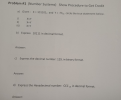 Problem #1 (Number Systems) Show Procedure to Get Credit a) Given : X = 101101, and Y = F3, circle the true statement below. i) X<Y X=Y Xəy iii) b) Express 10111 in decimal format. Answer: c) Express the decimal number: 129, in binary format. Answer: d) Express the Hexadecimal number: CCC 16 in decimal format. Answer:
2. Perform the following binary multiplications, assuming unsigned integers: B. 10011 x 011 C. 11010 x...
2. Perform the following binary multiplications, assuming unsigned integers: B. 10011 x 011 C. 11010 x 1011 3. Perform the following binary divisions, assuming unsigned integers: B. 10000001 / 101 C. 1001010010 / 1011 4. Assume we are using the simple model for floating-point representation as given in the text (the representation uses a 14-bit format, 5 bits for the exponent with a bias of 16, a normalized mantissa of 8 bits, and single sign bit for the number ):...
JH: Student Name: 4) Given the following array, do the following (show all the work). A...
 JH: Student Name: 4) Given the following array, do the following (show all the work). A (56, 89, 23, 58, 22, 11, 45, 48, 90) (a - 5 pts) Construct a hash table for the given array using the hash function H(K)- K mod 5 (b- 4 pts) Determine the average number of comparisons for a successful search using the hash table of (c -3 pts) What is the worst case number of comparisons for an unsuccessful search in the...
PLEASE SHOW MATH OF IT ALL Given n bits, how many signed numbers can be represented...
PLEASE SHOW MATH OF IT ALL Given n bits, how many signed numbers can be represented using the sign-and-magnitude method, the ones’ complement method, and the two’s complement method, respectively? (5 points) Number conversion (2.5 x 22 = 55 points) Convert the following unsigned binary numbers to decimal: 11111 101 Convert the following decimal numbers to binary: 111 35 Convert the following octal numbers to binary: 1111 731 Convert the following unsigned binary numbers to octal: 101010111001 1001 Convert the...
given the following key values, show what the data structures would look like after insertions: Hashing...
 given the following key values, show what the data structures
would look like after insertions:
Hashing Lab Given the following key values, show what the data structures would look like after insertions 27 53 13 10 138 109 49 174 26 24 (no preprocessing necessary: PL = key) a. Linear array of 10 elements using division hashing b. Bucket hashing of 10 elements (N=10) and the linear-quotient collision path algorithm ip = (p) % N N = 13, 4k+3 prime...
given the following key values, show what the data structures
would look like after insertions:
Hashing Lab Given the following key values, show what the data structures would look like after insertions 27 53 13 10 138 109 49 174 26 24 (no preprocessing necessary: PL = key) a. Linear array of 10 elements using division hashing b. Bucket hashing of 10 elements (N=10) and the linear-quotient collision path algorithm ip = (p) % N N = 13, 4k+3 prime...
 CODEWORK IS 14 BITS. 10 BITS are DATAWORD and remaining are
CONTROL BITS.
Given the dataword 1010011110 and the divisor 10111 a. Show the generation of the codeword at the sender site (using binary division). b. Show the checking of the codeword at the receiver site (assume no error).
CODEWORK IS 14 BITS. 10 BITS are DATAWORD and remaining are
CONTROL BITS.
Given the dataword 1010011110 and the divisor 10111 a. Show the generation of the codeword at the sender site (using binary division). b. Show the checking of the codeword at the receiver site (assume no error).
 Write legibly to receive good rating.
Consider a CRC code with a generator polynomial of g(x) -xSx21 a. (15 points) Show step by step (using the longhand division) how to find the codeword that corresponds to information bits of 10011 b. (15 points) Show the shift-register circuit that implements this CRC code. C. Suppose the codeword length is 10. Answer the following questions, with proper justifications i. (10 points) Give an example of undetectable error burst of length 9 ii....
Write legibly to receive good rating.
Consider a CRC code with a generator polynomial of g(x) -xSx21 a. (15 points) Show step by step (using the longhand division) how to find the codeword that corresponds to information bits of 10011 b. (15 points) Show the shift-register circuit that implements this CRC code. C. Suppose the codeword length is 10. Answer the following questions, with proper justifications i. (10 points) Give an example of undetectable error burst of length 9 ii....
 4. Perform subtraction on the given unsigned binary numbers using the 2nd complement of the subtrahend (using 8-bit register). Show the result also in decimal 10111- 10110 101010 - 101110
 Problem #1 (Number Systems) Show Procedure to Get Credit a) Given : X = 101101, and Y = F3, circle the true statement below. i) X<Y X=Y Xəy iii) b) Express 10111 in decimal format. Answer: c) Express the decimal number: 129, in binary format. Answer: d) Express the Hexadecimal number: CCC 16 in decimal format. Answer:
 JH: Student Name: 4) Given the following array, do the following (show all the work). A (56, 89, 23, 58, 22, 11, 45, 48, 90) (a - 5 pts) Construct a hash table for the given array using the hash function H(K)- K mod 5 (b- 4 pts) Determine the average number of comparisons for a successful search using the hash table of (c -3 pts) What is the worst case number of comparisons for an unsuccessful search in the...
 given the following key values, show what the data structures
would look like after insertions:
Hashing Lab Given the following key values, show what the data structures would look like after insertions 27 53 13 10 138 109 49 174 26 24 (no preprocessing necessary: PL = key) a. Linear array of 10 elements using division hashing b. Bucket hashing of 10 elements (N=10) and the linear-quotient collision path algorithm ip = (p) % N N = 13, 4k+3 prime...
given the following key values, show what the data structures
would look like after insertions:
Hashing Lab Given the following key values, show what the data structures would look like after insertions 27 53 13 10 138 109 49 174 26 24 (no preprocessing necessary: PL = key) a. Linear array of 10 elements using division hashing b. Bucket hashing of 10 elements (N=10) and the linear-quotient collision path algorithm ip = (p) % N N = 13, 4k+3 prime...
Most questions answered within 3 hours.
-
Where is the error in this code sequence?
String s1 = "Hello";
String s2 = "ello";...
asked 10 months ago -
Financial data for Joel de Paris, Inc., for last year
follow:
Joel de Paris, Inc.
Balance...
asked 10 months ago -
Consider this reaction:
Al2(SO4)3 (aq)+ BaCl3
(aq) Al2Cl6 (aq)- +
3BaSO4(s) . What is the...
asked 10 months ago -
Suppose that Savneet is considering increasing her
recent random sample from 20 car rentals to 40...
asked 10 months ago -
Trucks arrive at an unloading terminal at an average rate of 120
per hour.
Trucks arrive...
asked 10 months ago -
Why are methanol and ethanol completely soluble in water while
octanol is not very little soluble....
asked 10 months ago -
A facilities manager at a university reads in a research report
that the mean amount of...
asked 10 months ago -
When the CuSO4 is rehydrated by adding water to the anhydrous
compound, is this an endothermic...
asked 10 months ago -
A ray of sunlight is passing from diamond into crown glass; the
angle of incidence is...
asked 10 months ago -
A block of mass 0.249 kg is placed on top of a light, vertical
spring of...
asked 10 months ago -
how do the kidneys compensate in the presences of acidosis
a) trigger hyperventilate
b) reserve acid...
asked 10 months ago -
Question 501 pts
The rental rate of capital to the firm increases. Which of the
following...
asked 10 months ago