Implement the following in C++ Imagine that you are an engineer on a distant planet. You...
Implement the following in C++
Imagine that you are an engineer on a distant planet. You were tasked with mining the resources of the planet and have done so through largely primitive means. However you have managed to set up an automated train system to gather and collect the resources from your distant operations. Your train system collects boxes full of resources. A box might contain ores or wood or even liquid fuel. These boxes are placed into the train using drones who stack them on each other to save space. You now need to implement a management system using the newly researched data structures that will prove useful. In particular, the rapid pace of your development means that resources are accumulated quickly and fixed sized structures would be unwise. Therefore you will be implementing the stack through the use of a linked list.
resrcStack
The class is defined according to the simple UML diagram below:
resrcStack<T>
-top: stackNode<T>*
----------------------------
+resrcStack()
+~resrcStack()
+push(t: stackNode<T>*):void
+pop():void
+peek():stackNode<T>*
+print():void
+determineTransportRequirement():string
The class variables are defined below:
•top: The current top of the stack. It will start
as null but should refer to the top of the stack.
The class methods are defined below:
•resrcStack: The class constructor. It will start
by initialising the variables to null.
•~resrcStack:The class destructor. It will deallocate all of the memory assigned by the class.
•push: This will receive a stackNode to add onto the current stack. The node is added from the front.
•pop: This will remove the top stackNode from the stack. If it is empty, print out ”EMPTY” with a newline at the end and no quotation marks. When removing the node, it should be deleted.
•peek: This will return the top node of the stack but without removing it from the stack.
•print: This will print the entire contents of the stack. For each resrc node in the stack, print the following information out sequentially, line by line. The format of this is as follows:
Resource:
Unrefined Ores
Quantity:
3500
Resource: Refined
Alloys
Quantity:
30000
•determineTransportRequirement: This function
will be used to determine what sort of transportation will be
required to move the resources contained within the stack to their
required destinations. The result of this function is a string
returned for the following conditions:
1. drone: If the number of nodes is less than or equal to 5, drones
will required.
2. car: If the quantity of the items in total, is greater than 50
and the items number at no more than 10, a car will be required.
Quantity of items refers to the sum of the quantity variables in
each of the stack nodes.
3. train: If the quantity of the items in total of the items is
over 100, a train will be required. Quantity of items refers to the
sum of the quantity variables in each of the stack nodes.
Return either drone, car or train depending on the conditions
present. If none of the conditions are met, return ”LOGISTICS
ERROR” without the quotation marks. The train takes precedence over
the car which takes precedence over the drones for what to
return.
==============stackNode.h=================================
#ifndef STACKNODE_H
#define STACKNODE_H
#include<iostream>
#include<string>
using namespace std;
// Defines a class Node
template <class T>
class stackNode
{
private:
T resrc;
int quantity;
public:
stackNode *next;
stackNode(T i, int q)
{
resrc = i;
quantity = q;
}
~stackNode()
{
delete next;
}
T getResrc()
{
return resrc;
}
int getQuantity()
{
return quantity;
}
};
#endif
Homework Answers
resrcStack.h
====================
#pragma once
#include "stackNode.h"
template <typename T>
class resrcStack {
private:
stackNode<T>* top; // The current top of the
stack
public:
resrcStack(); // constructor
~resrcStack(); // destructor
void push(stackNode<T>* t); // add a node at
front of list
void pop(); // removes top node from the stack
stackNode<T>* peek(); // return the top node of
the stack but without removing it
void print(); // print the entire contents of the
stack
string determineTransportRequirement(); // return
either drone, car or train
// depending on the conditions
present
};
template <typename T>
resrcStack<T>::resrcStack() {
// initialize members
top = nullptr;
}
template <typename T>
resrcStack<T>::~resrcStack() {
// create a iterator
stackNode<T>* itr = top;
// loop each element in stack
while (itr != nullptr) {
//move top to next element in the
stack
top = top->next;
// delete the element
delete itr;
// reassign iterator
itr = top;
}
}
template <typename T>
void resrcStack<T>::push(stackNode<T>* t) {
// check if top is null
if (top == nullptr) {
// assign new node to top
top = t;
}
else {
// assign new node at top ofthe
stack
t->next = top;
// reassign top of the stack
top = t;
}
}
template <typename T>
void resrcStack<T>::pop() {
// check if top is null
if (top == nullptr) {
// print message that idicate the
stack is empty
cout << "EMPTY" <<
endl;
}
else {
// remove firsrt element from the
stack
// assign temparary pointer to
top
stackNode<T>* temp =
top;
// move top to next element
top = top->next;
// delete temparary element
delete temp;
}
}
template <typename T>
stackNode<T>* resrcStack<T>::peek() {
// return pointer to first element in the stack
return top;
}
template <typename T>
void resrcStack<T>::print() {
// print the entire contents of the stack, line by
line
// create an iterator to iterate over stack
stackNode<T>* itr = top;
while (itr != nullptr) {
// print element
cout << "Resource: " <<
itr->getResrc() << endl;
cout << "Quantity: " <<
itr->getQuantity() << endl;
// move itrerator to next
element
itr = itr->next;
}
}
template <typename T>
string resrcStack<T>::determineTransportRequirement() {
// get number of elements
int number_of_item = 0;
// get total quantity of item
int total_quantity = 0;
// create iterator to iterate over stack
stackNode<T>* itr = top;
while (itr != nullptr) {
// increase item number
number_of_item++;
// increase item quantity
total_quantity = total_quantity +
itr->getQuantity();
// set iterator to next
element
itr = itr->next;
}
// check if cargo canbe transported with drone
if (number_of_item < 6 && total_quantity
<= 50) {
return "Drone";
}
else if (number_of_item < 11 &&
total_quantity > 50 && total_quantity <= 100) {
return "Car";
}
else if (total_quantity > 100) {
return "Train";
}
else {
return "LOGISTICS ERROR";
}
}
====================
main.cpp
====================
#include "resrcStack.h"
int main() {
cout << "Establishing automated train system"
<< endl;
resrcStack<string>* stack = new
resrcStack<string>();
cout << "Mining ores" << endl;
stackNode<string>* ore = new
stackNode<string>("Unrefined Ore", 10);
cout << "Putting ores on stack" <<
endl;
stack->push(ore);
cout << "Current stack is:" << endl;
stack->print();
cout << "Required transport is: " <<
stack->determineTransportRequirement() << endl;
cout << endl;
cout << "Gathering wood" << endl;
stackNode<string>* wood = new
stackNode<string>("Logs", 45);
cout << "Putting wood on stack" <<
endl;
stack->push(wood);
cout << "Current stack is:" << endl;
stack->print();
cout << "Required transport is: " <<
stack->determineTransportRequirement() << endl;
cout << endl;
cout << "Mining fuel" << endl;
stackNode<string>* fuel = new
stackNode<string>("Unrefined Oil", 70);
cout << "Putting fuel on stack" <<
endl;
stack->push(fuel);
cout << "Current stack is:" << endl;
stack->print();
cout << "Required transport is: " <<
stack->determineTransportRequirement() << endl;
cout << endl;
cout << "First item on stack is: " <<
stack->peek()->getResrc() << endl;
cout << "Removing first item from stack."
<< endl;
stack->pop();
cout << "Current stack is:" << endl;
stack->print();
return 0;
}
====================
stackNode.h
====================
#ifndef STACKNODE_H
#define STACKNODE_H
#include<iostream>
#include<string>
using namespace std;
// Defines a class Node
template <class T>
class stackNode {
private:
T resrc;
int quantity;
public:
stackNode* next;
stackNode(T i, int q) {
resrc = i;
quantity = q;
}
~stackNode() {
// why its deleting next
node?
// it should delete current
node
// delete next;
// there is no dynamicaly assign
memory in this class
// so no deletion should be
done
}
T getResrc() {
return resrc;
}
int getQuantity() {
return quantity;
}
};
#endif
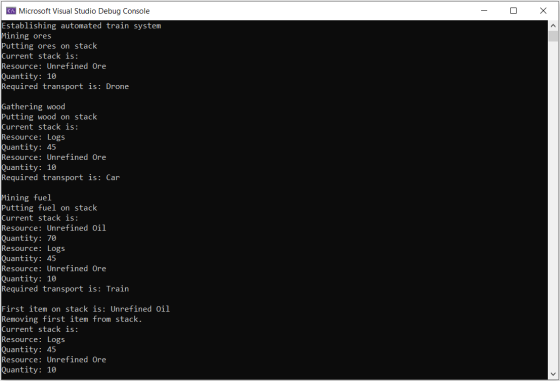
the stackNode class requires modification in its destructor , i have added comments in code.
let me know if have any doubts or problem running code.
Add Answer to:
Implement the
following in C++
Imagine that you are
an engineer on a distant planet. You...
I need help with a c++ code, i am new learner on stack, please help me...
I need help with a c++ code, i am new learner on stack, please help me write Stack.cpp according to Stack.h provided, thanks(Notes: That data structure is a singly linked list in which pushed items are placed at the tail of the linked list. Similarly, popped items will be removed from the tail of the list.) Actually,I can write a regular one, but i'm not sure how to use the tail in the question. class Stack { private: // Desc:...
I have added a little Code but I need help with the rest. /** A class...
I have added a little Code but I need help with the rest. /** A class of stacks whose entries are stored in a chain of nodes. Implement all methods in MyStack class Main Reference : text book or class notes Do not change or add data fields */ package PJ2; public class MyStack<T> implements StackInterface<T> { // Data fields private Node<T> topNode; // references the first node in the chain private int numberOfEntries; public...
Java - data structures Suppose that in the array-based stack, the array doubles in size after...
Java - data structures Suppose that in the array-based stack, the array doubles in size after multiple push operations. But later on, fewer than half of the array’s locations might actually be used by the stack due to pop operations. Revise the implementation so that its array also can shrink in size as objects are removed from the stack. Accomplishing this task will require two new private methods, as follows: The first new method checks whether we should reduce the...
PLEASE CODE IN C++ AND MAKE IT COPYABLE! In this project, you will design and implement...
PLEASE CODE IN C++ AND MAKE IT COPYABLE! In this project, you will design and implement an algorithm to determine the next greater element of an element in an array in Θ(n) time, where 'n' is the number of elements in the array. You could use the Stack ADT for this purpose. The next greater element (NGE) for an element at index i in an array A is the element that occurs at index j (i < j) such that...
In Java. What would the methods of this class look like? StackADT.java public interface StackADT<T> {...
 In Java. What would the methods of this class look like?
StackADT.java
public interface StackADT<T>
{
/** Adds one element to the top of this stack.
* @param element element to be pushed onto stack
*/
public void push (T element);
/** Removes and returns the top element from this stack.
* @return T element removed from the top of the stack
*/
public T pop();
/** Returns without removing the top element of this
stack.
* @return T...
In Java. What would the methods of this class look like?
StackADT.java
public interface StackADT<T>
{
/** Adds one element to the top of this stack.
* @param element element to be pushed onto stack
*/
public void push (T element);
/** Removes and returns the top element from this stack.
* @return T element removed from the top of the stack
*/
public T pop();
/** Returns without removing the top element of this
stack.
* @return T...
Currently, I'm getting this as my output: "Exception in thread "main" java.lang.NullPointerException at InfixExpression.execute(InfixExpression.java:98) ...
Currently, I'm getting this as my output: "Exception in thread "main" java.lang.NullPointerException at InfixExpression.execute(InfixExpression.java:98) at InfixExpression.Evaluate(InfixExpression.java:65) at InfixExpression.setWholeExpr(InfixExpression.java:24) at InfixExpression.<init>(InfixExpression.java:17) at Main.testHW1(Main.java:17) at Main.main(Main.java:6)" I need to get this as my output: "Testing InfixExpression: When passing null, the String and double = Infix String: , result: 0.0 When passing a valid String, the String and double = Infix String: ( 234.5 * ( 5.6 + 7.0 ) ) / 100.2, result: 29.488023952095805 ..." I...
Am Specification For this assignment, you will write a multi-file C program to define, implement ...
 Must be written and C, and compile with MinGW. Thank
you!
am Specification For this assignment, you will write a multi-file C program to define, implement and use a dynamic linked lists. Please refer to Lab 07 for the definition of a basic linked list. In this assignment you will need to use the basic ideas of a node and of a linked list of nodes to implement a suit of functions which can be used to create and maintain...
Must be written and C, and compile with MinGW. Thank
you!
am Specification For this assignment, you will write a multi-file C program to define, implement and use a dynamic linked lists. Please refer to Lab 07 for the definition of a basic linked list. In this assignment you will need to use the basic ideas of a node and of a linked list of nodes to implement a suit of functions which can be used to create and maintain...
There is a data structure called a drop-out stack that behaves like a stack in every...
There is a data structure called a drop-out stack that behaves like a stack in every respect except that if the stack size is n, then when the n+1element is pushed, the bottom element is lost. Implement a drop-out stack using links, by modifying the LinkedStack code. (size, n, is provided by the constructor. Request: Please create a separate driver class, in a different file, that tests on different types of entries and show result of the tests done on...
// thanks for helping // C++ homework // The homework is to complete below in the...
// thanks for helping // C++ homework // The homework is to complete below in the stack.h : // 1. the copy constructor // 2. the assignment operator // 3. the destructor // 4. Write a test program (mytest.cpp) to test copy and assignment // 5. Verify destructor by running the test program in Valgrind // This is the main.cpp #include <iostream> #include "stack.h" using namespace std; int main() { Stack<int> intStack; cout << "\nPush integers on stack and dump...
For this computer assignment, you are to write a C++ program to implement a class for...
For this computer assignment, you are to write a C++ program to implement a class for binary trees. To deal with variety of data types, implement this class as a template. The definition of the class for a binary tree (as a template) is given as follows: template < class T > class binTree { public: binTree ( ); // default constructor unsigned height ( ) const; // returns height of tree virtual void insert ( const T& ); //...
 In Java. What would the methods of this class look like?
StackADT.java
public interface StackADT<T>
{
/** Adds one element to the top of this stack.
* @param element element to be pushed onto stack
*/
public void push (T element);
/** Removes and returns the top element from this stack.
* @return T element removed from the top of the stack
*/
public T pop();
/** Returns without removing the top element of this
stack.
* @return T...
In Java. What would the methods of this class look like?
StackADT.java
public interface StackADT<T>
{
/** Adds one element to the top of this stack.
* @param element element to be pushed onto stack
*/
public void push (T element);
/** Removes and returns the top element from this stack.
* @return T element removed from the top of the stack
*/
public T pop();
/** Returns without removing the top element of this
stack.
* @return T...
 Must be written and C, and compile with MinGW. Thank
you!
am Specification For this assignment, you will write a multi-file C program to define, implement and use a dynamic linked lists. Please refer to Lab 07 for the definition of a basic linked list. In this assignment you will need to use the basic ideas of a node and of a linked list of nodes to implement a suit of functions which can be used to create and maintain...
Must be written and C, and compile with MinGW. Thank
you!
am Specification For this assignment, you will write a multi-file C program to define, implement and use a dynamic linked lists. Please refer to Lab 07 for the definition of a basic linked list. In this assignment you will need to use the basic ideas of a node and of a linked list of nodes to implement a suit of functions which can be used to create and maintain...
Most questions answered within 3 hours.
-
Where is the error in this code sequence?
String s1 = "Hello";
String s2 = "ello";...
asked 10 months ago -
Financial data for Joel de Paris, Inc., for last year
follow:
Joel de Paris, Inc.
Balance...
asked 10 months ago -
Consider this reaction:
Al2(SO4)3 (aq)+ BaCl3
(aq) Al2Cl6 (aq)- +
3BaSO4(s) . What is the...
asked 10 months ago -
Suppose that Savneet is considering increasing her
recent random sample from 20 car rentals to 40...
asked 10 months ago -
Trucks arrive at an unloading terminal at an average rate of 120
per hour.
Trucks arrive...
asked 10 months ago -
Why are methanol and ethanol completely soluble in water while
octanol is not very little soluble....
asked 10 months ago -
A facilities manager at a university reads in a research report
that the mean amount of...
asked 10 months ago -
When the CuSO4 is rehydrated by adding water to the anhydrous
compound, is this an endothermic...
asked 10 months ago -
A ray of sunlight is passing from diamond into crown glass; the
angle of incidence is...
asked 10 months ago -
A block of mass 0.249 kg is placed on top of a light, vertical
spring of...
asked 10 months ago -
how do the kidneys compensate in the presences of acidosis
a) trigger hyperventilate
b) reserve acid...
asked 10 months ago -
Question 501 pts
The rental rate of capital to the firm increases. Which of the
following...
asked 10 months ago