Choose one of the following topics and write a 3-5 page essay with 3 sources cited....
Choose one of the following topics and write a 3-5 page essay
with 3 sources cited.
1. Discuss Erikson's theory of development.
2. Discuss Kohlberg's theory of morality.
Homework Answers
1.
Erikson's theory of development
Erikson's theory of development is known as Identity theory where he extended Freud's theory in :
- He elaborated on Freud’s stages of development. Erikson suggested that personality continues to develop in a succession of eight stages over the entire life span.
- Greater emphasis on the ego than on the id.
- Erikson recognized the impact on personality of cultural and historical forces. He argued that we are not governed entirely by innate biological factors at work in childhood.
Psycho social stages of personality development
To Erikson, eight successive stages encompassing the life span. At each stage, we must cope with a crisis in either an adaptive or a maladaptive way. Erikson suggested that the developmental process was governed by what he called the epigenetic principle of maturation:
The idea that human development is governed by a sequence of stages that depend on genetic or hereditary factors.
In Erikson’s theory, human development involves a series of personal conflicts. The potential for these conflicts exists at birth as innate predispositions; these will become prominent at different stages when our environment demands certain adaptations. Each confrontation with our environment is called a crisis. The crisis involves a shift in perspective, requiring us to refocus our instinctual energy in accordance with the needs of each stage of the life cycle.
We may respond to the crisis in one of two ways: a maladaptive (negative) way or an adaptive (positive) way. Only when we have resolved each conflict can the personality continue its normal developmental sequence and acquire the strength to confront the next stage’s crisis. If the conflict at any stage remains unresolved, we are less likely to be able to adapt to later problems.
To Erikson, motivating characteristics and beliefs that derive from the satisfactory resolution of the crisis at each developmental stage ,the basic strength.
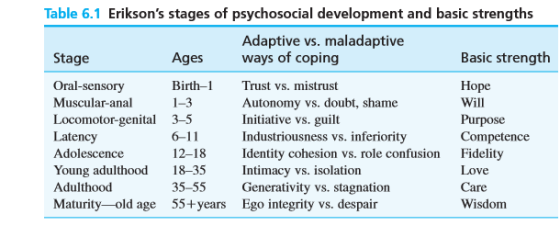
Trust versus Mistrust
The infant is totally dependent on the mother or primary caregiver for survival, security, and affection. The baby’s interaction with the mother determines whether an attitude of trust or mistrust for future dealings with the environment will be incorporated into his or her personality. If the mother responds appropriately to the baby’s physical needs and provides ample affection, love, and security, then the infant will develop a sense of trust.
On the other hand, if the mother is rejecting, inattentive, or inconsistent in her behavior, the infant develops an attitude of mistrust and will become suspicious, fearful, and anxious. According to Erikson , mistrust can also occur if the mother does not display an exclusive focus on the child.
The basic strength of hope is associated with the successful resolution of the crisis during the oral-sensory stage. Erikson described this strength as the belief that our desires will be satisfied. Hope involves a persistent feeling of confidence, a feeling we will maintain despite temporary setbacks or reverses.
Autonomy versus Doubt and Shame
The important point is that during this stage, for the first time, children are able to exercise some degree of choice, to experience the power of their autonomous will. Although still dependent on their parents, they begin to see themselves as persons or forces in their own right and they want to exercise their newfound strengths.
The major crisis between parent and child at this stage typically involves toilet training. The child is taught to hold on and let go only at appropriate times and places. Parents may permit the child to proceed with toilet training at his or her own pace or may become annoyed. In that case, parents may deny the child’s free will by forcing the training, showing impatience and anger when the child does not behave correctly. When parents thus thwart and frustrate their child’s attempt to exercise his or her independence, the child develops feelings of self-doubt and a sense of shame in dealing with others.
The basic strength that develops from autonomy is will, which involves a determination to exercise freedom of choice and self-restraint in the face of society’s demands.
Initiative versus Guilt
Motor and mental abilities are continuing to develop, and children can accomplish more on their own. They express a strong desire to take the initiative in many activities. Initiative may also develop in the form of fantasies, manifested in the desire to possess the parent of the opposite sex and in rivalry with the parent of the same sex. The child’s initiative can be channelled toward realistic and socially sanctioned goals in preparation for the development of adult responsibility and morality. In Freudian terms, we would call this the superego.
The basic strength called purpose arises from initiative. Purpose involves the courage to envision and pursue goals.
Industriousness versus Inferiority
The child begins school and is exposed to new social influences. The child’s growing powers of deductive reasoning and the ability to play by rules lead to the deliberate refinement of the skills displayed in building things. Erikson’s ideas reflect the sex stereotypes of the period in which he proposed his theory. In his view, boys will build tree houses and model airplanes; girls will cook and sew.
Again, the attitudes and behaviours of parents and teachers largely determine how well children perceive themselves to be developing and using their skills. If children are scolded, ridiculed, or rejected, they are likely to develop feelings of inferiority and inadequacy. On the other hand, praise and reinforcement foster feelings of competence and encourage continued striving.
The basic strength that emerges from industriousness during the latency stage is competence. It involves the exertion of skill and intelligence in pursuing and completing tasks.
The outcome of the crisis at each of these four childhood stages depends on other people. Although children experience increasing independence from birth to age 11, psychosocial development remains mostly under the influence of parents and teachers, typically the most significant people in our life at this time.
Identity Cohesion versus Role Confusion: The Identity Crisis
Adolescence, between ages 12 and 18, is the stage at which we must meet and resolve the crisis of our basic ego identity. This is when we form our self-image, the integration of our ideas about ourselves and about what others think of us. If this process is resolved satisfactorily, the result is a consistent and congruent picture. Adolescents experiment with different roles and ideologies, trying to determine the most compatible fit.
People who emerge from this stage with a strong sense of self-identity are equipped to face adulthood with certainty and confidence. Those who fail to achieve a cohesive identity—who experience an identity crisis—The failure to achieve ego identity during adolescence. They do not seem to know who or what they are, where they belong, or where they want to go. They may withdraw from the normal life sequence (education, job, marriage) as Erikson did for a time or seek a negative identity in crime or drugs. Even a negative identity, as society defines it, is preferable to no identity, although it is not as satisfactory as a positive identity. Erikson noted the potentially strong impact of peer groups on the development of ego identity in adolescence.
The basic strength that should develop during adolescence is fidelity, which emerges from a cohesive ego identity. Fidelity encompasses sincerity, genuineness, and a sense of duty in our relationships with other people.
Intimacy versus Isolation
Erikson considered young adulthood to be a longer stage than the previous ones, extending from the end of adolescence to about age 35. During this period we establish our independence from parents and quasi-parental institutions, such as college, and begin to function more autonomously as mature, responsible adults. We undertake some form of productive work and establish intimate relationships— close friendships and sexual unions, encompassed feelings of caring and commitment.
People who are unable to establish such intimacies in young adulthood will develop feelings of isolation. They avoid social contacts and reject other people, and may even become aggressive toward them. They prefer to be alone because they fear intimacy as a threat to their ego identity.
The basic strength that emerges from the intimacy of the young adult years is love, which Erikson considered to be the greatest human virtue. He described it as a mutual devotion in a shared identity, the fusing of oneself with another person.
Generativity versus Stagnation
stage of maturity in which we need to be actively involved in teaching and guiding the next generation.
One need not be a parent to display generativity, nor does having children automatically satisfy this urge. Erikson believed that all institutions—whether business, government, social service, or academic—provide opportunities for us to express generativity. Thus, in whatever organizations or activities we are involved, we can usually find a way to become a mentor, teacher, or guide to younger people for the betterment of society at large.
When middle-aged people cannot or will not seek an outlet for generativity, they may become overwhelmed by “stagnation, boredom, and interpersonal impoverishment”.
Care is the basic strength that emerges from generativity in adulthood. Erikson defined care as a broad concern for others and believed it was manifested in the need to teach, not only to help others but also to fulfill one’s identity.
Ego Integrity versus Despair
During the final stage of psychosocial development, maturity and old age, we are confronted with a choice between ego integrity and despair. These attitudes govern the way we evaluate the whole of our life. If we look back with a sense of fulfillment and satisfaction, believing we have adequately coped with life’s victories and failures, then we are said to possess ego integrity. Simply stated, ego integrity involves accepting one’s place and one’s past.
On the other hand, if we review our life with a sense of frustration, angry about missed opportunities and regretful of mistakes that cannot be rectified, then we will feel despair. We will become disgusted with ourselves, contemptuous of others, and bitter over what might have been.
The basic strength associated with this final developmental stage is wisdom. Deriving from ego integrity, wisdom is expressed in a detached concern with the whole of life. It is conveyed to succeeding generations in an integration of experience best described by the word heritage.
Basic Weaknesses
Motivating characteristics that derive from the unsatisfactory resolution of developmental crises.
In an unbalanced development, the ego consists solely of one attitude, either the adaptive or the maladaptive one. Erikson labelled this condition maldevelopment. When only the positive, adaptive, tendency is present in the ego, the condition is said to be “maladaptive.” When only the negative tendency is present, the condition is called “malignant.” Maladaptions can lead to neuroses; malignancies can lead to psychoses.
Erikson expected that both conditions could be corrected through psychotherapy. Maladaptions, which are the less severe disturbances, can also be relieved through a process of re-adaptation, aided by environmental changes, supportive social relationships, or successful adaptation at a later developmental stage.
His view of human nature is more like an optimistic .He believed that human by themselves have the potential to solve their own situations in a successful way.He believed along with biological forces and heredity learning and experiences affects the personality.This are the basic stages explained by Erikson through which a personality develops.
Core reference :
Schultz, S.E. (2009). Theories of personality, 9th Edition. USA: Wadsworth
Hall, C.S., Lindzey, G., & Campbell, J.B. (1998). Theories of personality, 4th Edition. New Delhi: John Wiley & Son
Add Answer to:
Choose one of the following topics and write a 3-5 page essay
with 3 sources cited....
Write a minimum 5 – paragraph argumentative essay exploring ONE of the following topics. Ensure that...
Write a minimum 5 – paragraph argumentative essay exploring ONE of the following topics. Ensure that you choose a side to argue and present documented facts to support your arguments. Also, include a bibliography with at least three different sources of information. A rubric is included to guide your final product. 100 MARKS Summarize the importance of photosynthesis and cellular respiration to life on Earth. Which important points are increasing or decreasing as a result of human activity
Directions and criteria for Final Essay 2A: Write an essay (3 to 5 pages in length),...
Directions and criteria for Final Essay 2A: Write an essay (3 to 5 pages in length), with works cited (minimum of four citations)responding to the following instructions: *Outlines are optional. However, if you include an outline your outline will be worth 20 points. This will mean that your overall quality and research will be worth 60/100 and not 80/100. Part I: Begin by defining your relation to power and privilege according to your sexual orientation, ability-level and race. Next, analyze...
2pages Week One Assignment-Reflective Essay Reflective Essay Write a 2-3 page essay in which you discuss...
 2pages
Week One Assignment-Reflective Essay Reflective Essay Write a 2-3 page essay in which you discuss your own cultural beliefs and values. How do your beliefs and values influence the way you view leadership? Post your essay on a Word file in the appropriate for Week 1. Click on the "Week One Assignment - Reflective Essay" link above to submit your assignment, as well to get more information regarding the due date and grading rubric.
2pages
Week One Assignment-Reflective Essay Reflective Essay Write a 2-3 page essay in which you discuss your own cultural beliefs and values. How do your beliefs and values influence the way you view leadership? Post your essay on a Word file in the appropriate for Week 1. Click on the "Week One Assignment - Reflective Essay" link above to submit your assignment, as well to get more information regarding the due date and grading rubric.
Choose one of the topics below for your paragraph: 1. Write a paragraph about 3-5 important...
 Choose one of the topics below for your paragraph: 1. Write a paragraph about 3-5 important changes in your life in the past 5 to 10 years. How is your life different now than it was 10 years ago? 2. Write a paragraph about 3-5 events in your life that made you feel like an adult.
1.Locate three sources on the topic (Why It Is Important to Test Athletes for Performance-Enhancing Drugs)....
1.Locate three sources on the topic (Why It Is Important to Test Athletes for Performance-Enhancing Drugs). Cite the sources in MLA format and provide annotations of each of the sources, evaluating the credibility and usefulness of the source. 2.Write an organized argument on this topic(Bans on smoking in public places) in which you use logical reasoning and data to support objectively written claims and reasons. Organize your paper so that the structure is clear. Choose words and rhetorical devices, such...
IMMUNOLOGY & SEROLOGY LAB Assignment Spring 2019-2020 PLEASE CHOOSE ONE OF THE FOLLOWING TOPICS TO WRITE...
 IMMUNOLOGY & SEROLOGY LAB Assignment Spring 2019-2020 PLEASE CHOOSE ONE OF THE FOLLOWING TOPICS TO WRITE YOUR ASSIGNMENT (10 MARKS) 1. Monoclonal Antibodies VS. Polyclonal Antibodies 2. Types of Therapeutic Monoclonal Antibodies 3. Diagnostic Usage of the Antibodies 4. Develop Novel Antibodies against COVID-19 Disease KEY POINTS WORD COUNT: APPROX. 1000 WORDS. REFERENCES: INCLUDE THE REFERENCES USED IN THE TEXT AND THE REFERENCE LIST AT THE END OF THE ESSAY. DEADLINE FOR SUBMISSION Monday: March 30, 2020 at 2:00 pm...
Write a one page paper on the 3 components of the "Iron Triangle of Health Care"...
Write a one page paper on the 3 components of the "Iron Triangle of Health Care" make sure your paper is properly formatted and your sources are cited.
ENC 1102 Prompt: Select one topic and write a thesis statement: Choose one of the topics...
ENC 1102 Prompt: Select one topic and write a thesis statement: Choose one of the topics provided. Choose from the list of accepted topics is in the Module 2 Resources folder titled "Choose One of These Topics." The list provides topics which are focused (not too broad), challenging (not just factual), and grounded (not too speculative). All the topics are debatable, establishing a basis for a persuasive argument paper. If you professor approves, choose your own topic as long as...
Choose a topic from the web articles and write a short essay. topics: 1) What is...
Choose a topic from the web articles and write a short essay. topics: 1) What is Magecart ? 2) Research on robotic arm controlled by your mind ? 3) How networks are being used to study environments 4) How you can keep track of your (grand)parents at home. 5) Different services to help the elderly at home. 6) How networked classrooms can enhance learning and bridge the gender gap 7) A way to control mites in beehives. 8) How linking...
please read the question and then write one page essay on any of the topic other...
 please read the question and then write one page essay
on any of the topic other than FDA and biocompatibility. it should
be one page full and there should be citations from reputable
source. citations is must. essay should be one A4 size paper
full.
YES you can , but you know the length of the paper
size. Please write about medical device testing techniques topic
with citations. Please don't write about other topics
Perform research (1 page) into current...
please read the question and then write one page essay
on any of the topic other than FDA and biocompatibility. it should
be one page full and there should be citations from reputable
source. citations is must. essay should be one A4 size paper
full.
YES you can , but you know the length of the paper
size. Please write about medical device testing techniques topic
with citations. Please don't write about other topics
Perform research (1 page) into current...
 2pages
Week One Assignment-Reflective Essay Reflective Essay Write a 2-3 page essay in which you discuss your own cultural beliefs and values. How do your beliefs and values influence the way you view leadership? Post your essay on a Word file in the appropriate for Week 1. Click on the "Week One Assignment - Reflective Essay" link above to submit your assignment, as well to get more information regarding the due date and grading rubric.
2pages
Week One Assignment-Reflective Essay Reflective Essay Write a 2-3 page essay in which you discuss your own cultural beliefs and values. How do your beliefs and values influence the way you view leadership? Post your essay on a Word file in the appropriate for Week 1. Click on the "Week One Assignment - Reflective Essay" link above to submit your assignment, as well to get more information regarding the due date and grading rubric.
 Choose one of the topics below for your paragraph: 1. Write a paragraph about 3-5 important changes in your life in the past 5 to 10 years. How is your life different now than it was 10 years ago? 2. Write a paragraph about 3-5 events in your life that made you feel like an adult.
 IMMUNOLOGY & SEROLOGY LAB Assignment Spring 2019-2020 PLEASE CHOOSE ONE OF THE FOLLOWING TOPICS TO WRITE YOUR ASSIGNMENT (10 MARKS) 1. Monoclonal Antibodies VS. Polyclonal Antibodies 2. Types of Therapeutic Monoclonal Antibodies 3. Diagnostic Usage of the Antibodies 4. Develop Novel Antibodies against COVID-19 Disease KEY POINTS WORD COUNT: APPROX. 1000 WORDS. REFERENCES: INCLUDE THE REFERENCES USED IN THE TEXT AND THE REFERENCE LIST AT THE END OF THE ESSAY. DEADLINE FOR SUBMISSION Monday: March 30, 2020 at 2:00 pm...
 please read the question and then write one page essay
on any of the topic other than FDA and biocompatibility. it should
be one page full and there should be citations from reputable
source. citations is must. essay should be one A4 size paper
full.
YES you can , but you know the length of the paper
size. Please write about medical device testing techniques topic
with citations. Please don't write about other topics
Perform research (1 page) into current...
please read the question and then write one page essay
on any of the topic other than FDA and biocompatibility. it should
be one page full and there should be citations from reputable
source. citations is must. essay should be one A4 size paper
full.
YES you can , but you know the length of the paper
size. Please write about medical device testing techniques topic
with citations. Please don't write about other topics
Perform research (1 page) into current...
Most questions answered within 3 hours.
-
Where is the error in this code sequence?
String s1 = "Hello";
String s2 = "ello";...
asked 11 months ago -
Financial data for Joel de Paris, Inc., for last year
follow:
Joel de Paris, Inc.
Balance...
asked 11 months ago -
Consider this reaction:
Al2(SO4)3 (aq)+ BaCl3
(aq) Al2Cl6 (aq)- +
3BaSO4(s) . What is the...
asked 11 months ago -
Suppose that Savneet is considering increasing her
recent random sample from 20 car rentals to 40...
asked 11 months ago -
Trucks arrive at an unloading terminal at an average rate of 120
per hour.
Trucks arrive...
asked 11 months ago -
Why are methanol and ethanol completely soluble in water while
octanol is not very little soluble....
asked 11 months ago -
A facilities manager at a university reads in a research report
that the mean amount of...
asked 11 months ago -
When the CuSO4 is rehydrated by adding water to the anhydrous
compound, is this an endothermic...
asked 11 months ago -
A ray of sunlight is passing from diamond into crown glass; the
angle of incidence is...
asked 11 months ago -
A block of mass 0.249 kg is placed on top of a light, vertical
spring of...
asked 11 months ago -
how do the kidneys compensate in the presences of acidosis
a) trigger hyperventilate
b) reserve acid...
asked 11 months ago -
Question 501 pts
The rental rate of capital to the firm increases. Which of the
following...
asked 11 months ago