Consider a cannon on top of a cliff of height h = 60 m located at...
Consider a cannon on top of a cliff of height h = 60 m located at x = 0. It shoots a cannonball of mass m = 4 kg horizontally with an initial speed of v0 = 90 m/s. Ignore air resistance.
(a.) Immediately after the cannonball leaves the cannon what are the x and y components of it's velocity? (b.) right after the cannonball leaves the cannon, what are the x and y components of it's acceleration? (c.) How long in seconds does the cannon ball remain in the air? (d.) What value of x does the cannonball hit the ground (e.) What are the x and y component of it's velocity right before hitting the ground?
Homework Answers
(a) immediately after leaving cannon, velocity component are
 = 90 m/sec
 = 0 m/sec
(b) Components of acceleration are
 = 0
= 0

(c)

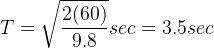
(D) x = T.
= 3.5 x 90 m
= 315 m
(E)  = 90 m/sec
 = - 9.8 x 3.5 m/sec
= - 34.3 m/sec
Negative sign shows that velocity is downward.
Add Answer to:
Consider a cannon on top of a cliff of height h = 60 m located
at...
A cannon shoots a cannonball from the ground level (ignore the height of the cannon) towards a cliff of height h = 170 m
 A cannon shoots a cannonball from the ground level (ignore the height of the cannon) towards a cliff of height h = 170 m. The cannonball is launched with an initial velocity of 110 m/s at an angle of 64° above the horizontal. Neglect air resistance. Assume the cannonball hits the cliff as it descends (on its way down) exactly at the edge, as shown. a. Determine the maximum height above the ground reached by the cannonball.b. What speed will the...
A cannonball is fired horizontally from the top of a cliff. The cannon is at height H = 70.0m above ground level, and t...
A cannonball is fired horizontally from the top of a cliff. The cannon is at height H = 70.0m above ground level, and the ball is fired with initial horizontal speed v0. Assume acceleration due to gravity to be g = 9.80m/s2 . Part A Assume that the cannon is fired at time t=0 and that the cannonball hits the ground at time tg. What is the y position of the cannonball at the time tg/2? Answer is 52.5 Part...
1. Solve the following problem on a clean sheet of paper. A cannon shoots a cannonball...
 1. Solve the following problem on a clean sheet of paper. A cannon shoots a cannonball from the ground level (ignore the height of the cannon) towards a cliff of height h 170 m. The cannonball is launched with an initial velocity of 110 m/s at an angle of 64° above the horizontal. Neglect air resistance. Assume the cannonball hits the cliff as it descends (on its way down) exactly at the edge, as shown. Landing point a. Deternine the...
A cannon launches a cannonball 20 degree above the horizontal off of a 75-meter high cliff...
A cannon launches a cannonball 20 degree above the horizontal off of a 75-meter high cliff The initial speed of the cannonball as it leaves the cannon is v0=50m/s. what maximum height above the bottom of the cliff does the cannonball reach? find the velocity of the cannonball exactly 2 seconds after it fired
A cannon on a cliff at a height of H = 34 meters fires a cannonball...
A cannon on a cliff at a height of H = 34 meters fires a cannonball in the horizontal direction. The initial velocity of the cannonball is 6.9 m/s. What is the horizontal distance D which the cannonball travels before it hits the ground below? What will the speed of the ball be just before it hits the ground? What direction will the cannonball be moving just before it hits the ground? Enter the angle relative to the horizontal axis....
A cannon fires a ball horizontally with a velocity of 240 m/s. If the cannon is...
A cannon fires a ball horizontally with a velocity of 240 m/s. If the cannon is in a 44 meter tall tower and the ground below is flat, then (a) How long does the ball take to hit the ground after being fired? (b) At what horizontal distance from the cannon does the ball hit the ground? and (c) What are the horizontal and vertical components of the ball's velocity just before it hits the ground?
please help am doubting my analysis i. Solve the following problem on a clean sheet of...
 please help am doubting my analysis
i. Solve the following problem on a clean sheet of paper. A cannon shoots a cannonball from the ground level (ignore the height of the cannon) towards a cliff of height h = 170 m. The cannonball is launched with an initial velocity of 110 m/s at an angle of 64° above the horizontal. Neglect air resistance. Assume the cannonball hits the cliff as it descends (on its way down) exactly at the edge,...
please help am doubting my analysis
i. Solve the following problem on a clean sheet of paper. A cannon shoots a cannonball from the ground level (ignore the height of the cannon) towards a cliff of height h = 170 m. The cannonball is launched with an initial velocity of 110 m/s at an angle of 64° above the horizontal. Neglect air resistance. Assume the cannonball hits the cliff as it descends (on its way down) exactly at the edge,...
A cannon-ball is fired horizontally with a speed vo = 60.0 m/s above the edge of...
A cannon-ball is fired horizontally with a speed vo = 60.0 m/s above the edge of a cliff at point O a height h = 200 m directly above point B on the valley floor. Calculate the following: a. (4) The time t it takes the cannon ball to hit the valley floor at point C. b. (4) The horizontal range R . c. (6) The x- and y-components x v and y v , respectively, of the cannonball velocity...
A cannon launches a cannonball with mass 5.0 kg horizontally off a cliff that is 25.5...
A cannon launches a cannonball with mass 5.0 kg horizontally off a cliff that is 25.5 meter high. If the ball lands 64.537m from the edge of the cliff, find the muzzle velocity and momentum of the cannon shot. And if the cannon ball hits an enemy ship at close range(so you can assume the velocity is stilll the muzzle velocty) and penetrates it's hull stopping in 1/50 second, what was the force it hit with and find the average...
Consider again the cannonball launched by a cannon from the top of a very high cliff....
 Consider again the cannonball launched by a cannon from the top of a very high cliff. Suppose that the cannonball is launched horizontally with no upward angle whatsoever and with an initial speed of 20 m/s. If there were no gravity, the cannonball would continue in motion at 20 m/s in the horizontal direction. Yet in actuality, gravity causes the cannonball to accelerate downwards at a rate of 9.8 m/s/s. This means that the vertical velocity is changing by 9.8...
 1. Solve the following problem on a clean sheet of paper. A cannon shoots a cannonball from the ground level (ignore the height of the cannon) towards a cliff of height h 170 m. The cannonball is launched with an initial velocity of 110 m/s at an angle of 64° above the horizontal. Neglect air resistance. Assume the cannonball hits the cliff as it descends (on its way down) exactly at the edge, as shown. Landing point a. Deternine the...
 please help am doubting my analysis
i. Solve the following problem on a clean sheet of paper. A cannon shoots a cannonball from the ground level (ignore the height of the cannon) towards a cliff of height h = 170 m. The cannonball is launched with an initial velocity of 110 m/s at an angle of 64° above the horizontal. Neglect air resistance. Assume the cannonball hits the cliff as it descends (on its way down) exactly at the edge,...
please help am doubting my analysis
i. Solve the following problem on a clean sheet of paper. A cannon shoots a cannonball from the ground level (ignore the height of the cannon) towards a cliff of height h = 170 m. The cannonball is launched with an initial velocity of 110 m/s at an angle of 64° above the horizontal. Neglect air resistance. Assume the cannonball hits the cliff as it descends (on its way down) exactly at the edge,...
 Consider again the cannonball launched by a cannon from the top of a very high cliff. Suppose that the cannonball is launched horizontally with no upward angle whatsoever and with an initial speed of 20 m/s. If there were no gravity, the cannonball would continue in motion at 20 m/s in the horizontal direction. Yet in actuality, gravity causes the cannonball to accelerate downwards at a rate of 9.8 m/s/s. This means that the vertical velocity is changing by 9.8...
Most questions answered within 3 hours.
-
Where is the error in this code sequence?
String s1 = "Hello";
String s2 = "ello";...
asked 11 months ago -
Financial data for Joel de Paris, Inc., for last year
follow:
Joel de Paris, Inc.
Balance...
asked 11 months ago -
Consider this reaction:
Al2(SO4)3 (aq)+ BaCl3
(aq) Al2Cl6 (aq)- +
3BaSO4(s) . What is the...
asked 11 months ago -
Suppose that Savneet is considering increasing her
recent random sample from 20 car rentals to 40...
asked 11 months ago -
Trucks arrive at an unloading terminal at an average rate of 120
per hour.
Trucks arrive...
asked 11 months ago -
Why are methanol and ethanol completely soluble in water while
octanol is not very little soluble....
asked 11 months ago -
A facilities manager at a university reads in a research report
that the mean amount of...
asked 11 months ago -
When the CuSO4 is rehydrated by adding water to the anhydrous
compound, is this an endothermic...
asked 11 months ago -
A ray of sunlight is passing from diamond into crown glass; the
angle of incidence is...
asked 11 months ago -
A block of mass 0.249 kg is placed on top of a light, vertical
spring of...
asked 11 months ago -
how do the kidneys compensate in the presences of acidosis
a) trigger hyperventilate
b) reserve acid...
asked 11 months ago -
Question 501 pts
The rental rate of capital to the firm increases. Which of the
following...
asked 11 months ago