THE QUESTION I AM SHARING WITH YOU IS THE QUESTION FROM THE SUBJECT ELECTROMAGNETICS IN THIS...
THE QUESTION I AM SHARING WITH YOU IS THE QUESTION
FROM THE SUBJECT ELECTROMAGNETICS IN THIS QUESTION WE HAVE TO USE
MATLAB PLEASE COMMENT EACH STEP AND DO YOUR BEST TO SLOVE
IT
Question2: [5 marks]
Use MATLAB to write a generic program to find “E” at point P (x1,
y1, z1) in free space due to the following charge distributions:
point charge, A nC, at point P (x2, y2, z2) in free space; uniform
line charge density, B nC/m, at x = t, y = t1; uniform surface
charge density, C nC/m2 at x = t2.
Where A, B, C, x1, y1, z1 x2, y2, z2, t, t1& t2 can take any
arbitrary value from real numbers
Homework Answers
If you have any doubts , ask me in comment section.
Let's take this example :

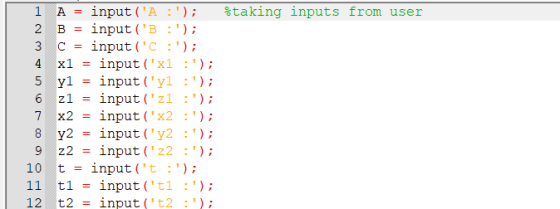
Code :
OUTPUT :

RAW_CODE :
A = input('A :'); %taking inputs from user
B = input('B :');
C = input('C :');
x1 = input('x1 :');
y1 = input('y1 :');
z1 = input('z1 :');
x2 = input('x2 :');
y2 = input('y2 :');
z2 = input('z2 :');
t = input('t :');
t1 = input('t1 :');
t2 = input('t2 :');
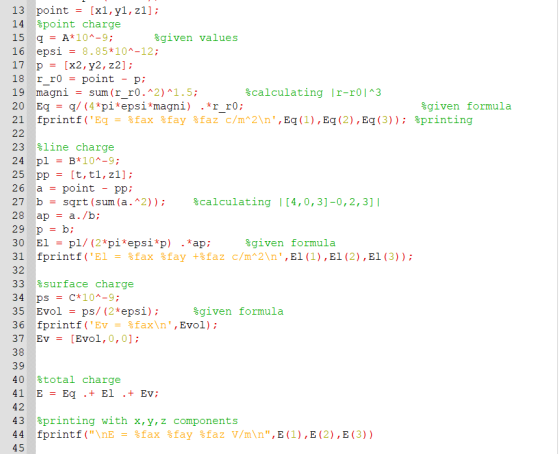
point = [x1,y1,z1];
%point charge
q = A*10^-9; %given values
epsi = 8.85*10^-12;
p = [x2,y2,z2];
r_r0 = point - p;
magni = sum(r_r0.^2)^1.5; %calculating |r-r0|^3
Eq = q/(4*pi*epsi*magni) .*r_r0; %given formula
fprintf('Eq = %fax %fay %faz c/m^2\n',Eq(1),Eq(2),Eq(3));
%printing
%line charge
pl = B*10^-9;
pp = [t,t1,z1];
a = point - pp;
b = sqrt(sum(a.^2)); %calculating |[4,0,3]-0,2,3]|
ap = a./b;
p = b;
El = pl/(2*pi*epsi*p) .*ap; %given formula
fprintf('El = %fax %fay +%faz c/m^2\n',El(1),El(2),El(3));
%surface charge
ps = C*10^-9;
Evol = ps/(2*epsi); %given formula
fprintf('Ev = %fax\n',Evol);
Ev = [Evol,0,0];
%total charge
E = Eq .+ El .+ Ev;
%printing with x,y,z components
fprintf("\nE = %fax %fay %faz V/m\n",E(1),E(2),E(3))
Practical_calculations :

Add Answer to:
THE QUESTION I AM SHARING WITH YOU IS THE QUESTION
FROM THE SUBJECT ELECTROMAGNETICS IN THIS...
THIS IS THE QUESTION FROM THE SUBJECT ELECTROMAGNETICS AND YOU HAVE TO TAKE VALUE OF YOUR...
THIS IS THE QUESTION FROM THE SUBJECT ELECTROMAGNETICS AND YOU HAVE TO TAKE VALUE OF YOUR OWN. FIRST WRITE THE QUESTION WITH VALUES AND THEN SOLVE IT .... find “E” at point P (x1, y1, z1) in free space due to the following charge distributions: point charge, A nC, at point P (x2, y2, z2) in free space; uniform line charge density, B nC/m, at x = t, y = t1; uniform surface charge density, C nC/m2 at x =...
Question 1 (compulsory): (i) State Gauss' law for the electric field (E-field) in words and explain its meaning. Write the corresponding mathematical expression and clearly define all symbols...
 Question 1 (compulsory): (i) State Gauss' law for the electric field (E-field) in words and explain its meaning. Write the corresponding mathematical expression and clearly define all symbols and operations used. Describe one application of Gauss' law. 15% (ii) A very long wire carrying electric charge with uniform line charge density is located in free space. Applying Gauss' law, derive the E-field due to this wire. Clearly explain every step of your derivation and the assumptions you take. 40% Find...
Question 17 (2 points) Let A be a 3 x 4 matrix with a column space...
 Question 17 (2 points) Let A be a 3 x 4 matrix with a column space of dimension 2. What is the dimension of the row space of A? Not enough information has been given. O 1/2 3 2. Question 16 (2 points) The rank of the matrix 1 2 - 1 2 4 2 1 2 3 is 02 O none of the given options Question 15 (2 points) Which of the following is not a vector space because...
Solve part b: Note the answer should be a vector (1 point) Sketch S, the part...
 Solve part b: Note the answer
should be a vector
(1 point) Sketch S, the part of the plane - 10x + 5y + 10z = -39 selected by the inequality x2 + y2 + z2 <9. Assume a uniform surface charge with density ps = 36 nC/m² on S, with no other charges anywhere in space. Both parts below refer to the resulting electric field at the origin, E(O). (a) Find the point P at which E(P) = -E(O)....
Solve part b: Note the answer
should be a vector
(1 point) Sketch S, the part of the plane - 10x + 5y + 10z = -39 selected by the inequality x2 + y2 + z2 <9. Assume a uniform surface charge with density ps = 36 nC/m² on S, with no other charges anywhere in space. Both parts below refer to the resulting electric field at the origin, E(O). (a) Find the point P at which E(P) = -E(O)....
In space R^3, we define a scalar product by regulation 〈(x1, y1, z1), (x2, y2, z2)〉...
In space R^3, we define a scalar product by regulation 〈(x1, y1, z1), (x2, y2, z2)〉 = 2x1x2 + y1y2 + 2z1z2 + x1z2 + x2z1. (a) [10] Calculate the perpendicular projection of the point T (1, 1, 1) on the plane U in R3 with the equation x + 2y + 2z = 0 with respect to the given scalar product. (b) [10] Let φ: R^3 → R be a linear functional with φ (x, y, z) = x...
please help me I am have problem understanding this question 1)A very long straight wire has...
please help me I am have problem understanding this question 1)A very long straight wire has charge per unit length 1.48×10⁻¹⁰ C/m . At what distance from the wire is the magnitude of the electric field equal to 2.53 N/C ? Use 8.85×10⁻¹² C2/(N⋅m2) for the permittivity of free space, and use π=3.14159. 2)A −12 nC charge is located at (x,y)=(1.0 cm, 0 cm). PART A) What is the electric field at the position (x1,y1)=(5.0 cm , 0 cm) in...
Hi, I need help solving number 13. Please show all the steps, thank you. :) Consider the solid Q bounded by z-2-y2;z-tx at each point Р (x, y, z) is given by mass of Q [15 pts] 9. x-4. The density Z/...
 Hi, I need help solving number 13. Please show all the steps,
thank you. :)
Consider the solid Q bounded by z-2-y2;z-tx at each point Р (x, y, z) is given by mass of Q [15 pts] 9. x-4. The density Z/m 3 . Find the center of (x, y, z) [15 pts] 10. Evaluate the following integral: ee' dy dzdx [15 pts] 11. Use spherical coordinates to find the mass m of a solid Q that lies between the...
Hi, I need help solving number 13. Please show all the steps,
thank you. :)
Consider the solid Q bounded by z-2-y2;z-tx at each point Р (x, y, z) is given by mass of Q [15 pts] 9. x-4. The density Z/m 3 . Find the center of (x, y, z) [15 pts] 10. Evaluate the following integral: ee' dy dzdx [15 pts] 11. Use spherical coordinates to find the mass m of a solid Q that lies between the...
i am sharing you a question from the subject modern micro processor 8086 1) Assume that...
i am sharing you a question from the subject modern micro processor 8086 1) Assume that the physical address for a location is 0046CH, suggest a possible logical address ( answer is 0042:004C) ( kindly show all calculations in proper steps and label steps as 1, 2, 3 and so on and plz also tell its vice virsa, how to find physical address from logical address with same calculations ) 2) I am sharing you some commands along with...
Fundamentals of Engineering Question - 20 points Reference Figure "EE". Your survey crew has provided you with the following coordinates for the tract of land shown in this Figure "EE"...
Fundamentals of Engineering Question - 20 points Reference Figure "EE". Your survey crew has provided you with the following coordinates for the tract of land shown in this Figure "EE". Point A X1 = 100' Y1 = 100' Point B X2 = 223' Y2 = 528' Point C X3 = 457' Y3 = 666' Point D X4 = 630' Y4 = 323' Point E X5 = 365' Y5 = 198' You are in charge of ordering the dirt for adding...
Question 1 (compulsory): The following set of charges is given in free space Charge σ,--40 nC/m Number and type of charge #1 , charged spherical shell of radius Ri-10 cm carrying uniform surface char...
 Question 1 (compulsory): The following set of charges is given in free space Charge σ,--40 nC/m Number and type of charge #1 , charged spherical shell of radius Ri-10 cm carrying uniform surface charge density σ #2, charged spherical shell of radius R2-5 cm carrying uniform surface charge density Ơ Location (0, 0, 0) m (position of the centre of the sphere) (0, 0, 0) m (position of the centre of the sphere σ,-160 nC/m2 The positions of the spheres'...
 Question 1 (compulsory): (i) State Gauss' law for the electric field (E-field) in words and explain its meaning. Write the corresponding mathematical expression and clearly define all symbols and operations used. Describe one application of Gauss' law. 15% (ii) A very long wire carrying electric charge with uniform line charge density is located in free space. Applying Gauss' law, derive the E-field due to this wire. Clearly explain every step of your derivation and the assumptions you take. 40% Find...
 Question 17 (2 points) Let A be a 3 x 4 matrix with a column space of dimension 2. What is the dimension of the row space of A? Not enough information has been given. O 1/2 3 2. Question 16 (2 points) The rank of the matrix 1 2 - 1 2 4 2 1 2 3 is 02 O none of the given options Question 15 (2 points) Which of the following is not a vector space because...
 Solve part b: Note the answer
should be a vector
(1 point) Sketch S, the part of the plane - 10x + 5y + 10z = -39 selected by the inequality x2 + y2 + z2 <9. Assume a uniform surface charge with density ps = 36 nC/m² on S, with no other charges anywhere in space. Both parts below refer to the resulting electric field at the origin, E(O). (a) Find the point P at which E(P) = -E(O)....
Solve part b: Note the answer
should be a vector
(1 point) Sketch S, the part of the plane - 10x + 5y + 10z = -39 selected by the inequality x2 + y2 + z2 <9. Assume a uniform surface charge with density ps = 36 nC/m² on S, with no other charges anywhere in space. Both parts below refer to the resulting electric field at the origin, E(O). (a) Find the point P at which E(P) = -E(O)....
 Hi, I need help solving number 13. Please show all the steps,
thank you. :)
Consider the solid Q bounded by z-2-y2;z-tx at each point Р (x, y, z) is given by mass of Q [15 pts] 9. x-4. The density Z/m 3 . Find the center of (x, y, z) [15 pts] 10. Evaluate the following integral: ee' dy dzdx [15 pts] 11. Use spherical coordinates to find the mass m of a solid Q that lies between the...
Hi, I need help solving number 13. Please show all the steps,
thank you. :)
Consider the solid Q bounded by z-2-y2;z-tx at each point Р (x, y, z) is given by mass of Q [15 pts] 9. x-4. The density Z/m 3 . Find the center of (x, y, z) [15 pts] 10. Evaluate the following integral: ee' dy dzdx [15 pts] 11. Use spherical coordinates to find the mass m of a solid Q that lies between the...
 Question 1 (compulsory): The following set of charges is given in free space Charge σ,--40 nC/m Number and type of charge #1 , charged spherical shell of radius Ri-10 cm carrying uniform surface charge density σ #2, charged spherical shell of radius R2-5 cm carrying uniform surface charge density Ơ Location (0, 0, 0) m (position of the centre of the sphere) (0, 0, 0) m (position of the centre of the sphere σ,-160 nC/m2 The positions of the spheres'...
Most questions answered within 3 hours.
-
Where is the error in this code sequence?
String s1 = "Hello";
String s2 = "ello";...
asked 10 months ago -
Financial data for Joel de Paris, Inc., for last year
follow:
Joel de Paris, Inc.
Balance...
asked 10 months ago -
Consider this reaction:
Al2(SO4)3 (aq)+ BaCl3
(aq) Al2Cl6 (aq)- +
3BaSO4(s) . What is the...
asked 10 months ago -
Suppose that Savneet is considering increasing her
recent random sample from 20 car rentals to 40...
asked 10 months ago -
Trucks arrive at an unloading terminal at an average rate of 120
per hour.
Trucks arrive...
asked 10 months ago -
Why are methanol and ethanol completely soluble in water while
octanol is not very little soluble....
asked 10 months ago -
A facilities manager at a university reads in a research report
that the mean amount of...
asked 10 months ago -
When the CuSO4 is rehydrated by adding water to the anhydrous
compound, is this an endothermic...
asked 10 months ago -
A ray of sunlight is passing from diamond into crown glass; the
angle of incidence is...
asked 10 months ago -
A block of mass 0.249 kg is placed on top of a light, vertical
spring of...
asked 10 months ago -
how do the kidneys compensate in the presences of acidosis
a) trigger hyperventilate
b) reserve acid...
asked 10 months ago -
Question 501 pts
The rental rate of capital to the firm increases. Which of the
following...
asked 10 months ago