QUESTION 1: A fireworks shell is accelerated from rest to a velocity of 55.0 m/s over...
QUESTION 1:
A fireworks shell is accelerated from rest to a velocity of 55.0 m/s over a distance of 0.210 m.
(a)
How long (in s) did the acceleration last?
s
(b)
Calculate the acceleration (in m/s2). (Enter the magnitude.)
m/s2
QUESTION 2:
A bullet in a gun is accelerated from the firing chamber to the end of the barrel at an average rate of 5.70 ✕ 105 m/s2 for 9.60 ✕ 10−4 s. What is its muzzle velocity (in m/s) (that is, its final velocity)? (Enter the magnitude.)
Homework Answers
Hi,
Hope you are doing well.
QUESTION 1:
I'm doing Part (b) first and then Part (a) which is more convenient.
PART (b):
We know that, according to kinematic equations, final speed is given by,

Where we have,
Final speed, 
Initial speed, 
Distance traveled, 
Hence acceleration of the shell is given by,


PART (a):
We know that, according to kinematic equations, final speed is given by,

Where we have,
Final speed,
Initial speed,
Acceleration of the shell, 
Hence time taken by the shell is given by,


QUESTION 2:
We know that, according to kinematic equations, final speed is given by,
Where we have,
Acceleration, 
Initial speed,
Time taken, 
Hence the final speed is given by,


QUESTION 1: (a) Using the kinematic equation: v^2 = u^2 + 2as where u=0 (initial velocity), v=55.0 m/s (final velocity), s=0.210 m (distance), we can solve for the time duration of acceleration: t = (v^2 - u^2) / 2as = (55.0^2) / (2*0.210) = 732.14 ms = 0.73214 s (to 5 significant figures)
Therefore, the acceleration lasted for 0.73214 seconds.
(b) The acceleration (a) can be calculated using the same kinematic equation: a = (v^2 - u^2) / 2s = (55.0^2) / (2*0.210) = 7230.95 m/s^2 ≈ 7231 m/s^2 (to 4 significant figures)
Therefore, the acceleration of the fireworks shell was approximately 7231 m/s^2.
QUESTION 2: Using the kinematic equation: v = u + at where u=0 (initial velocity), a=5.70 ✕ 10^5 m/s^2 (acceleration), and t=9.60 ✕ 10^-4 s (time), we can solve for the final velocity (v): v = u + at = 0 + (5.70 ✕ 10^5)(9.60 ✕ 10^-4) = 547.2 m/s (to 3 significant figures)
Therefore, the muzzle velocity of the bullet is 547.2 m/s.
Add Answer to:
QUESTION 1:
A fireworks shell is accelerated from rest to a velocity of 55.0
m/s over...
A fireworks shell is accelerated from rest to a velocity of 54.0 m/s over a distance...
A fireworks shell is accelerated from rest to a velocity of 54.0 m/s over a distance of 0.240 m. PLEASE PROVIDE STEPS FOR PARTS A AND B. (a) How long (in s) did the acceleration last? ___________ s (b) Calculate the acceleration (in m/s2). (Enter the magnitude.) ___________ m/s2
(796) Problem 14: A bullet in a gun is accelerated from rest from the firing chamber...
 (796) Problem 14: A bullet in a gun is accelerated from rest from the firing chamber to the end of the barrel at an average rate of 6.35 x 10⁵ m/s2 for 8.45 x 10⁴s atus or Grade Summary Deductions Potential 100 sin0 cotanO asin acoSO cosh0 tanh0 cotanh cos per attempt tailed vievw Hint mpleted mpleted mpleted Hints:ーーdeduction per hint Hun remaning-
Please show all work with algebra 2. A 15.0 g bullet is accelerated from rest to...
 Please show all work with algebra
2. A 15.0 g bullet is accelerated from rest to a speed of 780 m/s in a rifle barrel of length 0.720 m. In. (a) (8 points) Determine the kinetic energy of the bullet as it leaves the barrel (b) (8 points) Determine the total work done on the bullet while it is in the barrel (c) (8 points) Determine the magnitude of the avernge force that acted on the bullet while it was...
Please show all work with algebra
2. A 15.0 g bullet is accelerated from rest to a speed of 780 m/s in a rifle barrel of length 0.720 m. In. (a) (8 points) Determine the kinetic energy of the bullet as it leaves the barrel (b) (8 points) Determine the total work done on the bullet while it is in the barrel (c) (8 points) Determine the magnitude of the avernge force that acted on the bullet while it was...
(hrw8c9p15) A shell is fired from a gun with a muzzle velocity of 23 m/s, at...
(hrw8c9p15) A shell is fired from a gun with a muzzle velocity of 23 m/s, at an angle of 60° with the horizontal. At the top of the trajectory, the shell explodes into two fragments of equal mass (see the figure). One fragment, whose speed immediately after the explosion is zero, falls vertically. How far from the gun does the other fragment land, assuming that the terrain is level and that the air drag is negligible
10. An object initially at rest experiences an acceleration of 1.90 m/s² for 5.70 s then...
10. An object initially at rest experiences an acceleration of 1.90 m/s² for 5.70 s then travels at that constant velocity for another 9.60 s. What is the magnitude of the object’s average velocity over the 15.3 s interval?
A 26.0-kg shell is fired from a gun with a muzzle velocity 170.0 m/s at 68.0o...
A 26.0-kg shell is fired from a gun with a muzzle velocity 170.0 m/s at 68.0o above the horizontal. At the top of the trajectory, the shell explodes into two fragments of equal mass. One fragment, whose speed immediately after the explosion is zero, falls vertically. What is the horizontal speed of the other fragment?
On level ground a shell is fired with an initial velocity of 30.0 m/s at 55.0°...
 On level ground a shell is fired with an initial velocity of 30.0 m/s at 55.0° above the horizontal and feels no appreciable air resistance. Part A Find the horizontal and vertical components of the shell's initial velocity Express your answers in meters per second separated by a comma. PO AQ 0 2 ? VOh, Voy = Voh , Vov = m/s Submit Request Answer Part B How long does it take the shell to reach its highest point? Express...
1-A football punter accelerates a football from rest to a speed of 10 m/s during the...
1-A football punter accelerates a football from rest to a speed of 10 m/s during the time in which his toe is in contact with the ball ( about 0.20 s). If the football has a mass of 0.50 kg, what average force does the punter exert on the ball? 2- A 5.0 g bullet leaves the muzzle of a rifle with a speed of 320 m/s. What force ( assumed constant) is exerted on the bullet while it is...
A 15.0-g bullet is fired at a muzzle velocity of 3250 m/s from a high-powered rifle...
A 15.0-g bullet is fired at a muzzle velocity of 3250 m/s from a high-powered rifle with a mass of 4.75 kg and barrel of length 75.0 cm. (a) How long is the bullet in the barrel? (b) What is the force on the bullet while it is in the barrel? (c) Find the impulse exerted on the bullet while it is in the barrel. (d) Find the bullet’s momentum as it leaves the barrel. I've seen this question a...
Question 2 To a close approximation the pressure behind a rifle bullet varies inversely with the...
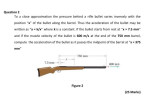 Question 2 To a close approximation the pressure behind a rifle bullet varies inversely with the position "x" of the bullet along the barrel. Thus the acceleration of the bullet may be written as "a = k/x" where k is a constant. If the bullet starts from rest at "x = 7.5 mm" and if the muzzle velocity of the bullet is 600 m/s at the end of the 750 mm barrel, compute the acceleration of the bullet as it...
 (796) Problem 14: A bullet in a gun is accelerated from rest from the firing chamber to the end of the barrel at an average rate of 6.35 x 10⁵ m/s2 for 8.45 x 10⁴s atus or Grade Summary Deductions Potential 100 sin0 cotanO asin acoSO cosh0 tanh0 cotanh cos per attempt tailed vievw Hint mpleted mpleted mpleted Hints:ーーdeduction per hint Hun remaning-
 Please show all work with algebra
2. A 15.0 g bullet is accelerated from rest to a speed of 780 m/s in a rifle barrel of length 0.720 m. In. (a) (8 points) Determine the kinetic energy of the bullet as it leaves the barrel (b) (8 points) Determine the total work done on the bullet while it is in the barrel (c) (8 points) Determine the magnitude of the avernge force that acted on the bullet while it was...
Please show all work with algebra
2. A 15.0 g bullet is accelerated from rest to a speed of 780 m/s in a rifle barrel of length 0.720 m. In. (a) (8 points) Determine the kinetic energy of the bullet as it leaves the barrel (b) (8 points) Determine the total work done on the bullet while it is in the barrel (c) (8 points) Determine the magnitude of the avernge force that acted on the bullet while it was...
 On level ground a shell is fired with an initial velocity of 30.0 m/s at 55.0° above the horizontal and feels no appreciable air resistance. Part A Find the horizontal and vertical components of the shell's initial velocity Express your answers in meters per second separated by a comma. PO AQ 0 2 ? VOh, Voy = Voh , Vov = m/s Submit Request Answer Part B How long does it take the shell to reach its highest point? Express...
 Question 2 To a close approximation the pressure behind a rifle bullet varies inversely with the position "x" of the bullet along the barrel. Thus the acceleration of the bullet may be written as "a = k/x" where k is a constant. If the bullet starts from rest at "x = 7.5 mm" and if the muzzle velocity of the bullet is 600 m/s at the end of the 750 mm barrel, compute the acceleration of the bullet as it...
Most questions answered within 3 hours.
-
Where is the error in this code sequence?
String s1 = "Hello";
String s2 = "ello";...
asked 10 months ago -
Financial data for Joel de Paris, Inc., for last year
follow:
Joel de Paris, Inc.
Balance...
asked 10 months ago -
Consider this reaction:
Al2(SO4)3 (aq)+ BaCl3
(aq) Al2Cl6 (aq)- +
3BaSO4(s) . What is the...
asked 10 months ago -
Suppose that Savneet is considering increasing her
recent random sample from 20 car rentals to 40...
asked 10 months ago -
Trucks arrive at an unloading terminal at an average rate of 120
per hour.
Trucks arrive...
asked 10 months ago -
Why are methanol and ethanol completely soluble in water while
octanol is not very little soluble....
asked 10 months ago -
A facilities manager at a university reads in a research report
that the mean amount of...
asked 10 months ago -
When the CuSO4 is rehydrated by adding water to the anhydrous
compound, is this an endothermic...
asked 10 months ago -
A ray of sunlight is passing from diamond into crown glass; the
angle of incidence is...
asked 10 months ago -
A block of mass 0.249 kg is placed on top of a light, vertical
spring of...
asked 10 months ago -
how do the kidneys compensate in the presences of acidosis
a) trigger hyperventilate
b) reserve acid...
asked 10 months ago -
Question 501 pts
The rental rate of capital to the firm increases. Which of the
following...
asked 10 months ago