turn the following if function in to C++ % Define variables: % fn -- Fibonacci number...
turn the following if function in to C++
% Define variables:
% fn -- Fibonacci number
% n -- The item in the sequence to calculate
% Get n
n = input('Enter the Fibonacci number n to evaluate (n>2):
');
% Check to see that n is an integer greater than two
if n <= 2
disp('Error--n must greater than two!');
elseif round(n) ~= n
disp('Error--n must be an integer!');
else
% Calculate fn
fn = zeros(1,n);
fn(1) = 1;
fn(2) = 2;
ii = 3;
while ii <= n;
fn(ii) = fn(ii-1) + fn(ii-2);
ii = ii + 1;
end
% Display result
disp(['The ' int2str(n) 'th Fibonacci number = '
int2str(fn(n))]);
end
Homework Answers
//C++ code
#include<math.h>
#include <iostream>
using namespace std;
int fibo(int n)
{
if(n==1)
return 1;
else if(n==2)
return 2;
return fibo(n-1)+fibo(n-2);
}
int main()
{
//declare variables
int fn;
float n;
//accept n as integer from keyboard
cout<<"Enter the Fibonacci number n to evvaluate (n>2) :
";
cin>>n;
if(n<=2)
cout<<"Error -- n must be greater than two!";
else if(n!=round(n))
cout<<"Error -- n must be integer";
else
{
fn=fibo(n);
cout<<"\n The Fibonacci number:"<<fn;
}
return 0;
}
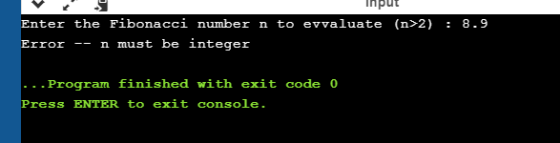
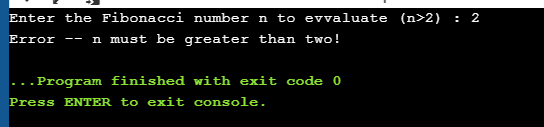
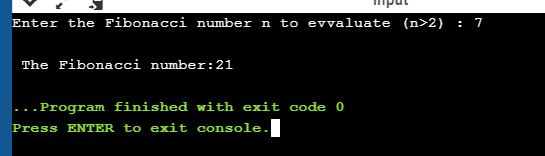
Add Answer to:
turn the following if function in to C++
% Define variables:
% fn -- Fibonacci number...
• Fibonacci numbers, denoted as Fn, form a sequence, called the Fibonacci sequence, such that each...
 • Fibonacci numbers, denoted as Fn, form a sequence, called the Fibonacci sequence, such that each number is the sum of the two preceding ones, starting from 0 and 1. • Fn = Fn-1 + Fn-2 (n > 1) • Fo = 0 and F1 = 1 • Submit the R script to write the first 100 numbers of Fibonacci sequence, i.e., F, to F99, to a file named as Fibonacci_100.txt and put in the folder in path /user/R/output/. •...
Fibonacci num Fn are defined as follow. F0 is 1, F1 is 1, and Fi+2 =...
Fibonacci num Fn are defined as follow. F0 is 1, F1 is 1, and Fi+2 = Fi + Fi+1, where i = 0, 1, 2, . . . . In other words, each number is the sum of the previous two numbers. Write a recursive function definition in C++ that has one parameter n of type int and that returns the n-th Fibonacci number. You can call this function inside the main function to print the Fibonacci numbers. Sample Input...
In mathematics, the Fibonacci numbers are the series of number that exhibit the following pattern: 0,1,1,2,3,5,8,13,21,34,55,89,144,.......
In mathematics, the Fibonacci numbers are the series of number that exhibit the following pattern: 0,1,1,2,3,5,8,13,21,34,55,89,144,.... In mathematical notation the sequence Fn of Fibonacci number is defined by the following recurrence relation: Fn=Fn-1+Fn-2 With the initial values of F0=0 and F1=1. Thus, the next number in the series is the sum of the previous two numbers. Write a program that asks the user for a positive integer N and generate the Nth Fibonacci number. Your main function should handle user...
Below you will find a recursive function that computes a Fibonacci sequence (Links to an external...
Below you will find a recursive function that computes a Fibonacci sequence (Links to an external site.). # Python program to display the Fibonacci sequence up to n-th term using recursive functions def recur_fibo(n): """Recursive function to print Fibonacci sequence""" if n <= 1: return n else: return(recur_fibo(n-1) + recur_fibo(n-2)) # Change this value for a different result nterms = 10 # uncomment to take input from the user #nterms = int(input("How many terms? ")) # check if the number...
The Fibonacci Sequence F1, F2, ... of integers is defined recursively by F1=F2=1 and Fn=Fn-1+Fn-2 for each integer . Pro...
 The Fibonacci Sequence F1, F2, ... of
integers is defined recursively by F1=F2=1
and Fn=Fn-1+Fn-2 for each integer
. Prove
that (picture) Just the top one( not
7.23)
n 3 Chapter 7 Reviewing Proof Techniques 196 an-2 for every integer and an ao, a1, a2,... is a sequence of rational numbers such that ao = n > 2, then for every positive integer n, an- 3F nif n is even 2Fn+1 an = 2 Fn+ 1 if n is odd....
The Fibonacci Sequence F1, F2, ... of
integers is defined recursively by F1=F2=1
and Fn=Fn-1+Fn-2 for each integer
. Prove
that (picture) Just the top one( not
7.23)
n 3 Chapter 7 Reviewing Proof Techniques 196 an-2 for every integer and an ao, a1, a2,... is a sequence of rational numbers such that ao = n > 2, then for every positive integer n, an- 3F nif n is even 2Fn+1 an = 2 Fn+ 1 if n is odd....
** C++ LANGUAGE ** Write a function that will implement each Fibonacci number with the help...
** C++ LANGUAGE ** Write a function that will implement each Fibonacci number with the help of an integer array of size 100 (elements of this array will be digits of the Fibonacci number). When the function is called to find , it will calculate all Fibonacci numbers from to using the basic formula . To add two Fibonacci numbers, the function will add elements of two arrays corresponding to and and store their sums in the array corresponding to...
Please help with this Fibonacci Code (C++)
#include <iostream>void fibonacci (int n)// compute the Fibonacci number F sub n{ if (n <= 1) cout << n << endl; // F sub 0 = 0 and F sub 1 = 1 else { // compute F sub n int fn; int fnm2 = 0; int fnm1 = 1; for (int i = 2; i<=n; i++) { fn = fnm1 + fnm2; fnm2 = fnm1; fnm1 = fn; } // end of for cout << fn << endl; } // end of else} // end of fibonaccivoid main(){ int n; cout << "Input n " << endl; cin >> n; cout << "The Fibonacci Number corresp to" << n << " is "; fibonacci(n);}
MATLAB 1. The Fibonacci sequence is defined by the recurrence relation Fn = Fn-1+Fn-2 where Fo...
 MATLAB
1. The Fibonacci sequence is defined by the recurrence relation Fn = Fn-1+Fn-2 where Fo = 0 and F1 = 1. Hence F2 = 1, F3 = 2, F4 = 3, etc. In this problem you will use three different methods to compute the n-th element of the sequence. Then, you will compare the time complexity of these methods. (a) Write a recursive function called fibRec with the following declaration line begin code function nElem = fibrec (n) end...
MATLAB
1. The Fibonacci sequence is defined by the recurrence relation Fn = Fn-1+Fn-2 where Fo = 0 and F1 = 1. Hence F2 = 1, F3 = 2, F4 = 3, etc. In this problem you will use three different methods to compute the n-th element of the sequence. Then, you will compare the time complexity of these methods. (a) Write a recursive function called fibRec with the following declaration line begin code function nElem = fibrec (n) end...
Can someone tell me how to deal with (b)?? Let Fn be the n-th Fibonacci number,...
 Can someone tell me how to deal with (b)??
Let Fn be the n-th Fibonacci number, defined recursively by F() = 0.FI = 1 and fn Fn-1 F-2 for n 2 2. Prove the following by induction (or strong induction): (a) For all n 20, F+1 s (Z). (b) Let Gn be the number of tilings of a 2 x n grid using domino pieces (i.e. 2 x 1 or 1 x 2 pieces). Then Gn- Fn
Can someone tell me how to deal with (b)??
Let Fn be the n-th Fibonacci number, defined recursively by F() = 0.FI = 1 and fn Fn-1 F-2 for n 2 2. Prove the following by induction (or strong induction): (a) For all n 20, F+1 s (Z). (b) Let Gn be the number of tilings of a 2 x n grid using domino pieces (i.e. 2 x 1 or 1 x 2 pieces). Then Gn- Fn
Fibonacci numbers – for loops We’ll define the Fibonacci numbers to be an integer sequence starting...
Fibonacci numbers – for loops We’ll define the Fibonacci numbers to be an integer sequence starting with 1, 1, and where each subsequent element is got by adding the previous two elements: 1, 1, 2, 3, 5, 8, . . . (Mathematicians start with 0, 1, . . . , but we want to avoid zeros because you can’t take their log. ) Write a python programme in a Jupyter notebook which uses a for-loop to fill an array with...
 • Fibonacci numbers, denoted as Fn, form a sequence, called the Fibonacci sequence, such that each number is the sum of the two preceding ones, starting from 0 and 1. • Fn = Fn-1 + Fn-2 (n > 1) • Fo = 0 and F1 = 1 • Submit the R script to write the first 100 numbers of Fibonacci sequence, i.e., F, to F99, to a file named as Fibonacci_100.txt and put in the folder in path /user/R/output/. •...
 The Fibonacci Sequence F1, F2, ... of
integers is defined recursively by F1=F2=1
and Fn=Fn-1+Fn-2 for each integer
. Prove
that (picture) Just the top one( not
7.23)
n 3 Chapter 7 Reviewing Proof Techniques 196 an-2 for every integer and an ao, a1, a2,... is a sequence of rational numbers such that ao = n > 2, then for every positive integer n, an- 3F nif n is even 2Fn+1 an = 2 Fn+ 1 if n is odd....
The Fibonacci Sequence F1, F2, ... of
integers is defined recursively by F1=F2=1
and Fn=Fn-1+Fn-2 for each integer
. Prove
that (picture) Just the top one( not
7.23)
n 3 Chapter 7 Reviewing Proof Techniques 196 an-2 for every integer and an ao, a1, a2,... is a sequence of rational numbers such that ao = n > 2, then for every positive integer n, an- 3F nif n is even 2Fn+1 an = 2 Fn+ 1 if n is odd....
 MATLAB
1. The Fibonacci sequence is defined by the recurrence relation Fn = Fn-1+Fn-2 where Fo = 0 and F1 = 1. Hence F2 = 1, F3 = 2, F4 = 3, etc. In this problem you will use three different methods to compute the n-th element of the sequence. Then, you will compare the time complexity of these methods. (a) Write a recursive function called fibRec with the following declaration line begin code function nElem = fibrec (n) end...
MATLAB
1. The Fibonacci sequence is defined by the recurrence relation Fn = Fn-1+Fn-2 where Fo = 0 and F1 = 1. Hence F2 = 1, F3 = 2, F4 = 3, etc. In this problem you will use three different methods to compute the n-th element of the sequence. Then, you will compare the time complexity of these methods. (a) Write a recursive function called fibRec with the following declaration line begin code function nElem = fibrec (n) end...
 Can someone tell me how to deal with (b)??
Let Fn be the n-th Fibonacci number, defined recursively by F() = 0.FI = 1 and fn Fn-1 F-2 for n 2 2. Prove the following by induction (or strong induction): (a) For all n 20, F+1 s (Z). (b) Let Gn be the number of tilings of a 2 x n grid using domino pieces (i.e. 2 x 1 or 1 x 2 pieces). Then Gn- Fn
Can someone tell me how to deal with (b)??
Let Fn be the n-th Fibonacci number, defined recursively by F() = 0.FI = 1 and fn Fn-1 F-2 for n 2 2. Prove the following by induction (or strong induction): (a) For all n 20, F+1 s (Z). (b) Let Gn be the number of tilings of a 2 x n grid using domino pieces (i.e. 2 x 1 or 1 x 2 pieces). Then Gn- Fn
Most questions answered within 3 hours.
-
Where is the error in this code sequence?
String s1 = "Hello";
String s2 = "ello";...
asked 10 months ago -
Financial data for Joel de Paris, Inc., for last year
follow:
Joel de Paris, Inc.
Balance...
asked 10 months ago -
Consider this reaction:
Al2(SO4)3 (aq)+ BaCl3
(aq) Al2Cl6 (aq)- +
3BaSO4(s) . What is the...
asked 10 months ago -
Suppose that Savneet is considering increasing her
recent random sample from 20 car rentals to 40...
asked 10 months ago -
Trucks arrive at an unloading terminal at an average rate of 120
per hour.
Trucks arrive...
asked 10 months ago -
Why are methanol and ethanol completely soluble in water while
octanol is not very little soluble....
asked 10 months ago -
A facilities manager at a university reads in a research report
that the mean amount of...
asked 10 months ago -
When the CuSO4 is rehydrated by adding water to the anhydrous
compound, is this an endothermic...
asked 10 months ago -
A ray of sunlight is passing from diamond into crown glass; the
angle of incidence is...
asked 10 months ago -
A block of mass 0.249 kg is placed on top of a light, vertical
spring of...
asked 10 months ago -
how do the kidneys compensate in the presences of acidosis
a) trigger hyperventilate
b) reserve acid...
asked 10 months ago -
Question 501 pts
The rental rate of capital to the firm increases. Which of the
following...
asked 10 months ago