Data Structures Draw memory call stack to show how recursion works in memory.
Data Structures
Draw memory call stack to show how recursion works in memory.
Homework Answers
Recursive functions use something called “the call stack.” When a program calls a function, that function goes on top of the call stack. This similar to a stack of books. You add things one at a time. Then, when you are ready to take something off, you always take off the top item.
I will show you the call stack in action with the factorial function. factorial(5) is written as 5! and it is defined like this: 5! = 5 * 4 * 3 * 2 * 1. Here is a recursive function to calculate the factorial of a number:
function fact(x) {
  if (x == 1) {
    return 1;
  } else {
    return x * fact(x-1);
  }
}
Now let’s see what happens if you call fact(3) The illustration bellow shows how the stack changes, line by line. The topmost box in the stack tells you what call to fact you’re currently on.
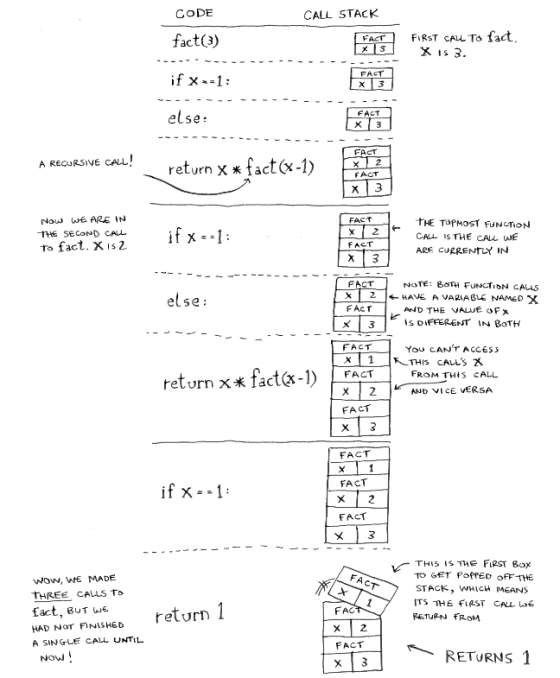
Notice how each call to fact has its own copy of x. This is very important to making recursion work. You can’t access a different function’s copy of x.
Add Answer to:
Data Structures
Draw memory call stack to show how recursion works in
memory.
Call stack question! Long one... The call stack is part of main memory that is reserved...
 Call stack question! Long one...
The call stack is part of main memory that is reserved for function calling. Like all r memory it is finite, so can be exhausted resulting in a stack overflow. Recursive functions allocate space on the stack for each recursive call: if there are many such recursive calls a stack overflow can result. The questions that follow ask you to investigate recursive functions and stack overflows. Note that when running programs in the Linux terminal...
Call stack question! Long one...
The call stack is part of main memory that is reserved for function calling. Like all r memory it is finite, so can be exhausted resulting in a stack overflow. Recursive functions allocate space on the stack for each recursive call: if there are many such recursive calls a stack overflow can result. The questions that follow ask you to investigate recursive functions and stack overflows. Note that when running programs in the Linux terminal...
Stack buffer overflow Memory Architecture. Describe the stack in the address space of the VM, in...
Stack buffer overflow Memory Architecture. Describe the stack in the address space of the VM, in generalities. Specifically, address where in memory the stack would be located, what the stack structure looks like when data is pushed onto the stack and popped off the stack. Discuss what register values are placed onto the stack, where user variables are placed within the stack, where arguments would be placed in the stack relative to pertinent register storage within the stack, and finally...
Data Structures and Algorithm Analysis 7.16 How would you implement mergesort without using recursion?
 Data Structures and Algorithm Analysis
7.16 How would you implement mergesort without using recursion?
Data Structures and Algorithm Analysis
7.16 How would you implement mergesort without using recursion?
Show how to implement a stack using two queues. Analyze the running time of the stack...
Show how to implement a stack using two queues. Analyze the running time of the stack operations. Assume that two queues Q1 and Q2 are the only data structures you can use so you shouldn’t need any auxiliary arrays.
Recursion Tree Goal: Predict the output of a recursive method call using a recursion tree. Draw...
Recursion Tree Goal: Predict the output of a recursive method call using a recursion tree. Draw the recursion tree of the following source code, showing all method calls and outputs: public class Main { public static void main(String[] args) { f(3, 4); } public static void f(int x, int y) { if(x + y > 1) { f(x - 2, y - 1); System.out.print(x + " "); f(y, x - 2); System.out.print(2 * x + y + " "); }...
Briefly explain HOW THREE BUSES CONNECTED TO MEMORY modules works to write or read data.
Briefly explain HOW THREE BUSES CONNECTED TO MEMORY modules works to write or read data.
Give an answer that's easy to understand. Define stack data structure. Show how the Stack operations...
Give an answer that's easy to understand. Define stack data structure. Show how the Stack operations work by means of diagrammatic representation. Also, explain their ADT’s. Give 2 real-time examples.
Resource: Ch. 5, "Recursion", of Data Structures: Abstraction and Design Using Java, Exercises for Section 5.6...
Resource: Ch. 5, "Recursion", of Data Structures: Abstraction and Design Using Java, Exercises for Section 5.6 Complete the following Review Questions within the "Exercises for Sections 5.6" subsection in Section 5.6, "Backtracking" of Ch. 5, "Recursion" in Data Structures: Abstraction and Design Using Java Review Question #7 For the maze path found in Figure 5.19, explain why cells (3, 4), (2, 5), (3, 5), and (4, 5) were never visited and why cells (5, 1) and (3, 0) through (9,...
A process' memory structure includes... stack pile section text or code data section heap
 A process' memory structure includes... stack pile section text or code data section heap
How can knowing more about how your memory works improve your memory skills? How will this...
How can knowing more about how your memory works improve your memory skills? How will this help you in college and in life?What if you start to apply these memory techniques to your other classes?
 Call stack question! Long one...
The call stack is part of main memory that is reserved for function calling. Like all r memory it is finite, so can be exhausted resulting in a stack overflow. Recursive functions allocate space on the stack for each recursive call: if there are many such recursive calls a stack overflow can result. The questions that follow ask you to investigate recursive functions and stack overflows. Note that when running programs in the Linux terminal...
Call stack question! Long one...
The call stack is part of main memory that is reserved for function calling. Like all r memory it is finite, so can be exhausted resulting in a stack overflow. Recursive functions allocate space on the stack for each recursive call: if there are many such recursive calls a stack overflow can result. The questions that follow ask you to investigate recursive functions and stack overflows. Note that when running programs in the Linux terminal...
 Data Structures and Algorithm Analysis
7.16 How would you implement mergesort without using recursion?
Data Structures and Algorithm Analysis
7.16 How would you implement mergesort without using recursion?
 A process' memory structure includes... stack pile section text or code data section heap
Most questions answered within 3 hours.
-
Where is the error in this code sequence?
String s1 = "Hello";
String s2 = "ello";...
asked 11 months ago -
Financial data for Joel de Paris, Inc., for last year
follow:
Joel de Paris, Inc.
Balance...
asked 11 months ago -
Consider this reaction:
Al2(SO4)3 (aq)+ BaCl3
(aq) Al2Cl6 (aq)- +
3BaSO4(s) . What is the...
asked 11 months ago -
Suppose that Savneet is considering increasing her
recent random sample from 20 car rentals to 40...
asked 11 months ago -
Trucks arrive at an unloading terminal at an average rate of 120
per hour.
Trucks arrive...
asked 11 months ago -
Why are methanol and ethanol completely soluble in water while
octanol is not very little soluble....
asked 11 months ago -
A facilities manager at a university reads in a research report
that the mean amount of...
asked 11 months ago -
When the CuSO4 is rehydrated by adding water to the anhydrous
compound, is this an endothermic...
asked 11 months ago -
A ray of sunlight is passing from diamond into crown glass; the
angle of incidence is...
asked 11 months ago -
A block of mass 0.249 kg is placed on top of a light, vertical
spring of...
asked 11 months ago -
how do the kidneys compensate in the presences of acidosis
a) trigger hyperventilate
b) reserve acid...
asked 11 months ago -
Question 501 pts
The rental rate of capital to the firm increases. Which of the
following...
asked 11 months ago