Consider the first-order conversion of reactant A to product B as follows: A ⟺ B. If...
Consider the first-order conversion of reactant A to product B as follows: A ⟺ B. If k1 is equal to 0.16 s-1 and k2 is equal to 0.03 s-1, then what will be the velocity of the forward reaction (vf) when equilibrium is reached? Assume that the initial concentration of reactant A is 1.08 M. Recall that vf (at equilibrium) is equal to k1 times the equilibrium concentration of reactant A. Report your answer in terms of M/s to the nearest thousandth.
Homework Answers

Add Answer to:
Consider the first-order conversion of reactant A to product B
as follows: A ⟺ B. If...
1. A certain first order reaction has a rate constant of 0.036 min-1. How much of the reactant will remain if the reacti...
1. A certain first order reaction has a rate constant of 0.036 min-1. How much of the reactant will remain if the reaction is run for 2.5 hours and the initial concentration of the reactant is 0.31 M? 2. A certain first order reaction has a rate constant of 0.036 min-1. How much of the reactant will remain if the reaction is run for 2.5 hours and the initial concentration of the reactant is 0.31 M? 3. The rate constant...
A certain reaction, A + B → C is first order with respect to each reactant
A certain reaction, A + B → C is first order with respect to each reactant, with k = 1.0 × 10⁻² L·mol-1.s-1. Calculate the concentration of A remaining after 100 s if the initial concentration of each reactant was 0.100 M.
5. Consider the generic reaction shown below in which reactant A is converted to product B....
 5. Consider the generic reaction shown below in which reactant A is converted to product B. A pure sample of reactant A is allowed to reach equilibrium. The concentrations of both A and B were monitored during this process and plotted below as a function of time. A(8)=B (8) concentration time a. Based on these data, is the value of Key for this reaction greater than or less than 1? Briefly explain how you can tell. b. The reaction is...
Chapter 13, Question 29 The conversion of C5H1Br into CsHo follows first-order kinetics, with a rate...
 Chapter 13, Question 29 The conversion of C5H1Br into CsHo follows first-order kinetics, with a rate constant of 0.385 h. If the initial concentration of CSHBr is 0.125 M, find (a) the time at which the concentration will be 1.52 x 10 M (b) the concentration after 3.0 h of reaction. Click if you would like to Show Work for this question: Open Show Work
For a certain first-order reaction, is takes 2880 seconds for the concentration of the reactant to...
 For a certain first-order reaction, is takes 2880 seconds for the concentration of the reactant to decrease to 25% of its initial value. What is the value for the rate constant (in s^-1) for the reaction? a) 2.9 times 10^-2 s^-1 b) 6.0 times 10^-3 s^-1 c) 4.8 times 10^-4 s^-1 d) 1.0 times 10^-4 s^-1
Q-4 (7.10). The concentration of a reactant in a first-order chemical reaction that proceeds at a...
 Q-4 (7.10). The concentration of a reactant in a first-order chemical reaction that proceeds at a rate k can be described as follows: In(C) = ln(Co) - kt, where C is the concentration of the reactant at time t, Co is the initial concentration and t is the elapsed time since the reaction started. Consider an initial concentration of Co = 0.3 mol/L. The experiment was repeated n times to give a geometric mean of the concentration at time t...
It is desired to achieve 70% conversion of the reactant A in a gas stream of...
 It is desired to achieve 70% conversion of the reactant A in a gas stream of pure A at 900 kPa entering a reactor with a volumetric flow rate (po) of 3 Ls1 at 300 °C. The reaction A?B follows second order rate equation: where-a rate of reaction of A, moll-s-1 CA concentration of A, moll-1 i) Initial concentration of A, Cao (in moll-) k specific rate constant, 0.30 Lmol-1s-1 Calculate: i) Initial molar flow rate of A, Fxo (in...
1. Consider the reaction: 2 NO (g) + 2 H2 (g) → N2 (g) + 2...
1. Consider the reaction: 2 NO (g) + 2 H2 (g) → N2 (g) + 2 H2O (g). If the rate of change in NO is -0.68 M s^-1 then write the rate of change for the other reactants and products. What is the rate of the reaction? 2. Consider the reaction: CH3COOC2H5 (aq) + OH- (aq) → CH3CO2- (aq) + CH3CH2OH (aq) The reaction is known to be first order in CH3COOC2H5 and first order in OH-. The second-...
6.The conversion of eyelopropan to proenroceds i1 order reaction. CH2 0% CH H2C-CH2 a. At a...
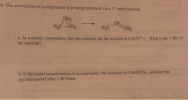 6.The conversion of eyelopropan to proenroceds i1 order reaction. CH2 0% CH H2C-CH2 a. At a certain temperature, the rate constant for the reaction is 5.4x10⁻⁴ s". what is the the reaction? life of b. If the initial concentration of cyclopropane (the reactant) is 0.00530 M, calculate the [cyclopropane] after 1.90 hours
A chemical reaction, A+B → P, has the following mechanism: 2A< Ki>A, (fast to equilibrium) A+B&K, ™C (fast to...
 A chemical reaction, A+B → P, has the following mechanism: 2A< Ki>A, (fast to equilibrium) A+B&K, ™C (fast to equilibrium), A,+C-k>P+ 2A (slow) where Kį and K2 are the equilibrium constants for the first two reactions, respectively. k3 is the rate constant for the third reaction. (a) [5 points] Based on this mechanism, show that the rate of product (P) formation is: d[P] – k[A[B], where k is the rate constant of the overall reaction. Write k in terms of...
 5. Consider the generic reaction shown below in which reactant A is converted to product B. A pure sample of reactant A is allowed to reach equilibrium. The concentrations of both A and B were monitored during this process and plotted below as a function of time. A(8)=B (8) concentration time a. Based on these data, is the value of Key for this reaction greater than or less than 1? Briefly explain how you can tell. b. The reaction is...
 Chapter 13, Question 29 The conversion of C5H1Br into CsHo follows first-order kinetics, with a rate constant of 0.385 h. If the initial concentration of CSHBr is 0.125 M, find (a) the time at which the concentration will be 1.52 x 10 M (b) the concentration after 3.0 h of reaction. Click if you would like to Show Work for this question: Open Show Work
 For a certain first-order reaction, is takes 2880 seconds for the concentration of the reactant to decrease to 25% of its initial value. What is the value for the rate constant (in s^-1) for the reaction? a) 2.9 times 10^-2 s^-1 b) 6.0 times 10^-3 s^-1 c) 4.8 times 10^-4 s^-1 d) 1.0 times 10^-4 s^-1
 Q-4 (7.10). The concentration of a reactant in a first-order chemical reaction that proceeds at a rate k can be described as follows: In(C) = ln(Co) - kt, where C is the concentration of the reactant at time t, Co is the initial concentration and t is the elapsed time since the reaction started. Consider an initial concentration of Co = 0.3 mol/L. The experiment was repeated n times to give a geometric mean of the concentration at time t...
 It is desired to achieve 70% conversion of the reactant A in a gas stream of pure A at 900 kPa entering a reactor with a volumetric flow rate (po) of 3 Ls1 at 300 °C. The reaction A?B follows second order rate equation: where-a rate of reaction of A, moll-s-1 CA concentration of A, moll-1 i) Initial concentration of A, Cao (in moll-) k specific rate constant, 0.30 Lmol-1s-1 Calculate: i) Initial molar flow rate of A, Fxo (in...
 6.The conversion of eyelopropan to proenroceds i1 order reaction. CH2 0% CH H2C-CH2 a. At a certain temperature, the rate constant for the reaction is 5.4x10⁻⁴ s". what is the the reaction? life of b. If the initial concentration of cyclopropane (the reactant) is 0.00530 M, calculate the [cyclopropane] after 1.90 hours
 A chemical reaction, A+B → P, has the following mechanism: 2A< Ki>A, (fast to equilibrium) A+B&K, ™C (fast to equilibrium), A,+C-k>P+ 2A (slow) where Kį and K2 are the equilibrium constants for the first two reactions, respectively. k3 is the rate constant for the third reaction. (a) [5 points] Based on this mechanism, show that the rate of product (P) formation is: d[P] – k[A[B], where k is the rate constant of the overall reaction. Write k in terms of...
Most questions answered within 3 hours.
-
Where is the error in this code sequence?
String s1 = "Hello";
String s2 = "ello";...
asked 10 months ago -
Financial data for Joel de Paris, Inc., for last year
follow:
Joel de Paris, Inc.
Balance...
asked 10 months ago -
Consider this reaction:
Al2(SO4)3 (aq)+ BaCl3
(aq) Al2Cl6 (aq)- +
3BaSO4(s) . What is the...
asked 10 months ago -
Suppose that Savneet is considering increasing her
recent random sample from 20 car rentals to 40...
asked 10 months ago -
Trucks arrive at an unloading terminal at an average rate of 120
per hour.
Trucks arrive...
asked 10 months ago -
Why are methanol and ethanol completely soluble in water while
octanol is not very little soluble....
asked 10 months ago -
A facilities manager at a university reads in a research report
that the mean amount of...
asked 10 months ago -
When the CuSO4 is rehydrated by adding water to the anhydrous
compound, is this an endothermic...
asked 10 months ago -
A ray of sunlight is passing from diamond into crown glass; the
angle of incidence is...
asked 10 months ago -
A block of mass 0.249 kg is placed on top of a light, vertical
spring of...
asked 10 months ago -
how do the kidneys compensate in the presences of acidosis
a) trigger hyperventilate
b) reserve acid...
asked 10 months ago -
Question 501 pts
The rental rate of capital to the firm increases. Which of the
following...
asked 10 months ago