a sample of titanium (TI) 0.523 J/g C° that loses 14200 J when it cools from...
a sample of titanium (TI) 0.523 J/g C° that loses 14200 J when it cools from 189 °C to 42°C
calculate the mass in grams and Express your answer with the appropriate units
Homework Answers

Add Answer to:
a sample of titanium (TI) 0.523 J/g C° that loses
14200 J when it cools from...
Please answer in detail on how these 2 answers are gotten. Include Heat formula (or any...
 Please answer in detail on how these 2 answers are
gotten. Include Heat formula (or any formula) and all math used to
get to answer
Calculate the mass, in grams, for each of the following using the table below Table Specific Heats of Some Substances Specific Heat (J/g C) Substance Aliminium, Al(s) Copper, Cu(s) Gold, Au(s) ron, Fe(s) Silver. Ag(s) Titanium, Ti(s) 0.897 0.385 0.129 0.452 0.235 0.523 2.04 2.46 0.864 4.184 2.03 Elements Compounds Ammonia, NHs(g) Ethanol, C2H5OHl) Sodium...
Please answer in detail on how these 2 answers are
gotten. Include Heat formula (or any formula) and all math used to
get to answer
Calculate the mass, in grams, for each of the following using the table below Table Specific Heats of Some Substances Specific Heat (J/g C) Substance Aliminium, Al(s) Copper, Cu(s) Gold, Au(s) ron, Fe(s) Silver. Ag(s) Titanium, Ti(s) 0.897 0.385 0.129 0.452 0.235 0.523 2.04 2.46 0.864 4.184 2.03 Elements Compounds Ammonia, NHs(g) Ethanol, C2H5OHl) Sodium...
A sample of steam with a mass of 0.523 g at a temperature of 100 ∘C...
A sample of steam with a mass of 0.523 g at a temperature of 100 ∘C condenses into an insulated container holding 4.20 g of water at 3.0 ∘C. (For water, ΔH∘vap=40.7 kJ/mol and Cwater=4.18 J/(g⋅∘C).) Assuming that no heat is lost to the surroundings, what is the final temperature of the mixture?
A Revi Use molar volume to calculate each of the following at STP: Part A the...
 A Revi Use molar volume to calculate each of the following at STP: Part A the volume, in liters, occupied by 3.50 moles of N2 gas 190 AS O O ? V = Submit Request Answer Part B the number of moles of CO2 in 2.10 L of CO2 gas Co Agon O O ? V = mol Submit Request Answer Problem 3.38 Review I Constants | Part A calories lost when 95 g of water cools from 45°C to...
Titanium reacts with iodine to form titanium(III) iodide, emitting heat. 2Ti(s) + 3I_2 (g) rightarrow 2TiI_3...
 Titanium reacts with iodine to form titanium(III) iodide, emitting heat. 2Ti(s) + 3I_2 (g) rightarrow 2TiI_3 (s)delta H degree_rxn = -839 kj Determine the masses of titanium and iodine that react if 1.60 times 10^3 kJ of heat is emitted by the reaction. Express your answer to three significant figures and include the appropriate units. m(Ti) = 0.183 kg Express your answer to three significant figures and include the appropriate units. m(I_2) = Value Units
2. A substance releases 5,323 J of heat as it cools from 50.2 °C to 27.8...
 2. A substance releases 5,323 J of heat as it cools from 50.2 °C to 27.8 °C. What is the specific heat (cp) of the material if there was 604.496 g of the substance? 3. When 1.2984 grams of HClO3 is neutralized with NH3, 2,107 J of heat are released. What is the molar heat of neutralization (in kJ/mole) for Hclo3?
Titanium(IV) chloride decomposes to form titanium and chlorine, Iike this: TiCl4)Ti(s)+2 C12(g) At a certain temperature,...
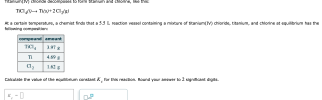 Titanium(IV) chloride decomposes to form titanium and chlorine, Iike this: TiCl4)Ti(s)+2 C12(g) At a certain temperature, a chemist finds that a 5.5 L reaction vessel containing a mixture of titanium(IV) chloride, titanium, and chlorine at equilibrium has the following composition: compound amount TiCl4 3.97 g 4.69 g Ti Cl2 1.62 g с Calculate the value of the equilibrium constant K for this reaction. Round your answer to 2 significant digits. К x10
350 J are released as ice ( Specific Heat = 2.1/(g°C)) cools from - 5.0 °C...
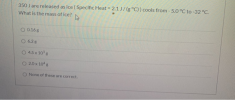 350 J are released as ice ( Specific Heat = 2.1/(g°C)) cools from - 5.0 °C to -32°C. What is the mass of ice? 6 O 0.168 O 6.28 O 4.5 x 10g 20x 104 g None of these are correct.
QUESTION 5 The combustion of titanium with oxygen produces titanium dioxide: Ti(s) + O2(g) → TiO2(s)...
 QUESTION 5 The combustion of titanium with oxygen produces titanium dioxide: Ti(s) + O2(g) → TiO2(s) When 2.060 g of titanium is combusted in a bomb calorimeter, the temperature of the calorimeter increases from 25.00 °C to 91.60 °C. In a separate experiment, the heat capacity of the calorimeter is measured to be 9.84 kJ/K. The heat of reaction for the combustion of a mole of Ti in this calorimeter is kulmol 19.6 -1.52 × 10⁴ -0.154 O-311 14.3 QUESTION...
34. Calculate the specific heat (J/g∘C) for a 25.5 g sample of a metal that absorbs...
34. Calculate the specific heat (J/g∘C) for a 25.5 g sample of a metal that absorbs 617 J when temperature increases from 38.9 ∘C to82.1 ∘C. SH = ? g/J Celcius 36. The heat of reaction, ΔH, is the amount of heat absorbed or released during a chemical reaction. It is calculated as the difference in energy of the products and the reactants. Part B. The energy diagram shown represents the chemical reaction between solid ammonium chloride and solid barium...
How much heat is released when 27.6 g PCl3 cools from 83.1 °C to 55.6 °C?...
How much heat is released when 27.6 g PCl3 cools from 83.1 °C to 55.6 °C? (The specific heat of PCl3 is 0.874 J/g °C). A 886 J. B 603 J. C 868 J. D 663 J.
 Please answer in detail on how these 2 answers are
gotten. Include Heat formula (or any formula) and all math used to
get to answer
Calculate the mass, in grams, for each of the following using the table below Table Specific Heats of Some Substances Specific Heat (J/g C) Substance Aliminium, Al(s) Copper, Cu(s) Gold, Au(s) ron, Fe(s) Silver. Ag(s) Titanium, Ti(s) 0.897 0.385 0.129 0.452 0.235 0.523 2.04 2.46 0.864 4.184 2.03 Elements Compounds Ammonia, NHs(g) Ethanol, C2H5OHl) Sodium...
Please answer in detail on how these 2 answers are
gotten. Include Heat formula (or any formula) and all math used to
get to answer
Calculate the mass, in grams, for each of the following using the table below Table Specific Heats of Some Substances Specific Heat (J/g C) Substance Aliminium, Al(s) Copper, Cu(s) Gold, Au(s) ron, Fe(s) Silver. Ag(s) Titanium, Ti(s) 0.897 0.385 0.129 0.452 0.235 0.523 2.04 2.46 0.864 4.184 2.03 Elements Compounds Ammonia, NHs(g) Ethanol, C2H5OHl) Sodium...
 A Revi Use molar volume to calculate each of the following at STP: Part A the volume, in liters, occupied by 3.50 moles of N2 gas 190 AS O O ? V = Submit Request Answer Part B the number of moles of CO2 in 2.10 L of CO2 gas Co Agon O O ? V = mol Submit Request Answer Problem 3.38 Review I Constants | Part A calories lost when 95 g of water cools from 45°C to...
 Titanium reacts with iodine to form titanium(III) iodide, emitting heat. 2Ti(s) + 3I_2 (g) rightarrow 2TiI_3 (s)delta H degree_rxn = -839 kj Determine the masses of titanium and iodine that react if 1.60 times 10^3 kJ of heat is emitted by the reaction. Express your answer to three significant figures and include the appropriate units. m(Ti) = 0.183 kg Express your answer to three significant figures and include the appropriate units. m(I_2) = Value Units
 2. A substance releases 5,323 J of heat as it cools from 50.2 °C to 27.8 °C. What is the specific heat (cp) of the material if there was 604.496 g of the substance? 3. When 1.2984 grams of HClO3 is neutralized with NH3, 2,107 J of heat are released. What is the molar heat of neutralization (in kJ/mole) for Hclo3?
 Titanium(IV) chloride decomposes to form titanium and chlorine, Iike this: TiCl4)Ti(s)+2 C12(g) At a certain temperature, a chemist finds that a 5.5 L reaction vessel containing a mixture of titanium(IV) chloride, titanium, and chlorine at equilibrium has the following composition: compound amount TiCl4 3.97 g 4.69 g Ti Cl2 1.62 g с Calculate the value of the equilibrium constant K for this reaction. Round your answer to 2 significant digits. К x10
 350 J are released as ice ( Specific Heat = 2.1/(g°C)) cools from - 5.0 °C to -32°C. What is the mass of ice? 6 O 0.168 O 6.28 O 4.5 x 10g 20x 104 g None of these are correct.
 QUESTION 5 The combustion of titanium with oxygen produces titanium dioxide: Ti(s) + O2(g) → TiO2(s) When 2.060 g of titanium is combusted in a bomb calorimeter, the temperature of the calorimeter increases from 25.00 °C to 91.60 °C. In a separate experiment, the heat capacity of the calorimeter is measured to be 9.84 kJ/K. The heat of reaction for the combustion of a mole of Ti in this calorimeter is kulmol 19.6 -1.52 × 10⁴ -0.154 O-311 14.3 QUESTION...
Most questions answered within 3 hours.
-
Where is the error in this code sequence?
String s1 = "Hello";
String s2 = "ello";...
asked 10 months ago -
Financial data for Joel de Paris, Inc., for last year
follow:
Joel de Paris, Inc.
Balance...
asked 10 months ago -
Consider this reaction:
Al2(SO4)3 (aq)+ BaCl3
(aq) Al2Cl6 (aq)- +
3BaSO4(s) . What is the...
asked 10 months ago -
Suppose that Savneet is considering increasing her
recent random sample from 20 car rentals to 40...
asked 10 months ago -
Trucks arrive at an unloading terminal at an average rate of 120
per hour.
Trucks arrive...
asked 10 months ago -
Why are methanol and ethanol completely soluble in water while
octanol is not very little soluble....
asked 10 months ago -
A facilities manager at a university reads in a research report
that the mean amount of...
asked 10 months ago -
When the CuSO4 is rehydrated by adding water to the anhydrous
compound, is this an endothermic...
asked 10 months ago -
A ray of sunlight is passing from diamond into crown glass; the
angle of incidence is...
asked 10 months ago -
A block of mass 0.249 kg is placed on top of a light, vertical
spring of...
asked 10 months ago -
how do the kidneys compensate in the presences of acidosis
a) trigger hyperventilate
b) reserve acid...
asked 10 months ago -
Question 501 pts
The rental rate of capital to the firm increases. Which of the
following...
asked 10 months ago