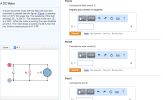
A shunt excited motor with Rm = 200Ω and Ra = 3Ω is connected to a...
A shunt excited motor with Rm = 200Ω and Ra = 3Ω is connected to
a constant DC power supply of 230V. A back-emf of 195V is induced
in the motor. The brush voltage drop is 1V / brush. Mechanical,
magnetic and stray losses are a total of 200W.
a) How much current does the motor draw? b) Calculate the shaft
power of the motor
Homework Answers
Request Answer!
We need at least 10 more requests to produce the answer.
0 / 10 have requested this problem solution
The more requests, the faster the answer.
Add Answer to:
A shunt excited motor with Rm = 200Ω and Ra = 3Ω is connected to
a...
QUESTION 1 A) (10 marks) A 10 kW, 250 V DC self-excited shunt generator, with an...
 QUESTION 1 A) (10 marks) A 10 kW, 250 V DC self-excited shunt generator, with an armature resistance of 0.1 ohm, is delivering 80 % of rated power to the mains at rated voltage when being run at 1000 r.p.m. (revolutions per minute). The field circuit resistance is 220 ohms. The brush contact drop is 0.5 V and rotational (mechanical) losses are 750 W Calculate The induced voltage The electromagnetic torque developed The shaft torque The overall efficiency B) (15...
A dc series excited motor is connected to 230V power supply. The resistance of the armature...
A dc series excited motor is connected to 230V power supply. The resistance of the armature winding is 0.25 ohms and the series winding resistance is 0.15 ohms. At 1100 rpm the motor consumes 50A. Calculate the speed of the motor when connected to a 200V power supply. Assume that the motor shaft torque is unchanged.
ing the arhature voltage (with the shunt field voltage held constant) offer a good method of...
 ing the arhature voltage (with the shunt field voltage held constant) offer a good method of speed control? □Yes □No REVIEW QUESTIONS 1. Explain how to locate the neutral brush position in a DC motor. Would the motor turn if only the armature were excited (had voltage applied across it)? 2. □ Yes □ No 3. Why is it dangerous to supply power to an unloaded series connected DC motor? 4. In what two ways may the rotation of a...
A 8250 w shunt DC motor has a terminal voltage of 300 V. A field resistance...
 A 8250 w shunt DC motor has a terminal voltage of 300 V. A field resistance Rf of 40 Ω, and an armature resistance Ra of 250 mm2. The field winding has 1500 turns. An adjustable resistance Rad is connected in series to the field winding. Rad is set at 20 Ω, but it can vary from 0 to 80 Ω. The magnetization curve is shown in Figure.1 and it is taken at a speed of 1200 rpm. (Armature reaction...
In a shunt-wound dc motor with the field coils and rotor connected in parallel (see the...
 In a shunt-wound dc motor with the field coils and rotor
connected in parallel (see the figure (Figure 1)), the resistance
Rf of the field coils is Rf = 103 Ω and the resistance Rr of the
rotor is Rr = 5.5 Ω. When a potential difference of V = 120 V is
applied to the brushes and the motor is running at full speed
delivering mechanical power, the current supplied to it is 4.90
A.
Part A.) What is...
In a shunt-wound dc motor with the field coils and rotor
connected in parallel (see the figure (Figure 1)), the resistance
Rf of the field coils is Rf = 103 Ω and the resistance Rr of the
rotor is Rr = 5.5 Ω. When a potential difference of V = 120 V is
applied to the brushes and the motor is running at full speed
delivering mechanical power, the current supplied to it is 4.90
A.
Part A.) What is...
A separately-excited dc motor with the following parameters: Ra = 0.25 ohm, La = 0.003H, and...
 A separately-excited dc motor with the following parameters: Ra = 0.25 ohm, La = 0.003H, and Kb = 0.35 V/rad/sec. is driving a load of 1-0.0155 ke-m2, B -0.004 Nm/rad/sec with a load torque of 120 Nm. Its armature is connected to a dc supply voltage of 450 V and is given the rated field power. Determine the armature input power of the motor and choose the right answer from the given answer options. 120.5 kW 450 kW 159.6 kW...
A shunt-wound DC motor with the field coils and rotor connected in parallel (see the figure)...
 A shunt-wound DC motor with the field coils and rotor connected
in parallel (see the figure) (Figure 1) operates from a 130 V DC
power line. The resistance of the field windings, Rf, is
234 ? . The resistance of the rotor, Rr, is 4.10 ? . When
the motor is running, the rotor develops an emf E. The motor draws
a current of 4.82 A from the line. Friction losses amount to 47.0 W
.
A shunt-wound DC motor with the field coils and rotor connected
in parallel (see the figure) (Figure 1) operates from a 130 V DC
power line. The resistance of the field windings, Rf, is
234 ? . The resistance of the rotor, Rr, is 4.10 ? . When
the motor is running, the rotor develops an emf E. The motor draws
a current of 4.82 A from the line. Friction losses amount to 47.0 W
.
3. A 20kW, 250V, 1000rpm shunt excited dc motor has armature and field resistances of 0.2...
 3. A 20kW, 250V, 1000rpm shunt excited dc motor has armature and field resistances of 0.2 ohm and 2002. When the motor takes 80A rated current at rated conditions. Draw the equivalent circuit and calculate induced torque at 1200rpm. Explain the starting current limiting methods for DC motors. (30 pts) 4. Explain the conditions for parallel operation of synchronous generators. A three phase, wye connected, synchronous generator is rated 150 MW, 0.85 lagging power factor, 12.6 kV, 60 Hz, and...
separately excited series, shunt, compound DC motor: *Describe how does decreasing the field current IF affect...
separately excited series, shunt, compound DC motor: *Describe how does decreasing the field current IF affect the speed versus voltage characteristic and constant K1 of a separately-excited dc motor. K1=(n2-n1)/(E2-E1) *Describe how does decreasing the field current IF affect the torque versus current characteristic and constant K2 of a separately-excited dc motor? k2=(T2-T1)/(I1-I2) *Briefly describe how the speed varies as the mechanical load applied to the series motor increases, i.e. as the motor torque increases.
220 v dc shunt motor has Ra= 0.25 ohms and Rf=120 ohms . At no-load the...
220 v dc shunt motor has Ra= 0.25 ohms and Rf=120 ohms . At no-load the motor draws a current It=6A. And runs at 1500 rpm. At full-load the motor draws 62 A. the armature reaction at full load reduces the flux by 10%. Determine the rotational losses , motor speed at full-load, the shaft torque and efficiency.
 QUESTION 1 A) (10 marks) A 10 kW, 250 V DC self-excited shunt generator, with an armature resistance of 0.1 ohm, is delivering 80 % of rated power to the mains at rated voltage when being run at 1000 r.p.m. (revolutions per minute). The field circuit resistance is 220 ohms. The brush contact drop is 0.5 V and rotational (mechanical) losses are 750 W Calculate The induced voltage The electromagnetic torque developed The shaft torque The overall efficiency B) (15...
 ing the arhature voltage (with the shunt field voltage held constant) offer a good method of speed control? □Yes □No REVIEW QUESTIONS 1. Explain how to locate the neutral brush position in a DC motor. Would the motor turn if only the armature were excited (had voltage applied across it)? 2. □ Yes □ No 3. Why is it dangerous to supply power to an unloaded series connected DC motor? 4. In what two ways may the rotation of a...
 A 8250 w shunt DC motor has a terminal voltage of 300 V. A field resistance Rf of 40 Ω, and an armature resistance Ra of 250 mm2. The field winding has 1500 turns. An adjustable resistance Rad is connected in series to the field winding. Rad is set at 20 Ω, but it can vary from 0 to 80 Ω. The magnetization curve is shown in Figure.1 and it is taken at a speed of 1200 rpm. (Armature reaction...
 In a shunt-wound dc motor with the field coils and rotor
connected in parallel (see the figure (Figure 1)), the resistance
Rf of the field coils is Rf = 103 Ω and the resistance Rr of the
rotor is Rr = 5.5 Ω. When a potential difference of V = 120 V is
applied to the brushes and the motor is running at full speed
delivering mechanical power, the current supplied to it is 4.90
A.
Part A.) What is...
In a shunt-wound dc motor with the field coils and rotor
connected in parallel (see the figure (Figure 1)), the resistance
Rf of the field coils is Rf = 103 Ω and the resistance Rr of the
rotor is Rr = 5.5 Ω. When a potential difference of V = 120 V is
applied to the brushes and the motor is running at full speed
delivering mechanical power, the current supplied to it is 4.90
A.
Part A.) What is...
 A separately-excited dc motor with the following parameters: Ra = 0.25 ohm, La = 0.003H, and Kb = 0.35 V/rad/sec. is driving a load of 1-0.0155 ke-m2, B -0.004 Nm/rad/sec with a load torque of 120 Nm. Its armature is connected to a dc supply voltage of 450 V and is given the rated field power. Determine the armature input power of the motor and choose the right answer from the given answer options. 120.5 kW 450 kW 159.6 kW...
 A shunt-wound DC motor with the field coils and rotor connected
in parallel (see the figure) (Figure 1) operates from a 130 V DC
power line. The resistance of the field windings, Rf, is
234 ? . The resistance of the rotor, Rr, is 4.10 ? . When
the motor is running, the rotor develops an emf E. The motor draws
a current of 4.82 A from the line. Friction losses amount to 47.0 W
.
A shunt-wound DC motor with the field coils and rotor connected
in parallel (see the figure) (Figure 1) operates from a 130 V DC
power line. The resistance of the field windings, Rf, is
234 ? . The resistance of the rotor, Rr, is 4.10 ? . When
the motor is running, the rotor develops an emf E. The motor draws
a current of 4.82 A from the line. Friction losses amount to 47.0 W
.
 3. A 20kW, 250V, 1000rpm shunt excited dc motor has armature and field resistances of 0.2 ohm and 2002. When the motor takes 80A rated current at rated conditions. Draw the equivalent circuit and calculate induced torque at 1200rpm. Explain the starting current limiting methods for DC motors. (30 pts) 4. Explain the conditions for parallel operation of synchronous generators. A three phase, wye connected, synchronous generator is rated 150 MW, 0.85 lagging power factor, 12.6 kV, 60 Hz, and...
Most questions answered within 3 hours.
-
Where is the error in this code sequence?
String s1 = "Hello";
String s2 = "ello";...
asked 11 months ago -
Financial data for Joel de Paris, Inc., for last year
follow:
Joel de Paris, Inc.
Balance...
asked 11 months ago -
Consider this reaction:
Al2(SO4)3 (aq)+ BaCl3
(aq) Al2Cl6 (aq)- +
3BaSO4(s) . What is the...
asked 11 months ago -
Suppose that Savneet is considering increasing her
recent random sample from 20 car rentals to 40...
asked 11 months ago -
Trucks arrive at an unloading terminal at an average rate of 120
per hour.
Trucks arrive...
asked 11 months ago -
Why are methanol and ethanol completely soluble in water while
octanol is not very little soluble....
asked 11 months ago -
A facilities manager at a university reads in a research report
that the mean amount of...
asked 11 months ago -
When the CuSO4 is rehydrated by adding water to the anhydrous
compound, is this an endothermic...
asked 11 months ago -
A ray of sunlight is passing from diamond into crown glass; the
angle of incidence is...
asked 11 months ago -
A block of mass 0.249 kg is placed on top of a light, vertical
spring of...
asked 11 months ago -
how do the kidneys compensate in the presences of acidosis
a) trigger hyperventilate
b) reserve acid...
asked 11 months ago -
Question 501 pts
The rental rate of capital to the firm increases. Which of the
following...
asked 11 months ago