What are three features of captopril structure that make it an effective inhibitor of Angiotensin -converting...
What are three features of captopril structure that make it an effective inhibitor of Angiotensin -converting enzyme?
Homework Answers
Features of Captopril
Captopril is an angiotension - converting enzyme inhibitor used in the therapy of hypertension and heart failure
It is used as an anti- hypertensive angiotensin converting drug inhibitor
Captopril may also reduce the blood pressure lowering effects of angiotensin converting enzyme inhibitor
Add Answer to:
What are three features of captopril structure that make it an
effective inhibitor of Angiotensin -converting...
Enalaprilat is a competitive inhibitor of the angiotensin-converting enzyme (ACE), which cleaves the blood-pressure regulating peptide...
Enalaprilat is a competitive inhibitor of the angiotensin-converting enzyme (ACE), which cleaves the blood-pressure regulating peptide angiotensin I. ACE has a KM=52 μM for angiotensin I, which is present in plasma at a concentration of 79 μM. When enalaprilat is present at 2.8 nM, the activity of ACE in plasma is 11 % of its uninhibited activity. What is the value of KI for enalaprilat?
We know that angiotensin II (ANG II) has effects on multiple tissues and, as such, the...
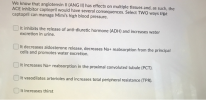 We know that angiotensin II (ANG II) has effects on multiple tissues and, as such, the ACE inhibitor captopril would have several consequences. Select TWO ways that captopril can manage Mimi's high blood pressure. It inhibits the release of anti-diuretic hormone (ADH) and increases water excretion in urine. It decreases aldosterone release, decreases Na+ reabsorption from the principal cells and promotes water excretion. It increases Na+ reabsorption in the proximal convoluted tubule (PCT). It vasodilates arterioles and increases total peripheral...
2. Captopril was the first of a class of blood-pressure lowering drugs that work by reversibly...
 2. Captopril was the first of a class of blood-pressure lowering drugs that work by reversibly inhibiting Angiotension-converting enzyme (ACE). Later to the market was Lisinopril. This class of drugs is the fifth most prescribed, approaching 200 million prescriptions per year in the US alone. ACE inhibitors work by preventing the proteolytic cleavage of angiotensin I by ACE to create its active form angiotensin II, which binds to receptors in the walls of blood vessels to initiate their relaxation, reducing...
only need answer for question d and e. thanks 2. Captopril was the first of a...
 only need answer for question d and e. thanks
2. Captopril was the first of a class of blood pressure lowering drugs that work by reversibly inhibiting Angiotension-converting enzyme (ACE). Later to the market was Lisinopril. This class of drugs is the fifth most prescribed, approaching 200 million prescriptions per year in the US alone. ACE inhibitors work by preventing the proteolytic cleavage of angiotensin I by ACE to create its active form angiotensin II, which binds to receptors in...
only need answer for question d and e. thanks
2. Captopril was the first of a class of blood pressure lowering drugs that work by reversibly inhibiting Angiotension-converting enzyme (ACE). Later to the market was Lisinopril. This class of drugs is the fifth most prescribed, approaching 200 million prescriptions per year in the US alone. ACE inhibitors work by preventing the proteolytic cleavage of angiotensin I by ACE to create its active form angiotensin II, which binds to receptors in...
Extract the following information from the abstract: Effects of an angiotensin-converting-enzyme inhibitor, ramipril, on cardiovascular events...
Extract the following information from the abstract: Effects of an angiotensin-converting-enzyme inhibitor, ramipril, on cardiovascular events in high-risk patients. Abstract BACKGROUND: We assessed the role of an angiotensin-converting-enzyme inhibitor, ramipril, in patients who were at high risk for cardiovascular events. METHODS: A total of 9297 high-risk patients (55 years of age or older) who had evidence of vascular disease or diabetes plus one other cardiovascular risk factor were randomly assigned to receive ramipril (10 mg once per day orally) or...
Using a table format, identify the three normal controls of blood pressure and how angiotensin-converting enzyme...
Using a table format, identify the three normal controls of blood pressure and how angiotensin-converting enzyme (ACE) inhibitors, angiotensin II receptor blockers (ARBs), calcium channel blockers, and vasodilator affect these controls. There are several classifications of antihypertensive medications used for control of hypertension. Some classifications are more commonly used specific population. What are the common concerns with the use of specific classifications of antihypertensive across the lifespan? .Many older adults are prescribed antianginal drugs. What factors make these patients, more...
8. What enzyme is used in the bicarbonate buffer system? A. Angiotensin Converting Enzyme B. Pepsin...
 8. What enzyme is used in the bicarbonate buffer system? A. Angiotensin Converting Enzyme B. Pepsin C. Trypsin D. Carbonic Anhydrase
A 1.00 mL blank serum sample was spiked with 46.9×10⁻⁹ g of lisinopril, an angiotensin-converting enzyme...
A 1.00 mL blank serum sample was spiked with 46.9×10⁻⁹ g of lisinopril, an angiotensin-converting enzyme inhibitor primarily used in the treatment of hypertension. The serum was prepared and analyzed using the normal laboratory method for the analysis of lisinopril that had previously been calibrated with aqueous lisinopril standards. The analysis of the spiked sample showed a measured lisinopril concentration of 45.8 μg/L. What is the percent recovery for lisinopril?
Bioprocces , enzyme kinetics 2. Angiotensin ll is a chemical that induces the increase of blood...
 Bioprocces , enzyme kinetics
2. Angiotensin ll is a chemical that induces the increase of blood pressure. By inhibiting the activity of Angiotensin Converting Enzyme (ACE), which produces angiotensin I, hypertension (high blood pressure) can be treated. A potential inhibitor has been developed, and the kinetic data together with inhibition kinetic data, obtained by ACE reaction with and without an inhibitor, are shown in the following table. Initial reaction rate (mM/h) Substrate concentration No Inhibitor 1.95 mM Inhibitor (mM) 0.25...
Bioprocces , enzyme kinetics
2. Angiotensin ll is a chemical that induces the increase of blood pressure. By inhibiting the activity of Angiotensin Converting Enzyme (ACE), which produces angiotensin I, hypertension (high blood pressure) can be treated. A potential inhibitor has been developed, and the kinetic data together with inhibition kinetic data, obtained by ACE reaction with and without an inhibitor, are shown in the following table. Initial reaction rate (mM/h) Substrate concentration No Inhibitor 1.95 mM Inhibitor (mM) 0.25...
angiotensin converting enzyme inhibitors are a central part of the treatment of heart failure because they...
angiotensin converting enzyme inhibitors are a central part of the treatment of heart failure because they have more than one action to address the pathological changes in this disorder. which of the following pathological changes in heart failure is not addressed by ace inhibitors ? a. changes in the structure of the left ventricle so that it dilates, hypertrophies, and uses energy less efficiently b. reduced formation of cross bridges so that contractile force decreases c. activation of the sympathetic...
 We know that angiotensin II (ANG II) has effects on multiple tissues and, as such, the ACE inhibitor captopril would have several consequences. Select TWO ways that captopril can manage Mimi's high blood pressure. It inhibits the release of anti-diuretic hormone (ADH) and increases water excretion in urine. It decreases aldosterone release, decreases Na+ reabsorption from the principal cells and promotes water excretion. It increases Na+ reabsorption in the proximal convoluted tubule (PCT). It vasodilates arterioles and increases total peripheral...
 2. Captopril was the first of a class of blood-pressure lowering drugs that work by reversibly inhibiting Angiotension-converting enzyme (ACE). Later to the market was Lisinopril. This class of drugs is the fifth most prescribed, approaching 200 million prescriptions per year in the US alone. ACE inhibitors work by preventing the proteolytic cleavage of angiotensin I by ACE to create its active form angiotensin II, which binds to receptors in the walls of blood vessels to initiate their relaxation, reducing...
 only need answer for question d and e. thanks
2. Captopril was the first of a class of blood pressure lowering drugs that work by reversibly inhibiting Angiotension-converting enzyme (ACE). Later to the market was Lisinopril. This class of drugs is the fifth most prescribed, approaching 200 million prescriptions per year in the US alone. ACE inhibitors work by preventing the proteolytic cleavage of angiotensin I by ACE to create its active form angiotensin II, which binds to receptors in...
only need answer for question d and e. thanks
2. Captopril was the first of a class of blood pressure lowering drugs that work by reversibly inhibiting Angiotension-converting enzyme (ACE). Later to the market was Lisinopril. This class of drugs is the fifth most prescribed, approaching 200 million prescriptions per year in the US alone. ACE inhibitors work by preventing the proteolytic cleavage of angiotensin I by ACE to create its active form angiotensin II, which binds to receptors in...
 8. What enzyme is used in the bicarbonate buffer system? A. Angiotensin Converting Enzyme B. Pepsin C. Trypsin D. Carbonic Anhydrase
 Bioprocces , enzyme kinetics
2. Angiotensin ll is a chemical that induces the increase of blood pressure. By inhibiting the activity of Angiotensin Converting Enzyme (ACE), which produces angiotensin I, hypertension (high blood pressure) can be treated. A potential inhibitor has been developed, and the kinetic data together with inhibition kinetic data, obtained by ACE reaction with and without an inhibitor, are shown in the following table. Initial reaction rate (mM/h) Substrate concentration No Inhibitor 1.95 mM Inhibitor (mM) 0.25...
Bioprocces , enzyme kinetics
2. Angiotensin ll is a chemical that induces the increase of blood pressure. By inhibiting the activity of Angiotensin Converting Enzyme (ACE), which produces angiotensin I, hypertension (high blood pressure) can be treated. A potential inhibitor has been developed, and the kinetic data together with inhibition kinetic data, obtained by ACE reaction with and without an inhibitor, are shown in the following table. Initial reaction rate (mM/h) Substrate concentration No Inhibitor 1.95 mM Inhibitor (mM) 0.25...
Most questions answered within 3 hours.
-
Where is the error in this code sequence?
String s1 = "Hello";
String s2 = "ello";...
asked 10 months ago -
Financial data for Joel de Paris, Inc., for last year
follow:
Joel de Paris, Inc.
Balance...
asked 10 months ago -
Consider this reaction:
Al2(SO4)3 (aq)+ BaCl3
(aq) Al2Cl6 (aq)- +
3BaSO4(s) . What is the...
asked 10 months ago -
Suppose that Savneet is considering increasing her
recent random sample from 20 car rentals to 40...
asked 10 months ago -
Trucks arrive at an unloading terminal at an average rate of 120
per hour.
Trucks arrive...
asked 10 months ago -
Why are methanol and ethanol completely soluble in water while
octanol is not very little soluble....
asked 10 months ago -
A facilities manager at a university reads in a research report
that the mean amount of...
asked 10 months ago -
When the CuSO4 is rehydrated by adding water to the anhydrous
compound, is this an endothermic...
asked 10 months ago -
A ray of sunlight is passing from diamond into crown glass; the
angle of incidence is...
asked 10 months ago -
A block of mass 0.249 kg is placed on top of a light, vertical
spring of...
asked 10 months ago -
how do the kidneys compensate in the presences of acidosis
a) trigger hyperventilate
b) reserve acid...
asked 10 months ago -
Question 501 pts
The rental rate of capital to the firm increases. Which of the
following...
asked 10 months ago