python/idle 1. Write a program that counts the number of A’s in a DNA sequence. The...
Homework Answers
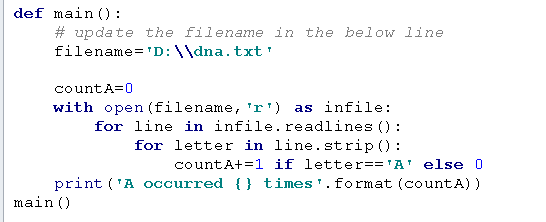
thanks for the question, here is the program in python.
Note:
# update the filename in the below
line
filename='D:\\dna.txt'
============================================================
def main():
# update the filename in the below
line
filename='D:\\dna.txt'
countA=0
with
open(filename,'r') as
infile:
for
line in infile.readlines():
for letter in line.strip():
countA+=1 if letter=='A'
else 0
print('A occurred {}
times'.format(countA))
main()
============================================================
Add Answer to:
python/idle
1. Write a program that counts the number of A’s in a DNA
sequence. The...
Write a Python program that converts an input file in FASTA format, called "fasta.txt", to an...
Write a Python program that converts an input file in FASTA format, called "fasta.txt", to an output file in PHYLIP format called "phylip.txt". For example, if the input file contains: >human ACCGTTATAC CGATCTCGCA >chimp ACGGTTATAC CGTACGATCG >monkey ACCTCTATAC CGATCGATCC >gorilla ATCTATATAC CGATCGATCG Then the output file should be human ACCGTTATACCGATCTCGCA chimp ACGGTTATACCGTACGATCG monkey ACCTCTATACCGATCGATCC gorilla ATCTATATACCGATCGATCG FASTA format has a description (indicated with a '>') followed by 1 or more lines of a DNA sequence. PHYLIP format has a description...
Write a Python function makeDict() that takes a filename as a parameter. The file contains DNA...
Write a Python function makeDict() that takes a filename as a parameter. The file contains DNA sequences in Fasta format, for example: >human ATACA >mouse AAAAAACT The function returns a dictionary of key:value pairs, where the key is the taxon name and the valus is the total number of 'A' and 'T' occurrences. For example, for if the file contains the data from the example above the function should return: {'human':4,'mouse':7}
In python Attached is a file called sequences.txt, it contains 3 sequences (one sequence per line)....
In python Attached is a file called sequences.txt, it contains 3 sequences (one sequence per line). Also attached is a file called AccessionNumbers.txt. Write a program that reads in those files and produces 3 separate FATSA files. Each accession number in the AccessionNumbers.txt file corresponds to a sequence in the sequences.txt file. Remember a FASTA formatted sequence looks like this: >ABCD1234 ATGCTTTACGTCTACTGTCGTATGCTTTACGTCTACTGACTGTCGTATGCTTACGTCTACTGTCG The file name should match the accession numbers, so for 1st one it should be called ABCD1234.txt. Note:...
In python Attached is a file called sequences.txt, it contains 3 sequences (one sequence per line)....
In python Attached is a file called sequences.txt, it contains 3 sequences (one sequence per line). Also attached is a file called AccessionNumbers.txt. Write a program that reads in those files and produces 3 separate FATSA files. Each accession number in the AccessionNumbers.txt file corresponds to a sequence in the sequences.txt file. Remember a FASTA formatted sequence looks like this: >ABCD1234 ATGCTTTACGTCTACTGTCGTATGCTTTACGTCTACTGACTGTCGTATGCTTACGTCTACTGTCG The file name should match the accession numbers, so for 1st one it should be called ABCD1234.txt. Note:...
Write a PYTHON program that tests to see whether a sequence has an AT repeat. For...
Write a PYTHON program that tests to see whether a sequence has an AT repeat. For this problem, we’ll define a repeat as 3 or more occurrences of AT, i.e. ATATAT…etc. Read in the sequence from a file (in FASTA format) to test your code. You can use the attached “Test.txt” sequence. Return a message to the user whether or not an AT repeat exits in the sequence. Use at least one function. Test.txt : >TestSeq ATGCTTTACGTCTACTGTCGTATGCTTTACGTCTACTGACTGTCGTATGCTTACGTCTACTGTCG TGCTTTACGTCTACTGACTGTCGTATATATATATATATATTGCTTTACGTCTACTGACTGTCGTA
Write a PYTHON program that asks the user for the name of the file. The program...
Write a PYTHON program that asks the user for the name of the file. The program should write the contents of this input file to an output file. In the output file, each line should be preceded with a line number followed by a colon. The output file will have the same name as the input filename, preceded by “ln” (for linenumbers). Be sure to use Try/except to catch all exceptions. For example, when prompted, if the user specifies “sampleprogram.py”...
Write a program that loads a file called "sample.txt" in read mode, reads its content, and...
Write a program that loads a file called "sample.txt" in read mode, reads its content, and closes the file. Use exception handling to catch any errors. 2. Compute the letter and punctuation distribution in the file. That is, output the number of a’s, the number of b’s, etc. and the number of commas, dashes, and periods. Ignore case when computing this, so ‘A’ and ‘a’ are the same letter. Use lists. 3. Compute the number of words in the file....
USE IDLE PLATFORM FOR PYTHON PLEASE Write a Python program that creates a list that contains...
USE IDLE PLATFORM FOR PYTHON PLEASE Write a Python program that creates a list that contains players of your favorite teams. The program then should ask the user to enter the name of a player. If the player is in your list, display a message indicating that the player is in the team. Otherwise, the program should display a message stating that the player isn't on the team.
python Write a program that calculates the AT and GC content (i.e. the percentage of G...
python Write a program that calculates the AT and GC content (i.e. the percentage of G and C, and the percentage of A and T) in a given sequence. You can make up your own dummy sequence and store it in text file (use something like Notepad, not word!). Your program should read in the sequence from the file and calculate the GC and AT content. Print out the results to a file called DNA_Statistics.txt, the result should look something...
average_value_in_file / Python 3.x: Your assistance is appreciated, thank you! Write a function named average_value_in_file that...
average_value_in_file / Python 3.x: Your assistance is appreciated, thank you! Write a function named average_value_in_file that accepts a file name as a parameter and reads that file, assumed to be full of numbers, and returns the average (mean) of the numbers in that file. The parameter, filename, gives the name of a file that contains a list of numbers, one per line. You may assume that the file exists and follows the proper format. For example, if a file named...
Most questions answered within 3 hours.
-
Where is the error in this code sequence?
String s1 = "Hello";
String s2 = "ello";...
asked 11 months ago -
Financial data for Joel de Paris, Inc., for last year
follow:
Joel de Paris, Inc.
Balance...
asked 11 months ago -
Consider this reaction:
Al2(SO4)3 (aq)+ BaCl3
(aq) Al2Cl6 (aq)- +
3BaSO4(s) . What is the...
asked 11 months ago -
Suppose that Savneet is considering increasing her
recent random sample from 20 car rentals to 40...
asked 11 months ago -
Trucks arrive at an unloading terminal at an average rate of 120
per hour.
Trucks arrive...
asked 11 months ago -
Why are methanol and ethanol completely soluble in water while
octanol is not very little soluble....
asked 11 months ago -
A facilities manager at a university reads in a research report
that the mean amount of...
asked 11 months ago -
When the CuSO4 is rehydrated by adding water to the anhydrous
compound, is this an endothermic...
asked 11 months ago -
A ray of sunlight is passing from diamond into crown glass; the
angle of incidence is...
asked 11 months ago -
A block of mass 0.249 kg is placed on top of a light, vertical
spring of...
asked 11 months ago -
how do the kidneys compensate in the presences of acidosis
a) trigger hyperventilate
b) reserve acid...
asked 11 months ago -
Question 501 pts
The rental rate of capital to the firm increases. Which of the
following...
asked 11 months ago