Your textbook states that, in the long run, representative firms in monopolistically competitive markets will just...
Your textbook states that, in the long run, representative firms in monopolistically competitive markets will just break even --- that is, earn zero economic profits. Yet some firms in highly competitive markets manage to continue to earn economic profits indefinitely. For example, perfumes, cosmetics, and hair care firm L’Oreal, in business since 1907, remains highly profitable today, despite competing in fiercely competitive product categories. How has L’Oreal managed to stay profitable for so long (clue: they have a research and development staff of over 1000 people)
Homework Answers
Some companies like hair care firm L’Oreal continue to remain profitable despite competing in fiercely competitive product categories for so long because they have been able to maintain their brand value for all the years. Their selling and marketing cost is also high which creates product differentiation for their product and differentiate their product from other similar firms in the market. Also the company spends huge amount of money on research and development. These factors lead to super normal profits for the firm in the long run despite the firm being in monopolistic competition.
Add Answer to:
Your textbook states that, in the long run, representative firms
in monopolistically competitive markets will just...
Your textbook states that, in the long run, representative firms in monopolistically competitive markets will just...
Your textbook states that, in the long run, representative firms in monopolistically competitive markets will just break even --- that is, earn zero economic profits. Yet some firms in highly competitive markets manage to continue to earn economic profits indefinitely. For example, perfumes, cosmetics, and hair care firm L’Oreal, in business since 1907, remains highly profitable today, despite competing in fiercely competitive product categories. How has L’Oreal managed to stay profitable for so long (clue: they have a research and...
16. If firms in a monopolistically competitive market are earning positive profits, then a. firms will likely be su...
 16. If firms in a monopolistically competitive market are earning positive profits, then a. firms will likely be subject to regulation. b. barriers to entry will be strengthened. c. some firms will exit the market. d. new firms will enter the market. 17. As new firms enter a monopolistically competitive market, profits of existing firms a. rise, and product diversity in the market decreases. b. decline, and product diversity in the market increases. c. rise, and product diversity in the...
In the long run, firms in monopolistically competitive markets operate O A. at optimal capacity because...
 In the long run, firms in monopolistically competitive markets operate O A. at optimal capacity because they have perfectly elastic demand curves O B. with excess capacity because they face downward-sloping demand curves. O c. with excess capacity because they face perfectly elastic demand curves. OD. at optimal capacity because they face downward-sloping demand curves The figure to the right depicts the short run outcome for a firm in a monopolistically competitive industry To maximize profits this for should produce...
In the long run firms in monopolistically competitive markets operate O A. with excess capacity because...
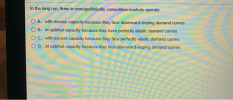 In the long run firms in monopolistically competitive markets operate O A. with excess capacity because they face downward-sloping demand curves. O B. at optimal capacity because they have perfectly elastic demand curves. O c. with excess capacity because they face perfectly elastic demand curves. D. at optimal capacity because they face downward-sloping demand curves. In the long run, firms in monopolistically competitive markets operate O A. with excess capacity because they face downward-sloping demand curves O B. at optimal...
In theory, in the long run, monopolistically competitive firms earns zero profits. However, in reality there...
In theory, in the long run, monopolistically competitive firms earns zero profits. However, in reality there are some ways by which a firm can avoid losing profits. Which of the following is one such way? A) gradually increase the mark up on the goods produced B) lower the price of its products to expand its market share C) identify new markets and develop products precisely for those markets D) find a market niche and keep it as narrow as possible...
QUESTION 6 In the short run, a monopolistically competitive firm. O makes profits just as it...
 QUESTION 6 In the short run, a monopolistically competitive firm. O makes profits just as it does in the long run because of barriers to entry O will earn zero economic because of free entry and exit. O produces where MR-MC O produces where PEMC QUESTION 7 In the long run, a monopolistically competitive firm: O makes profits just as it does in the short run because of barriers to entry will earn zero economic because of free entry and...
Suppose that firms in a monopolistically competitive industry are making positive profits in the short run....
Suppose that firms in a monopolistically competitive industry are making positive profits in the short run. Select the correct answers below to describe what will happen in this industry in the long run. Since profits are greater than zero, firms will enter/exit As this occurs, demand for each firm will, increase/decrease/stay the same This will continue until, profits increase/decrease/equal zero At this point, P=ATC/P=MR/P=MC
Classify each market characteristic as being a trait of competitive markets, monopolistically competitive markets, or both...
 Classify each market characteristic as being a trait of competitive markets, monopolistically competitive markets, or both market structures. Competitive Markets Monopolistically Competitive Markets Both Market Structures Answer Bank Differentiated goods Few, if any, barriers to entry No one buyer or seller can control prices Many buyers and sellers Identical/homogenous goods Match each example to the market structure it is most likely to belong to. Perfect (pure) competition Monopolistic competition Oligopoly Monopoly Answer Bank Carl's Taco Truck, one of many food...
Advertising is most widely seen in monopolistically competitive markets and oligopoly markets. True False In the...
 Advertising is most widely seen in monopolistically competitive markets and oligopoly markets. True False In the long run, only monopolists and oligopolists can make positive economic profits. True False When markets do not lead to the most efficient allocation of resources for society as a whole, then there has occurred market failure. True False The most efficient point of production occurs at the bottom of the average total cost (ATC) curve. True False Oligopoly markets are different from other market...
In the (short, long) run, monopolistically competitive firms will make (large,zero,or small) economics profits- that is,...
In the (short, long) run, monopolistically competitive firms will make (large,zero,or small) economics profits- that is, they will make a (normal, disappointing), rate of return. Pick the answers out of the choices in the parentheses.
 16. If firms in a monopolistically competitive market are earning positive profits, then a. firms will likely be subject to regulation. b. barriers to entry will be strengthened. c. some firms will exit the market. d. new firms will enter the market. 17. As new firms enter a monopolistically competitive market, profits of existing firms a. rise, and product diversity in the market decreases. b. decline, and product diversity in the market increases. c. rise, and product diversity in the...
 In the long run, firms in monopolistically competitive markets operate O A. at optimal capacity because they have perfectly elastic demand curves O B. with excess capacity because they face downward-sloping demand curves. O c. with excess capacity because they face perfectly elastic demand curves. OD. at optimal capacity because they face downward-sloping demand curves The figure to the right depicts the short run outcome for a firm in a monopolistically competitive industry To maximize profits this for should produce...
 In the long run firms in monopolistically competitive markets operate O A. with excess capacity because they face downward-sloping demand curves. O B. at optimal capacity because they have perfectly elastic demand curves. O c. with excess capacity because they face perfectly elastic demand curves. D. at optimal capacity because they face downward-sloping demand curves. In the long run, firms in monopolistically competitive markets operate O A. with excess capacity because they face downward-sloping demand curves O B. at optimal...
 QUESTION 6 In the short run, a monopolistically competitive firm. O makes profits just as it does in the long run because of barriers to entry O will earn zero economic because of free entry and exit. O produces where MR-MC O produces where PEMC QUESTION 7 In the long run, a monopolistically competitive firm: O makes profits just as it does in the short run because of barriers to entry will earn zero economic because of free entry and...
 Classify each market characteristic as being a trait of competitive markets, monopolistically competitive markets, or both market structures. Competitive Markets Monopolistically Competitive Markets Both Market Structures Answer Bank Differentiated goods Few, if any, barriers to entry No one buyer or seller can control prices Many buyers and sellers Identical/homogenous goods Match each example to the market structure it is most likely to belong to. Perfect (pure) competition Monopolistic competition Oligopoly Monopoly Answer Bank Carl's Taco Truck, one of many food...
 Advertising is most widely seen in monopolistically competitive markets and oligopoly markets. True False In the long run, only monopolists and oligopolists can make positive economic profits. True False When markets do not lead to the most efficient allocation of resources for society as a whole, then there has occurred market failure. True False The most efficient point of production occurs at the bottom of the average total cost (ATC) curve. True False Oligopoly markets are different from other market...
Most questions answered within 3 hours.
-
Where is the error in this code sequence?
String s1 = "Hello";
String s2 = "ello";...
asked 10 months ago -
Financial data for Joel de Paris, Inc., for last year
follow:
Joel de Paris, Inc.
Balance...
asked 10 months ago -
Consider this reaction:
Al2(SO4)3 (aq)+ BaCl3
(aq) Al2Cl6 (aq)- +
3BaSO4(s) . What is the...
asked 10 months ago -
Suppose that Savneet is considering increasing her
recent random sample from 20 car rentals to 40...
asked 10 months ago -
Trucks arrive at an unloading terminal at an average rate of 120
per hour.
Trucks arrive...
asked 10 months ago -
Why are methanol and ethanol completely soluble in water while
octanol is not very little soluble....
asked 10 months ago -
A facilities manager at a university reads in a research report
that the mean amount of...
asked 10 months ago -
When the CuSO4 is rehydrated by adding water to the anhydrous
compound, is this an endothermic...
asked 10 months ago -
A ray of sunlight is passing from diamond into crown glass; the
angle of incidence is...
asked 10 months ago -
A block of mass 0.249 kg is placed on top of a light, vertical
spring of...
asked 10 months ago -
how do the kidneys compensate in the presences of acidosis
a) trigger hyperventilate
b) reserve acid...
asked 10 months ago -
Question 501 pts
The rental rate of capital to the firm increases. Which of the
following...
asked 10 months ago