Using Le Chatelier's Principle, What will happen to the number of moles of SO3 in equilibrium...
Using Le Chatelier's Principle, What will happen to the number of moles of SO3 in equilibrium with SO2 and O2 in the reaction? 2SO3(g) ⇌ 2SO2(g) + O2(g) in each of the following cases:
1. Oxygen is added to reaction container.
2. The pressure is increased by decreasing the volume of the reaction container.
3. In the rigid container (i.e. constant volume), the pressure is increased by adding argon gas.
4. The temperature of the reaction container is decreased (Note: decomposition reaction is endothermic).
5. Gaseous sulfur dioxide is removed from reaction container.
Homework Answers
According to Le chartelier principle
1) If increase the pressure of the reaction, it proceeds towards the direction where upon less number of moles
2)Endo thermic reaction favourable at
high temperature
Add Answer to:
Using Le Chatelier's Principle, What will happen to the number
of moles of SO3 in equilibrium...
2. What will happen to the number of moles of So, in equilibrium with SO2 and...
 2. What will happen to the number of moles of So, in equilibrium with SO2 and O, in the reaction in each of the following cases? 250,(8) 250.(8) + ($) a. Oxygen gas is added. b. In a rigid reaction container, the pressure is increased. e. The temperature is decreased the reaction is endothermic). d. Gaseous sulfur dioxide is removed. 3. An initial mixture of nitrogen gas and hydrogen gas is reacted in a rigid container at a certain temperature...
1) The reaction below is exothermic 2SO2 (g) + O2(g) = 2803(g) + heat Le Châtelier's...
1) The reaction below is exothermic 2SO2 (g) + O2(g) ⇌ 2SO3(g) + heat Le Châtelier's Principle predicts that _______ will result in an increase in the number of moles of SO3 (g) in the reaction container. Which direction will the reaction shift: ? left or right A) increasing the volume of the container B) increasing the amount of SO2 C) removing some oxygen D) increasing the temperature E) decreasing the pressure 2) Consider the following reaction at equilibrium: 2SO2 (g) + O2 (g) ⇌ 2SO3 (g) + heat ΔH...
Le Chatelier's Principle
Is the statement true or false, with respect to the specified reaction in each case?H2(g) + F2(g)<-->2HF(g)If a vessel, containing an equilbrium mixture of these gases, is pressurized by adding helium gas, then the equilibrium position will shift to the right.2SO3(g)<-->2SO2(g) + O2(g)If an equilbrium mixture of these gases is released into a vessel of larger volume, then the equilibrium position will shift to the right.Fe3+(aq) + SCN-(aq)<-->FeSCN2+(aq)If KOH is dissolved in this solution, then the equilibrium position will shift...
This equilibrium reaction is exothermic: 2SO2 (g) + O2 (g) <-> 2SO3 (g) (where <-> indicates equilibrium,...
This equilibrium reaction is exothermic: 2SO2 (g) + O2 (g) <-> 2SO3 (g) (where <-> indicates equilibrium, or double headed arrows) Le Châtelier's principle predicts that __________ will result in an increase in the number of moles of SO3(g) in the reaction container. A) decreasing the liquid level B) removing some oxygen C) increasing the pressure D) increasing the volume of the container E) decreasing the pressure
One step in the manufacture of sulfuric acid is the oxidation of SO2 gas to SO3:...
One step in the manufacture of sulfuric acid is the oxidation of SO2 gas to SO3: 2SO2 (g) + O2 (g) 2SO3 (g) ΔH = ‒196 kJ mol–1 This reaction is usually performed at 698 K and 1-2 atmospheres of pressure. 2. Use Le Chatelier’s principle to explain why decreasing the temperature of the reaction vessel to 298 K should theoretically increase the yield of SO3 (g)
17. Le Chatelier's Principle: pressure effects Consider the following system at equilibrium at 346 K: If...
 17. Le Chatelier's Principle: pressure effects Consider the following system at equilibrium at 346 K: If the volume of the equilibrium system is suddenly increased at constant temperature: The reaction must: A. Run in the lorward direction to reestablish equiiorium B. Run in the reverse direction to reestablish equilibrium. C. Remain the same. Already at equilibrium. The number of moles of Br2 will: A. Increase. 8. Decrease. C. Remain the same. 18. Le Chatelier's Principle: mutiple etlects Consider the following...
5. Use Le Chatelier's principle to determine whether the equilibrium for the exothermic reaction below shifts...
 5. Use Le Chatelier's principle to determine whether the equilibrium for the exothermic reaction below shifts to the left, right, or does not change under each condition listed: N2(g) + 3H2(g) 2NH3(1) a. Some hydrogen is added b. A catalyst is added C. The temperature is raised d. The pressure is decreased by increasing the volume of the container
those are the 3 optiond Le Chatelier B07 Consider the following exothermic reaction at equilibrium: 2SO2(g)...
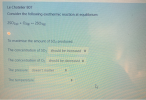 those are the 3 optiond
Le Chatelier B07 Consider the following exothermic reaction at equilibrium: 2SO2(g) + O2(g) +- 25O3() To maximise the amount of SO2 produced: The concentration of SO3 should be increased The concentration of Oz should be decreased The pressure doesn't matter 4 The temperature <
those are the 3 optiond
Le Chatelier B07 Consider the following exothermic reaction at equilibrium: 2SO2(g) + O2(g) +- 25O3() To maximise the amount of SO2 produced: The concentration of SO3 should be increased The concentration of Oz should be decreased The pressure doesn't matter 4 The temperature <
1. Consider the following reaction at equilibrium. 4 FeS2(s) + 11 O2(g) ⇌ 2 Fe2O3(s) + 8 SO2(g)...
1. Consider the following reaction at equilibrium. 4 FeS2(s) + 11 O2(g) ⇌ 2 Fe2O3(s) + 8 SO2(g) a. What will happen if the pressure increased? b. What will happen if the concentration of FeS2(s) is decreased? 2) The following reaction is exothermic: What direction will the equilibrium shift if the following changes are made? 2 SO2(g) + O2(g) ⇌ 2 SO3(g) a) Raising the temperature b) Adding SO3 c) Removing O2 d) Decreasing the volume
For the endothermic reaction CACO3(s) CaO(s) +CO2(8) Le Chatelier's principle predicts that will result in an...
 For the endothermic reaction CACO3(s) CaO(s) +CO2(8) Le Chatelier's principle predicts that will result in an increase in the number of moles of CO2. increasing the temperature decreasing the temperature increasing the pressure removing some of the CaCO3 (s) none of these
 2. What will happen to the number of moles of So, in equilibrium with SO2 and O, in the reaction in each of the following cases? 250,(8) 250.(8) + ($) a. Oxygen gas is added. b. In a rigid reaction container, the pressure is increased. e. The temperature is decreased the reaction is endothermic). d. Gaseous sulfur dioxide is removed. 3. An initial mixture of nitrogen gas and hydrogen gas is reacted in a rigid container at a certain temperature...
 17. Le Chatelier's Principle: pressure effects Consider the following system at equilibrium at 346 K: If the volume of the equilibrium system is suddenly increased at constant temperature: The reaction must: A. Run in the lorward direction to reestablish equiiorium B. Run in the reverse direction to reestablish equilibrium. C. Remain the same. Already at equilibrium. The number of moles of Br2 will: A. Increase. 8. Decrease. C. Remain the same. 18. Le Chatelier's Principle: mutiple etlects Consider the following...
 5. Use Le Chatelier's principle to determine whether the equilibrium for the exothermic reaction below shifts to the left, right, or does not change under each condition listed: N2(g) + 3H2(g) 2NH3(1) a. Some hydrogen is added b. A catalyst is added C. The temperature is raised d. The pressure is decreased by increasing the volume of the container
 those are the 3 optiond
Le Chatelier B07 Consider the following exothermic reaction at equilibrium: 2SO2(g) + O2(g) +- 25O3() To maximise the amount of SO2 produced: The concentration of SO3 should be increased The concentration of Oz should be decreased The pressure doesn't matter 4 The temperature <
those are the 3 optiond
Le Chatelier B07 Consider the following exothermic reaction at equilibrium: 2SO2(g) + O2(g) +- 25O3() To maximise the amount of SO2 produced: The concentration of SO3 should be increased The concentration of Oz should be decreased The pressure doesn't matter 4 The temperature <
 For the endothermic reaction CACO3(s) CaO(s) +CO2(8) Le Chatelier's principle predicts that will result in an increase in the number of moles of CO2. increasing the temperature decreasing the temperature increasing the pressure removing some of the CaCO3 (s) none of these
Most questions answered within 3 hours.
-
Where is the error in this code sequence?
String s1 = "Hello";
String s2 = "ello";...
asked 11 months ago -
Financial data for Joel de Paris, Inc., for last year
follow:
Joel de Paris, Inc.
Balance...
asked 11 months ago -
Consider this reaction:
Al2(SO4)3 (aq)+ BaCl3
(aq) Al2Cl6 (aq)- +
3BaSO4(s) . What is the...
asked 11 months ago -
Suppose that Savneet is considering increasing her
recent random sample from 20 car rentals to 40...
asked 11 months ago -
Trucks arrive at an unloading terminal at an average rate of 120
per hour.
Trucks arrive...
asked 11 months ago -
Why are methanol and ethanol completely soluble in water while
octanol is not very little soluble....
asked 11 months ago -
A facilities manager at a university reads in a research report
that the mean amount of...
asked 11 months ago -
When the CuSO4 is rehydrated by adding water to the anhydrous
compound, is this an endothermic...
asked 11 months ago -
A ray of sunlight is passing from diamond into crown glass; the
angle of incidence is...
asked 11 months ago -
A block of mass 0.249 kg is placed on top of a light, vertical
spring of...
asked 11 months ago -
how do the kidneys compensate in the presences of acidosis
a) trigger hyperventilate
b) reserve acid...
asked 11 months ago -
Question 501 pts
The rental rate of capital to the firm increases. Which of the
following...
asked 11 months ago