Let P(A) = 0.64, P(B | A) = 0.49, and P(B | Ac) = 0.24. Use...
Let P(A) = 0.64, P(B | A) = 0.49, and P(B | Ac) = 0.24. Use a probability tree to calculate the following probabilities: (Round your answers to 3 decimal places.)
| a. | P(Ac) | |
| b. | P(A ∩ B) | |
| P(Ac ∩ B) | ||
| c. | P(B) | |
| d. | P(A | B) |
Homework Answers

(Use computer) Let X represent a binomial random variable with n = 110 and p =...
(Use computer) Let X represent a binomial random variable with n = 110 and p = 0.19. Find the following probabilities. (Round your final answers to 4 decimal places.) a. P(X ≤ 20) b. P(X = 10) c. P(X > 30) d. P(X ≥ 25) (Use Computer) Let X represent a binomial random variable with n = 190 and p = 0.78. Find the following probabilities. (Round your final answers to 4 decimal places.) Probability a....
Consider the following discrete probability distribution. x 15 22 34 40 P(X = x) 0.13 0.49...
Consider the following discrete probability distribution. x 15 22 34 40 P(X = x) 0.13 0.49 0.24 0.14 a. Is this a valid probability distribution? Yes, because the probabilities add up to 1. No, because the gaps between x values vary. b. What is the probability that the random variable X is less than 38? (Round your answer to 2 decimal places.) c. What is the probability that the random variable X is between 10 and 28? (Round your answer...
If P(A) = 0.64, what is P(AC)? If necessary, round to 4 decimal places.
 If P(A) = 0.64, what is P(AC)? If necessary, round to 4 decimal places.
Let A and B be events such that A c B. Also, let P(A) = 0.30,...
 Let A and B be events such that A c B. Also, let P(A) = 0.30, and P(B) = 0.45. Calculate the following probabilities. Hints: Venn Diagrams will be useful. Remember the axioms of probability (a) P(AUB) (b) P(Ac) (c) P(An B) (d) P(Acn B)
Let P(X 14) = 0.31, P(14 < X 27) = 0.49, and P(X> 22) = 0.46....
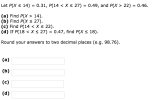 Let P(X 14) = 0.31, P(14 < X 27) = 0.49, and P(X> 22) = 0.46. (a) Find P(X > 14) (b) Find P(X S 27). (c) Find P(14 < X 22). (d) If P(18 < X 27) 0.47, find P(X 18). Round your answers to two decimal places (e.g. 98.76).
Let X be the number of material anomalies occurring in a particular region of an aircraft...
 Let X be the number of material anomalies occurring in a particular region of an aircraft gas-turbine disk. A researcher proposes a Poisson distribution for X. Suppose that ? = 6 The Poisson probability mass function is: P(x-fr 0,1,2.. Use the pmf to calculate probabilities. Verify these values in R using dpois(x,lambda) Compute the following probabilities: (Round your answers to three decimal places.) (a) P(X-3)- (c) P(X< 3) (d) PX 3)-
(Use computer) Let X represent a binomial random variable with n = 180 and p =...
(Use computer) Let X represent a binomial random variable with n = 180 and p = 0.23. Find the following probabilities. (Round your final answers to 4 decimal places.) a. P(X ≤ 45) b. P(X = 35) c. P(X > 55) d. P(X ≥ 50)
Consider the following probabilities: P(AC) 0.57, PB = 0.36, and P(A n B) 0.03 a. Find...
 Consider the following probabilities: P(AC) 0.57, PB = 0.36, and P(A n B) 0.03 a. Find P(A | BC). (Do not round intermediate calculations. Round your answer to 2 decimal places.) P(A | BC) b. Find P(BC | A). (Do not round intermediate calculations. Round your answer to 3 decimal places.) P(BC A) c. Are A and B independent events? Yes because PAI B = PA) Yes because PAN B)0 No because P(A I B)PA). No because PAN B)0
The following hypotheses are given. H0: p ≤ 0.49 H1: p > 0.49 A sample of...
The following hypotheses are given. H0: p ≤ 0.49 H1: p > 0.49 A sample of 142 observations revealed that = 0.39. At the 0.10 significance level, can the null hypothesis be rejected? a. State the decision rule. (Round the final answer to 3 decimal places.) Reject Correct H0 and and accept Correct H1 if z > 1.28 1.28 Incorrect or z < 1.28 1.28 Incorrect . b. Compute the value of the test statistic. (Round the final answer to...
Let X be a binomial random variable with p four decimal places (e.g. 98.7654) 10. Calculate...
 Let X be a binomial random variable with p four decimal places (e.g. 98.7654) 10. Calculate the following probabilities from the binomial probability mass function. Round your answers to 0.7 and n
 If P(A) = 0.64, what is P(AC)? If necessary, round to 4 decimal places.
 Let A and B be events such that A c B. Also, let P(A) = 0.30, and P(B) = 0.45. Calculate the following probabilities. Hints: Venn Diagrams will be useful. Remember the axioms of probability (a) P(AUB) (b) P(Ac) (c) P(An B) (d) P(Acn B)
 Let P(X 14) = 0.31, P(14 < X 27) = 0.49, and P(X> 22) = 0.46. (a) Find P(X > 14) (b) Find P(X S 27). (c) Find P(14 < X 22). (d) If P(18 < X 27) 0.47, find P(X 18). Round your answers to two decimal places (e.g. 98.76).
 Let X be the number of material anomalies occurring in a particular region of an aircraft gas-turbine disk. A researcher proposes a Poisson distribution for X. Suppose that ? = 6 The Poisson probability mass function is: P(x-fr 0,1,2.. Use the pmf to calculate probabilities. Verify these values in R using dpois(x,lambda) Compute the following probabilities: (Round your answers to three decimal places.) (a) P(X-3)- (c) P(X< 3) (d) PX 3)-
 Consider the following probabilities: P(AC) 0.57, PB = 0.36, and P(A n B) 0.03 a. Find P(A | BC). (Do not round intermediate calculations. Round your answer to 2 decimal places.) P(A | BC) b. Find P(BC | A). (Do not round intermediate calculations. Round your answer to 3 decimal places.) P(BC A) c. Are A and B independent events? Yes because PAI B = PA) Yes because PAN B)0 No because P(A I B)PA). No because PAN B)0
 Let X be a binomial random variable with p four decimal places (e.g. 98.7654) 10. Calculate the following probabilities from the binomial probability mass function. Round your answers to 0.7 and n
Most questions answered within 3 hours.
-
Where is the error in this code sequence?
String s1 = "Hello";
String s2 = "ello";...
asked 10 months ago -
Financial data for Joel de Paris, Inc., for last year
follow:
Joel de Paris, Inc.
Balance...
asked 10 months ago -
Consider this reaction:
Al2(SO4)3 (aq)+ BaCl3
(aq) Al2Cl6 (aq)- +
3BaSO4(s) . What is the...
asked 10 months ago -
Suppose that Savneet is considering increasing her
recent random sample from 20 car rentals to 40...
asked 10 months ago -
Trucks arrive at an unloading terminal at an average rate of 120
per hour.
Trucks arrive...
asked 10 months ago -
Why are methanol and ethanol completely soluble in water while
octanol is not very little soluble....
asked 10 months ago -
A facilities manager at a university reads in a research report
that the mean amount of...
asked 10 months ago -
When the CuSO4 is rehydrated by adding water to the anhydrous
compound, is this an endothermic...
asked 10 months ago -
A ray of sunlight is passing from diamond into crown glass; the
angle of incidence is...
asked 10 months ago -
A block of mass 0.249 kg is placed on top of a light, vertical
spring of...
asked 10 months ago -
how do the kidneys compensate in the presences of acidosis
a) trigger hyperventilate
b) reserve acid...
asked 10 months ago -
Question 501 pts
The rental rate of capital to the firm increases. Which of the
following...
asked 10 months ago