A small metal sphere, carrying a net charge of q1 = -2.70 μC , is held...
A small metal sphere, carrying a net charge of q1 = -2.70 μC , is held in a stationary position by insulating supports. A second small metal sphere, with a net charge of q2 = -7.50 μC and mass 1.70 g , is projected toward q1. When the two spheres are 0.800 m apart, q2 is moving toward q1 with speed 22.0 m/s (Figure 1). Assume that the two spheres can be treated as point charges.
What is the speed of q2 when the spheres are 0.400 m apart?
How close does q2 get to q1?
Homework Answers
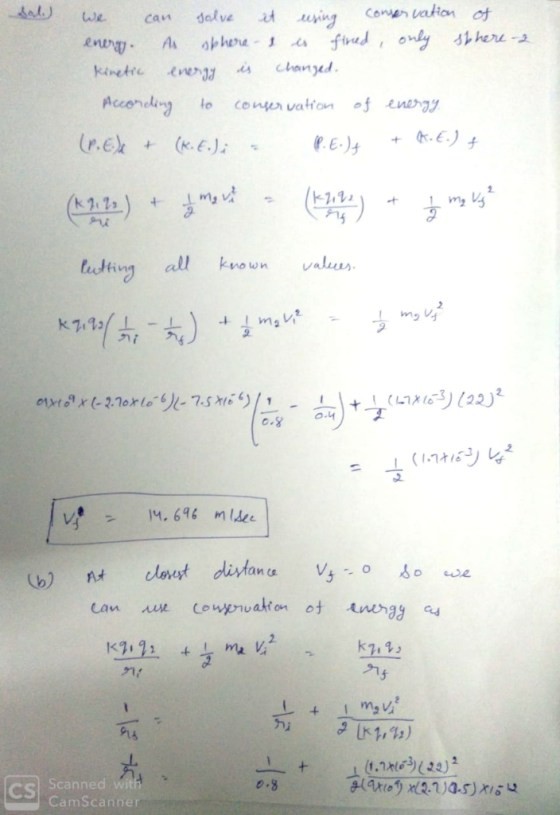

hope it helps...
Please give a thumbs up...
Comment for further clarifications...
To solve this problem, we can apply the principle of conservation of energy. The initial kinetic energy of sphere q2 is equal to the sum of the final kinetic energy and potential energy when the spheres are at a distance of 0.800 m apart. We can use this information to find the speed of q2 when the spheres are 0.400 m apart.
Let's denote the initial kinetic energy of q2 as K1, the final kinetic energy as K2, and the potential energy as U.
The initial kinetic energy of q2 is given by: K1 = (1/2) * m * v1^2
Where m is the mass of q2 and v1 is the initial speed of q2 (22.0 m/s).
The potential energy at a distance of 0.800 m apart is given by: U1 = k * (q1 * q2) / r1
Where k is the electrostatic constant (8.99 x 10^9 N*m^2/C^2), q1 is the charge of q1, q2 is the charge of q2, and r1 is the initial distance between the spheres (0.800 m).
The final kinetic energy of q2 when the spheres are 0.400 m apart is given by: K2 = (1/2) * m * v2^2
Where v2 is the final speed of q2.
The potential energy at a distance of 0.400 m apart is given by: U2 = k * (q1 * q2) / r2
Where r2 is the final distance between the spheres (0.400 m).
According to the principle of conservation of energy, the initial kinetic energy plus the initial potential energy is equal to the final kinetic energy plus the final potential energy: K1 + U1 = K2 + U2
Substituting the expressions for K1, U1, K2, and U2, we can solve for v2:
(1/2) * m * v1^2 + k * (q1 * q2) / r1 = (1/2) * m * v2^2 + k * (q1 * q2) / r2
Simplifying the equation, we get:
(1/2) * m * v1^2 - (1/2) * m * v2^2 = k * (q1 * q2) * (1/r2 - 1/r1)
Now we can solve for v2:
(1/2) * m * (v1^2 - v2^2) = k * (q1 * q2) * (1/r2 - 1/r1)
v2^2 = v1^2 - (2 * k * (q1 * q2) * (1/r2 - 1/r1)) / m
Finally, we can calculate v2 using the given values of q1, q2, m, v1, r1, and r2:
q1 = -2.70 μC q2 = -7.50 μC m = 1.70 g = 0.0017 kg v1 = 22.0 m/s r1 = 0.800 m r2 = 0.400 m
Substituting these values into the equation, we can solve for v2:
v2^2 = (22.0 m/s)^2 - (2 * (8.99 x 10^9 N*m^2/C^2) * (-2.70 x 10^-6 C) * (-7.50 x 10^-6 C) * (1/0.400 m - 1/0.800 m)) / 0.0017 kg
Simplifying the equation, we find:
v2^2 ≈ 485.88 m^2/s^2
Taking the square root of both sides, we get:
v2 ≈ 22.04 m/s
Therefore, the speed of q2 when the spheres are 0.400 m apart is approximately 22.04 m/s.
To determine how close q2 gets to q1, we can find the distance between the spheres at the closest approach. At the closest approach, the potential energy becomes zero. So we can set U2 = 0 and solve for r2:
0 = k * (q1 * q2) / r2
Simplifying the equation, we find:
r2 = k * (q1 * q2) / 0
Since the denominator is zero, we have an indeterminate form. This indicates that the spheres collide or come into contact with each other at the closest approach.
Add Answer to:
A small metal sphere, carrying a net charge of q1 = -2.70 μC ,
is held...
A small metal sphere, carrying a net charge of q1 = -2.70 μC ,is held...
 A small metal sphere, carrying a net charge of q1 = -2.70 μC ,
is held in a stationary position by insulating supports. A second
small metal sphere, with a net charge of q2 = -7.50 μC and mass
1.70 g , is projected toward q1. When the two spheres are 0.800 m
apart, q2 is moving toward q1 with speed 22.0 m/s(Figure 1). Assume
that the two spheres can be treated as point charges. You can
ignore the force...
A small metal sphere, carrying a net charge of q1 = -2.70 μC ,
is held in a stationary position by insulating supports. A second
small metal sphere, with a net charge of q2 = -7.50 μC and mass
1.70 g , is projected toward q1. When the two spheres are 0.800 m
apart, q2 is moving toward q1 with speed 22.0 m/s(Figure 1). Assume
that the two spheres can be treated as point charges. You can
ignore the force...
A small metal sphere, carrying a net charge of q1 = -2.70 μC , is held...
A small metal sphere, carrying a net charge of q1 = -2.70 μC , is held in a stationary position by insulating supports. A second small metal sphere, with a net charge of q2 = -7.50 μC and mass 1.80 g , is projected toward q1. When the two spheres are 0.800 m apart, q2 is moving toward q1 with speed 22.0 m/s (Figure 1). Assume that the two spheres can be treated as point charges. You can ignore the...
23.5 A small metal sphere, carrying a net charge of q1 = -3.00 μC , is...
23.5 A small metal sphere, carrying a net charge of q1 = -3.00 μC , is held in a stationary position by insulating supports. A second small metal sphere, with a net charge of q2 = -7.30 μC and mass 1.50 g , is projected toward q1. When the two spheres are 0.800 m apart, q2 is moving toward q1 with speed 22.0 m/s (Figure 1). Assume that the two spheres can be treated as point charges. You can ignore...
A small metal sphere, carrying a net charge of q1 = -280 μC. is held in a stationary position by insulating supports.
 A small metal sphere, carrying a net charge of q1 = -280 μC. is held in a stationary position by insulating supports. A second small metal sphere, with a net charge of q2=7.80μC and mass 1.50 g, is projected toward qi, when the two spheres are 0.800 m apart, q2. is moving toward q1 with speed 22.0 m/s. Assume that the two spheres can be treated as point charges You can ignore the force of gravity. (hint: use conservation of...
A small metal sphere, carrying a net charge of q1 = -3.00 ?C , is held...
 A small metal sphere, carrying a net charge of q1 = -3.00 ?C ,
is held in a stationary position by insulating supports. A second
small metal sphere, with a net charge of q2 = -7.60 ?C and mass
1.70 g , is projected toward q1. When the two spheres are 0.800 m
apart, q2 is moving toward q1 with speed 22.0 m/s (Figure 1).
Assume that the two spheres can be treated as point charges. You
can ignore the...
A small metal sphere, carrying a net charge of q1 = -3.00 ?C ,
is held in a stationary position by insulating supports. A second
small metal sphere, with a net charge of q2 = -7.60 ?C and mass
1.70 g , is projected toward q1. When the two spheres are 0.800 m
apart, q2 is moving toward q1 with speed 22.0 m/s (Figure 1).
Assume that the two spheres can be treated as point charges. You
can ignore the...
PHYS2426 CH23 duiz 1. A small metal sphere, carrying a net charge of q1-2.80 uC, is...
 PHYS2426 CH23 duiz 1. A small metal sphere, carrying a net charge of q1-2.80 uC, is held in a stationary position by insulating supports. A second small metal sphere, with a net charge of q27.80uC and mass 1.50 g, is projected toward q1. When the two spheres are 0.800 m apart, q2. is moving toward q1 with speed 22.0 m/s. Assume that the two spheres can be treated as point charges. You can ignore the force of gravity. (hint: use...
A small metal sphere, carrying a net charge of 21 = -2.40 C, is held in...
 A small metal sphere, carrying a net charge of 21 = -2.40 C, is held in a stationary position by insulating supports. A second small metal sphere, with a net charge of q2 = -7.20 uC and mass 1.50 g, is projected toward q1. When the two spheres are 0.800 m apart, q2 is moving toward q1 with speed 22.0 m/s (Figure 1). Assume that the two spheres can be treated as point charges. You can ignore the force of...
1. A small I metal sphere, carrying a net charge of e-2.80 uC, is held in...
 1. A small I metal sphere, carrying a net charge of e-2.80 uC, is held in a stationary position sphere, i by insulating supports. A mass 1.50 g, is projected toward q1. When the two spheres are o.S00 m apart. q, is moving You can ignore the force of gravity. (hint: use conservation of mergy second small metal sphere, with a net charge of q2--7.80uC and can be treated as poit C-7.80uC (a). What is the speod of 42 when...
3. A small metal sphere, carrying a net charge of 9,=+7.5 C, is held in a...
 3. A small metal sphere, carrying a net charge of 9,=+7.5 C, is held in a stationary position by insulating supports. A second small metal sphere, with net charge of 92=+3 C and mass 2 g is projected toward qı. When two spheres are 0.8 m apart, 92 is moving toward q with speed 22.0 m/s, see Figure. Assume that the two spheres can be treated as point charges. Neglect the force of gravity. a) What is the speed of...
A small metal sphere of mass 5.7 g and charge 8.3 μC is fired with an...
A small metal sphere of mass 5.7 g and charge 8.3 μC is fired with an initial speed of 1.7 m/s directly toward the center of a second metal sphere carrying charge 8.1 μC. This second sphere is held fixed. If the spheres are initially a large distance apart, how close do they get to each other? Treat the spheres as point charges.
 A small metal sphere, carrying a net charge of q1 = -2.70 μC ,
is held in a stationary position by insulating supports. A second
small metal sphere, with a net charge of q2 = -7.50 μC and mass
1.70 g , is projected toward q1. When the two spheres are 0.800 m
apart, q2 is moving toward q1 with speed 22.0 m/s(Figure 1). Assume
that the two spheres can be treated as point charges. You can
ignore the force...
A small metal sphere, carrying a net charge of q1 = -2.70 μC ,
is held in a stationary position by insulating supports. A second
small metal sphere, with a net charge of q2 = -7.50 μC and mass
1.70 g , is projected toward q1. When the two spheres are 0.800 m
apart, q2 is moving toward q1 with speed 22.0 m/s(Figure 1). Assume
that the two spheres can be treated as point charges. You can
ignore the force...
 A small metal sphere, carrying a net charge of q1 = -3.00 ?C ,
is held in a stationary position by insulating supports. A second
small metal sphere, with a net charge of q2 = -7.60 ?C and mass
1.70 g , is projected toward q1. When the two spheres are 0.800 m
apart, q2 is moving toward q1 with speed 22.0 m/s (Figure 1).
Assume that the two spheres can be treated as point charges. You
can ignore the...
A small metal sphere, carrying a net charge of q1 = -3.00 ?C ,
is held in a stationary position by insulating supports. A second
small metal sphere, with a net charge of q2 = -7.60 ?C and mass
1.70 g , is projected toward q1. When the two spheres are 0.800 m
apart, q2 is moving toward q1 with speed 22.0 m/s (Figure 1).
Assume that the two spheres can be treated as point charges. You
can ignore the...
 PHYS2426 CH23 duiz 1. A small metal sphere, carrying a net charge of q1-2.80 uC, is held in a stationary position by insulating supports. A second small metal sphere, with a net charge of q27.80uC and mass 1.50 g, is projected toward q1. When the two spheres are 0.800 m apart, q2. is moving toward q1 with speed 22.0 m/s. Assume that the two spheres can be treated as point charges. You can ignore the force of gravity. (hint: use...
 A small metal sphere, carrying a net charge of 21 = -2.40 C, is held in a stationary position by insulating supports. A second small metal sphere, with a net charge of q2 = -7.20 uC and mass 1.50 g, is projected toward q1. When the two spheres are 0.800 m apart, q2 is moving toward q1 with speed 22.0 m/s (Figure 1). Assume that the two spheres can be treated as point charges. You can ignore the force of...
 1. A small I metal sphere, carrying a net charge of e-2.80 uC, is held in a stationary position sphere, i by insulating supports. A mass 1.50 g, is projected toward q1. When the two spheres are o.S00 m apart. q, is moving You can ignore the force of gravity. (hint: use conservation of mergy second small metal sphere, with a net charge of q2--7.80uC and can be treated as poit C-7.80uC (a). What is the speod of 42 when...
 3. A small metal sphere, carrying a net charge of 9,=+7.5 C, is held in a stationary position by insulating supports. A second small metal sphere, with net charge of 92=+3 C and mass 2 g is projected toward qı. When two spheres are 0.8 m apart, 92 is moving toward q with speed 22.0 m/s, see Figure. Assume that the two spheres can be treated as point charges. Neglect the force of gravity. a) What is the speed of...
Most questions answered within 3 hours.
-
Where is the error in this code sequence?
String s1 = "Hello";
String s2 = "ello";...
asked 11 months ago -
Financial data for Joel de Paris, Inc., for last year
follow:
Joel de Paris, Inc.
Balance...
asked 11 months ago -
Consider this reaction:
Al2(SO4)3 (aq)+ BaCl3
(aq) Al2Cl6 (aq)- +
3BaSO4(s) . What is the...
asked 11 months ago -
Suppose that Savneet is considering increasing her
recent random sample from 20 car rentals to 40...
asked 11 months ago -
Trucks arrive at an unloading terminal at an average rate of 120
per hour.
Trucks arrive...
asked 11 months ago -
Why are methanol and ethanol completely soluble in water while
octanol is not very little soluble....
asked 11 months ago -
A facilities manager at a university reads in a research report
that the mean amount of...
asked 11 months ago -
When the CuSO4 is rehydrated by adding water to the anhydrous
compound, is this an endothermic...
asked 11 months ago -
A ray of sunlight is passing from diamond into crown glass; the
angle of incidence is...
asked 11 months ago -
A block of mass 0.249 kg is placed on top of a light, vertical
spring of...
asked 11 months ago -
how do the kidneys compensate in the presences of acidosis
a) trigger hyperventilate
b) reserve acid...
asked 11 months ago -
Question 501 pts
The rental rate of capital to the firm increases. Which of the
following...
asked 11 months ago